 Short Span Steel Bridges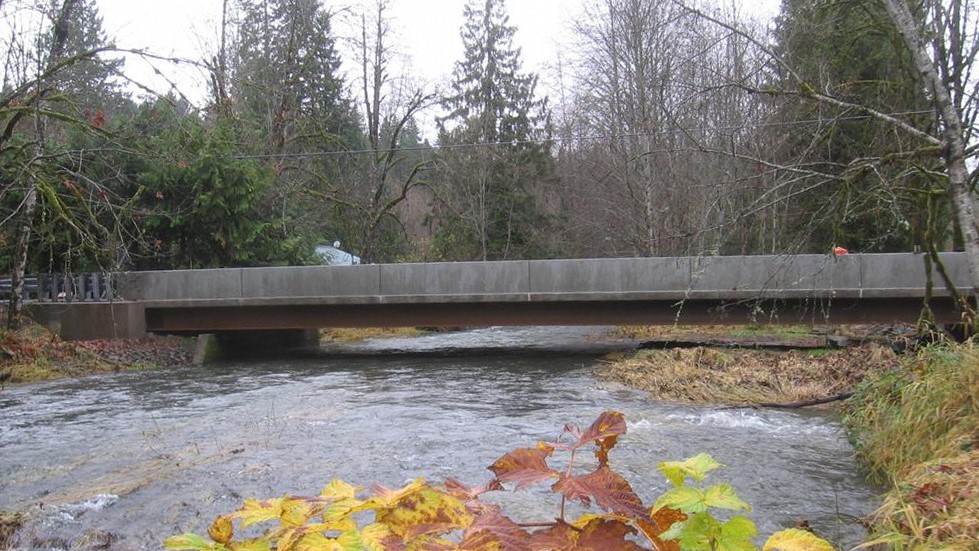
Steel Bridge Improves Habitat Conditions for Fish and Wildlife
Photo Credit: Washington County, Oregon
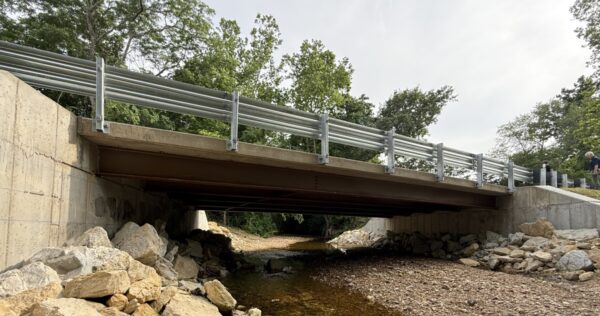
The Meacham Road Bridge crosses the East Fork of Dairy Creek approximately 22 miles west of Portland, Oregon. This bridge is a critical crossing, providing the only access to approximately 68 properties in the county. The bridge project area lies entirely within rural Washington County and is surrounded by farmlands.
Challenge
Originally constructed in 1957, the old bridge was built with longitudinal timber stringers with a transverse timber deck system. It was approximately 20 feet wide by 69 feet long and consisted of four equal spans of approximately 17 feet.
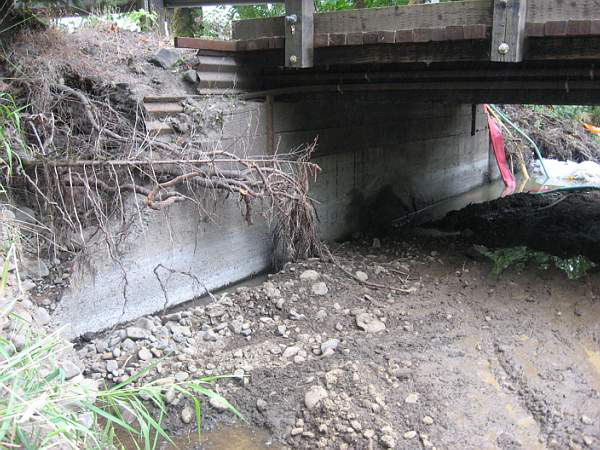
During flood events, debris accumulates against the three in-stream bents supporting the bridge.
The old bridge was damaged several times by large debris collecting on and between the bridge piles within the creek. During flood events, debris accumulated against the three in-stream bents supporting the bridge. The flood debris also caused upstream flooding and at times, made the road impassable.
Solution
A new single-span-bridge was built to replace the old four-span-bridge. The new bridge design has helped to resolve the flood debris problem by allowing it to pass freely underneath.
The new bridge is approximately the same size as the existing bridge, but is a single span with no supports in the stream. In addition to reducing flood debris accumulation, the new structure improves habitat conditions for fish and wildlife by restoring natural stream hydrology.
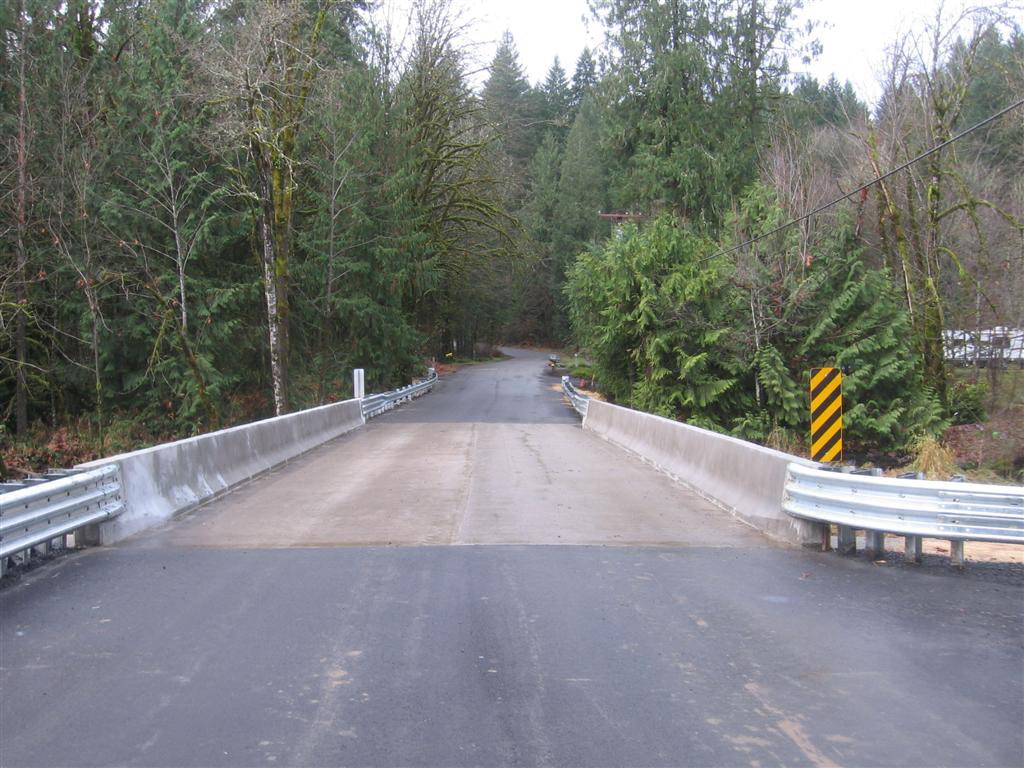
Besides reducing flood debris accumulation, the new structure will improve habitat conditions for fish and wildlife by restoring natural stream hydrology.
Washington County’s Department of Land Use and Transportation was awarded a FEMA Hazard Mitigation Grant through the Oregon Office of Emergency Management to replace the out-of-date bridge.
New Bridge Design
The replacement bridge uses rolled structural steel girders with a concrete deck. The superstructure design is a 75-foot single span consisting of seven W24x131 structural steel girders with an 8-inch-deep deck using high-performance concrete.
The roadway width is 22 feet. With two concrete bridge rails, the total deck width is approximately 25 feet. The deck surface is concrete with no asphalt concrete wearing surface.
Dr. Karl Barth, Ph.D., the Jack H. Samples Distinguished Professor at West Virginia University and Director of the Short Span Steel Bridge Alliance’s Steel Bridge Technology Center, notes that rolled steel beams are a logical choice for this crossing.
“The use of rolled beams was the right choice for this project,” he says. “In this particular situation, the girder spacing of the rolled beams was selected to minimize superstructure depth. In return, the hydraulic opening below the bridge was maximized. The horizontal and vertical alignments between the old and the new bridges remain essentially unchanged.”
The roadway design criteria are based on the 2004 American Association of State Highway Transportation Officials (AASHTO) reference, A Policy on Geometric Design of Highways and Streets, with the supplemental Guidelines for Geometric Design of Very Low-Volume Local Roads (ADT<400), 2001.
The bridge was designed according to the 2010 AASHTO LRFD Bridge Design Specifications, 5th Edition. The design loading is HL-93 with an allowance of 25 psf for a future wearing surface.
The structure is located in Seismic Zone 2. The site peak ground acceleration is 0.19g for the 500-year (serviceable) return period and 0.27g for the 100-year (no collapse) return period.
The total project estimate, including design and construction, is $882,700; with $662,025 funded by FEMA and $220,675 funded by Washington County’s Road Fund (gas tax).
Project Team
Designer: Peter Pagter, OBEC-DOWL Consulting Engineers
Contractor: Jeff Carter Construction, Inc.
Fabricator: Fought & Company, Inc.
Owner: Washington County Land Use & Transportation (LUT)
 News
News
Missouri Steel Bridge Bundle Project Wins Prize Bridge Award
The National Steel Bridge Alliance (NSBA) named Missouri’s FARM Bridges Design/Build Bundle the 2026 Prize Bridge Award winner in the Short Span category. Fabricated by SSSBA member DeLong’s, the project delivered 31 rural bridges across 15 counties using galvanized steel and SDCL design for a 100-year service life.
 Design
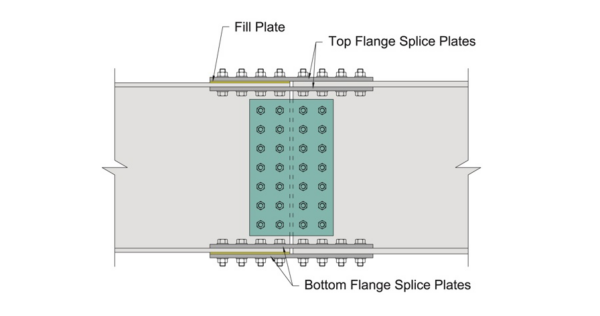
NSBA Releases Updated Bolted Splice Spreadsheet 4.01
NSBA’s Bolted Splice Spreadsheet 4.01 streamlines connection design with expanded options and updated AASHTO LRFD provisions for faster, more economical solutions.
 Case Study
Bridges of Franklin County: Why Missouri is Turning to Steel
Franklin County, Missouri, saved $283,000 by selecting steel over concrete for four short-span bridge projects, demonstrating that simplified designs combined with a competitive bidding process can deliver exceptional value, durability and long-term performance.