 Short Span Steel Bridges
Engineer Conducts Study to Evaluate Life Cycle Costs
Excerpt from ConstructConnect Canada
OGRA presenter says both steel and concrete should be considered for bridge projects
A U.S. engineer has conducted a study on which type of bridge is the best, steel or concrete, and his findings may be surprising to some.
“I talk to a lot of counties, a lot of consultants and a lot of state DOTs (departments of transportation). One of the most common questions they have is which are the best bridges for lifecycle costs,” Dr. Michael Barker, a civil and architectural engineer and a professor University of Wyoming, told the audience at the recent webinar entitled Accelerated Bridge Construction, presented by Acrow and hosted by the Ontario Good Roads Association (OGRA).
Barker carried out a large-scale analysis on bridge structures and summarized his findings during the webinar. The study compares precast I-beam, box adjacent, box spread bridges, steel rolled and welded plate girder bridges. The study found all are “similar” with none “way out” of balance, he said.
“Statistically any one type of bridge may be most economical for a given bridge project. There is no one type of bridge that clearly beats the others,” said Barker, who is also director of education for the Short Span Steel Bridge Alliance.
“There is a preconception out there that concrete is less expensive than steel.
“The results of this, and what we’ve known for a long time, is that typical concrete and steel bridges are competitive on initial costs, future costs, lifecycle costs and bridge life and that owners should consider both steel and concrete alternatives for individual bridge projects.”
In conducting the study, he looked at historical lifecycle costs, historical life service, performance and maintenance, and agency lifecycle costs of steel and concrete girder bridges. He needed a comprehensive inventory of bridges to be able to do comparisons including initial costs, date built, maintenance costs, including the date performed and how long the bridge lasts or the end of service date.
Additional Resources
- The full report, “Historical Life Cycle Costs of Steel and Concrete Girder Bridges” (including a detailed explanation of the criteria, calculations, and results) is available for a free download.
- Watch a video of Dr. Barker presenting information on life cycle costs (from a previous webinar).
Does steel provide an economical solution for bridge construction?
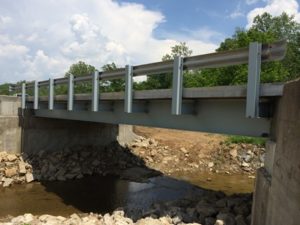
- Due to the light weight of steel, cost savings can be significant
- Studies show that weathering, A1010 (A709-50CR), and galvanized steel reduces both initial and life cycle costs.
- Steel can compete and even save costs when compared with nearly identical concrete structures. re.
- Steel bridges also have long lives, decreasing the need for replacement.
- Steel’s high strength permits longer spans, minimizing disruption to underlying habitats.
- Steel is highly resistant to extreme natural disasters such as earthquakes.
- Steel is the world’s most recycled material and is infinitely recyclable.
- Short span steel bridges can be designed with prefabricated elements which provide a simpler installation and cost savings.
 News
News
Missouri Steel Bridge Bundle Project Wins Prize Bridge Award
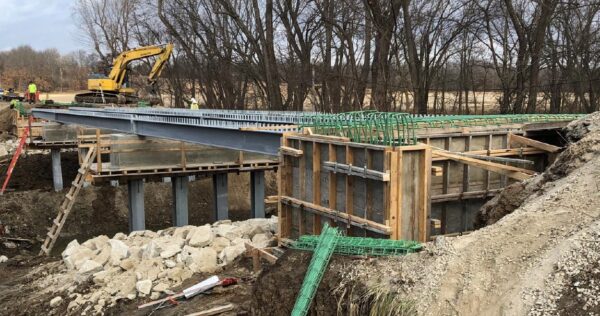
The National Steel Bridge Alliance (NSBA) named Missouri’s FARM Bridges Design/Build Bundle the 2026 Prize Bridge Award winner in the Short Span category. Fabricated by SSSBA member DeLong’s, the project delivered 31 rural bridges across 15 counties using galvanized steel and SDCL design for a 100-year service life.
 Economics
Steel vs. Concrete: A Deep Dive into Bridge Life Cycle Economics
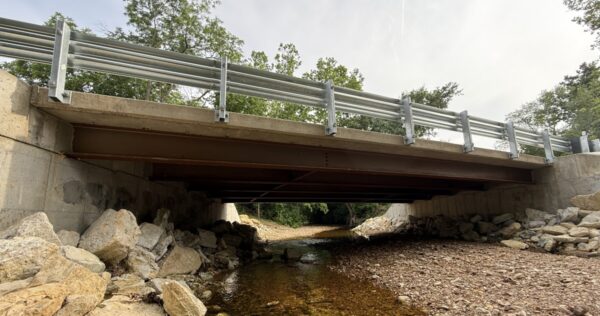
A comprehensive study by Dr. Michael Barker of the University of Wyoming analyzes 1,186 steel and concrete girder bridges in Pennsylvania to compare life cycle costs, offering data-driven insights into long-term economic performance and service life.
 Education
Steel Bridges for Smarter, Faster Construction – On-Demand Steel Bridge Video Series
This three-part on-demand video series covers integral abutments, simple for dead continuous for live designs and prefabricated bridge options.