 Short Span Steel Bridges
 The Life Cycle Cost of Galvanized Steel Bridges
The above video was presented by Dr. Michael Barker, University of Wyoming & SSSBA Director of Education, at the LatinGalva 2021 virtual conference.
Within the presentation, Dr. Barker makes reference to the following reports:
- Historical Life Cycle Costs of Steel and Concrete Girder Bridges (download)
- Life Cycle Cost of Bridges: Galvanized Steel vs. Concrete – Prepared for US Bridge, Cambridge, Ohio (download)
The following contains a summary (background and conclusions) of the Galvanized Steel vs. Concrete report.
For more information on the study, please see the U.S. Bridge website.
Life Cycle Cost of Bridges – Galvanized Steel vs. Concrete: Background and Conclusions
In 2016, the author published a study titled, Historical Life Cycle Costs of Steel & Concrete Girder Bridges. The primary conclusion from that study was that, notwithstanding the prevailing assumption that concrete bridges are more economical than steel bridges, for typical bridges (steel rolled beam, steel plate girder, concrete box adjacent, concrete box spread and concrete I beam bridges), all were economically competitive.
However, none of the bridges in the study’s database used galvanized beams or girders. Hot Dip Galvanizing with Zinc (HDG) is an old science but its application to bridges is relatively recent. US Bridge of Cambridge, OH, which serves secondary highway systems throughout the country and is the sponsor of this study, claims to have been the first to hot dip galvanize entire welded truss bridge sections in 1987.
Since then, the federal government has recommended HDG for bridge designs intended to last a century, a relatively new expectation considering that only a few decades ago the objective was a service life of 50 years. One reason for this is the increasingly limited funds for local bridge construction and repair. As a result, many counties in the United States now routinely specify galvanized bridges for their longer term economy. However, until now, no one has produced a study of the measurable financial benefits of HDG. This report attempts to fill that void.
This study has been based on certain assumptions:
- All painted bridges used in the original study were HDG instead of painted.
- The cost of HDG and modern multi-coat painting systems are roughly the same.
- HDG eliminates corrosion and most steel maintenance, thereby extending average service life by at least 25 years.
The latter two assumptions reasonably approximate industry experience when using galvanized members.
The general conclusions are that, by the use of HDG for typical steel bridges such as those in the previous study:
- The present value cost of future maintenance is reduced 50%.
- Capitalized Costs are reduced 8.5%.
- Galvanized steel bridges can have Capitalized Costs less than the best concrete alternatives.
Download the full report – Life Cycle Cost of Bridges: Galvanized Steel vs. Concrete – Prepared for US Bridge, Cambridge, Ohio
Does steel provide an economical solution for bridge construction?
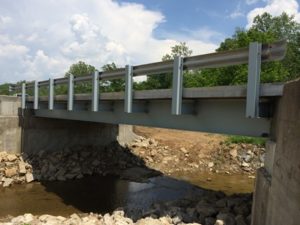
- Due to the light weight of steel, cost savings can be significant
- Studies show that weathering, A1010 (A709-50CR), and galvanized steel reduces both initial and life cycle costs.
- Steel can compete and even save costs when compared with nearly identical concrete structures. re.
- Steel bridges also have long lives, decreasing the need for replacement.
- Steel’s high strength permits longer spans, minimizing disruption to underlying habitats.
- Steel is highly resistant to extreme natural disasters such as earthquakes.
- Steel is the world’s most recycled material and is infinitely recyclable.
- Short span steel bridges can be designed with prefabricated elements which provide a simpler installation and cost savings.
 News
News
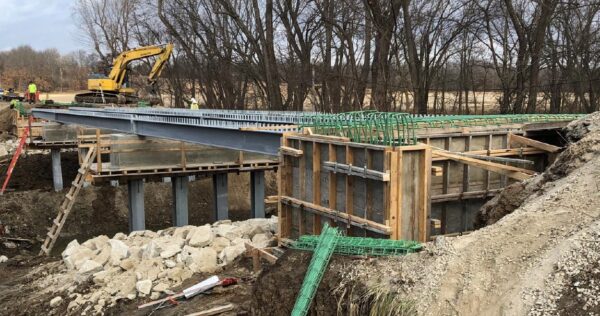
Missouri Steel Bridge Bundle Project Wins Prize Bridge Award
The National Steel Bridge Alliance (NSBA) named Missouri’s FARM Bridges Design/Build Bundle the 2026 Prize Bridge Award winner in the Short Span category. Fabricated by SSSBA member DeLong’s, the project delivered 31 rural bridges across 15 counties using galvanized steel and SDCL design for a 100-year service life.
 Economics
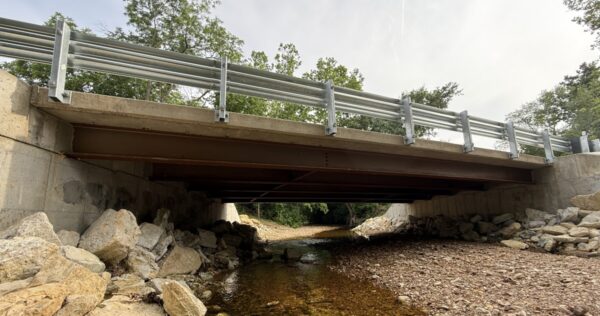
Steel vs. Concrete: A Deep Dive into Bridge Life Cycle Economics
A comprehensive study by Dr. Michael Barker of the University of Wyoming analyzes 1,186 steel and concrete girder bridges in Pennsylvania to compare life cycle costs, offering data-driven insights into long-term economic performance and service life.
 Education
Steel Bridges for Smarter, Faster Construction – On-Demand Steel Bridge Video Series
This three-part on-demand video series covers integral abutments, simple for dead continuous for live designs and prefabricated bridge options.