 Short Span Steel Bridges
2025 ASCE Report Card: Infrastructure Grade Improves, Bridges Remain at ‘C’
The following information was provided by the American Association of State Highway and Transportation Officials (AASHTO).
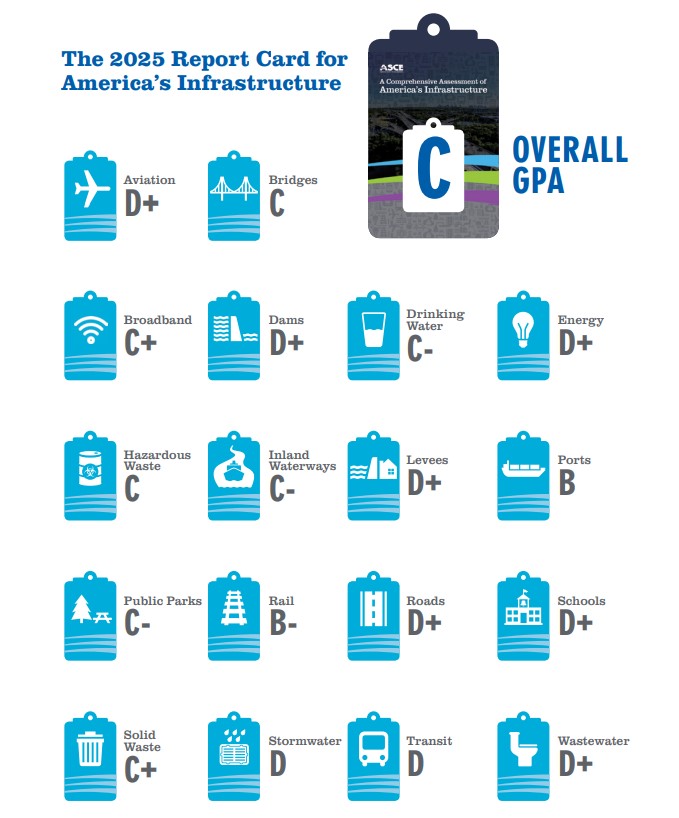
The American Society of Civil Engineers unveiled its 2025 “Report Card for America’s Infrastructure” on March 25 , 2025 at a media event at in Washington, D.C., upgrading the condition of U.S. infrastructure to an overall ‘C’ grade in part due to work spurred by the Infrastructure Investment and Jobs Act or IIJA of 2021.
Using an ‘A’ to ‘F’ school report card format, the Report Card provides a comprehensive assessment of current infrastructure conditions and needs across 18 categories, with broadband added as a new category to this year’s analysis, ASCE said.
ASCE 2025 Report Card for America’s Infrastructure
Growing $3.7 Trillion Infrastructure Funding Gap
The overall ‘C’ grade issued for U.S. infrastructure overall in the 2025 Report Card is an improvement compared to the ‘C-‘ overall grade from the 2021 Report Card. It is also the highest grade given by ASCE since it began its analysis of U.S. infrastructure in four-year increments back in 1998.
However, though the 2025 Report Card indicates IIJA investments have started to pay off, ASCE projects a $3.7 trillion gap between current planned infrastructure investments and what must be done to put U.S. infrastructure in good working order — an increase from the $2.59 trillion gap reported four years ago.
“If we maintain investments, each American household can save $700 per year,” noted Darren Olson, vice president of the Water Resources Department at Christopher B. Burke Engineering and chair of ASCE’s 2025 Report Card, in a statement. “Better infrastructure is an efficient investment of taxpayer dollars that results in a stronger economy and prioritizes American jobs, resilience and connectivity.”
3 Key Infrastructure Trends
ASCE pointed to three key infrastructure trends within its 2025 Report Card:
- Aging infrastructure systems are increasingly vulnerable to natural disasters and extreme weather events, creating unexpected and often avoidable risks to public safety and disrupting economic activity, ultimately hampering U.S. global competitiveness.
- Recent federal and state investments have had a positive impact, but the full force of increased funding will take years to realize. Sustained investments are key to providing certainty and ensuring planning goes to development, as well as making larger infrastructure projects attainable.
- Unreliable or unavailable data on key performance indicators continues to impact certain infrastructure sectors. There are still infrastructure sectors where data is scarce or unreliable.
ASCE added that its Report Card analysis underscores the essential need for lawmakers to maintain existing levels of federal infrastructure investment while increasing participation from state and local governments and the private sector. Those two efforts in support of infrastructure improvements should reduce costs for American households and bolster U.S. economic growth, the group said.
“We have seen the difference investment can make in improving infrastructure,” noted Feniosky Peña-Mora, executive vice president of research at the Tec de Monterrey private university in Mexico City and the 2025 president of ASCE. “As the Report Card makes clear, there is still a great need for sustained investments,” he stressed. “Delaying upgrades to our nation’s roads, bridges, transit and utilities will cost families and businesses time and money, in addition to creating unsafe yet often avoidable situations.”
Download the ASCE 2025 Report Card.

ASCE 2025 Report Card for America’s Infrastructure
Bridges Maintain ‘C’ Grade, Unchanged from 2021
Bridges received a substantial boost through the Infrastructure Investment and Jobs Act (IIJA), including $27.5 billion for the Bridge Formula Program and $12.5 billion for the Bridge Investment Program.
Despite this infusion of federal funding, bridge-related system rehabilitation needs are estimated at $191 billion. Therefore, strategic asset management planning and routine maintenance are essential to keeping bridge conditions from further declining and avoiding costly repair or rehabilitation work. While the effects of extreme weather events pose threats to bridges, innovative techniques are improving their security and resilience.
ASCE 2025 Report Card
Condition & Capacity
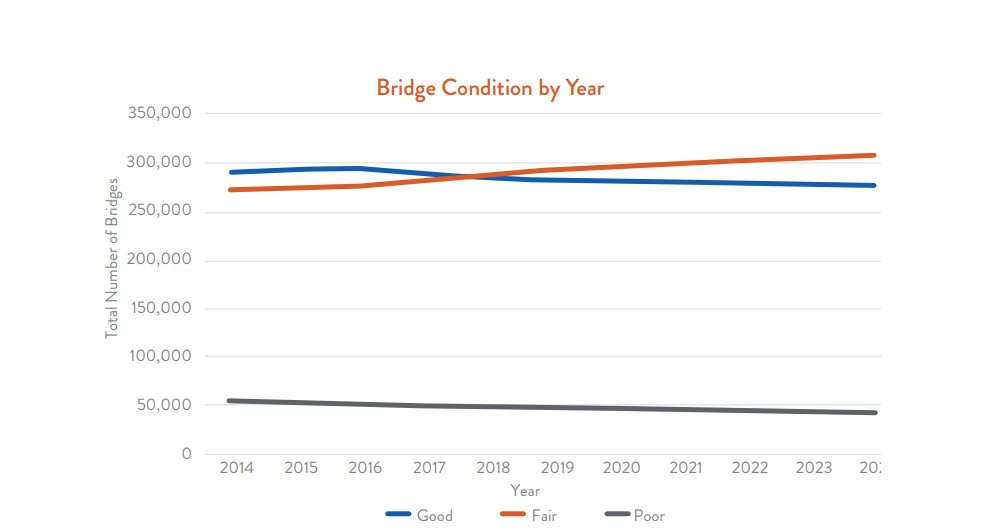
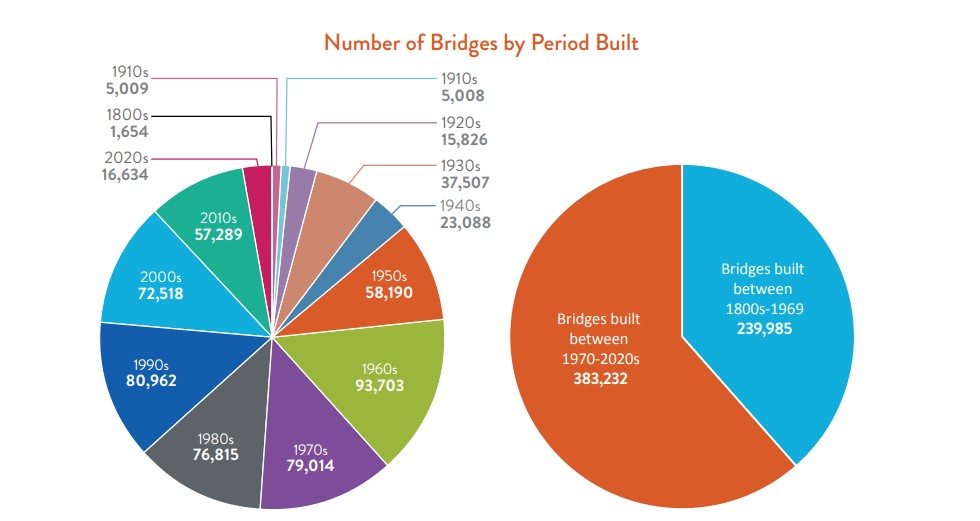
In 2024, over 4.9 billion motor vehicle trips were taken daily across the nation’s 623,218 bridges, slightly more than the daily trips recorded in 2021. Of these bridges, 49.1% are in fair condition, 44.1% are in good condition, and 6.8% are in poor condition—a number that has continued to decline over the past few years.
ASCE 2025 Report Card for America’s Infrastructure
Funding & Future Need
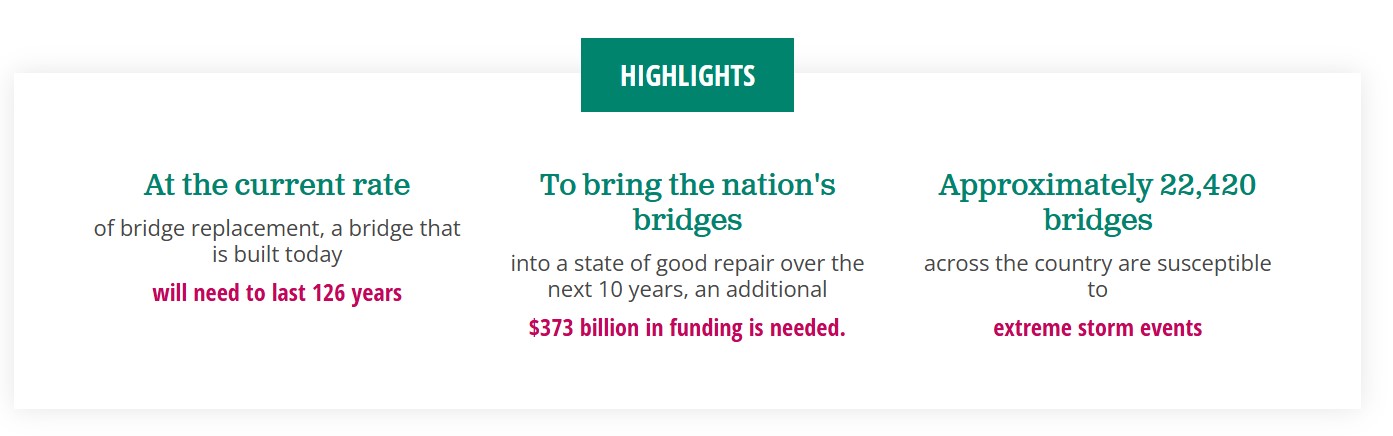
Chronic underinvestment has resulted in a substantial financial need for bridges. The Federal Highway Administration’s (FHWA) most recent assessment from 2018 estimated that $1.1 trillion was needed to address an existing backlog of highway and bridge investments. System rehabilitation needs for bridges are estimated at $191.3 billion. As of 2023, FHWA estimates the cost to replace poor bridges totals $69.7 billion, while rehabilitation costs are $47.4 billion. ASCE’s Bridging the Gap report indicates there is a funding gap of $373 billion over 10 years to bring the nation’s bridges into a state of good repair.
Operation & Maintenance
To handle bridges’ specific needs, state departments of transportation develop and use Transportation Asset Management Plans (TAMPs), which outline systematic, data-based approaches to managing their bridge inventories. The federally required TAMPs predict and set targets for the number of bridges in good or poor condition over the next 10 years. Strategic asset management planning is one of the most cost-effective ways the nation addresses its aging and deteriorating bridge inventory.
ASCE 2025 Report Card for America’s Infrastructure
Innovation
Engineers are using innovative design requirements, materials, and technologies to enhance the security and resilience of bridges. Various materials and techniques have been developed to maintain the design life of bridges. Materials that can add strength and durability to bridges include high-performance steel, stainless steel, ultra-high-performance concrete, and self-healing concrete (to fix minor cracks).
Improved coatings for steel such as galvanizing or metalizing can also increase design life. Remote monitoring of embedded sensors that have been placed in bridges and ultrasound tests of concrete can help engineers identify problems earlier, while drones present an option to assist in obtaining data during bridge inspections.
Bridge failures in recent years have provided opportunities to use innovative techniques. For example, innovative construction materials and ingenuity expedited the reopening of Interstate 95 in Philadelphia after a bridge collapsed in June 2023. Workers used foam glass aggregate (made from recycled glass) to build temporary travel lanes, allowing traffic to return to I-95 and relieving congestion.
Public Safety & Resilience
Resilience to natural and human-made disasters is essential in designing, rehabilitating, and replacing critical infrastructure, and bridges are no exception. Many of the country’s older bridges are susceptible to frequent weather-related disasters such as flooding, potentially resulting in overtopping, washout, and other storm damage.
Approximately 22,420 bridges were found to be susceptible to overtopping or having their foundations undermined during extreme storm events.
Raising the Grade: Solutions that Work
- Fund research into innovative technologies, materials, and construction techniques to extend and preserve the life of bridges.
Encourage states to develop multivariable prioritization formulas for the bridges in their jurisdiction and publish their project lists, including the funding sources and prioritization process that led to the projects’ programming. - Urge states to prioritize investing in bridges that are most critical, including those that experience high daily traffic volumes, are located on essential freight corridors, or serve as evacuation routes.
- Prioritize rehabilitating and preserving bridges in fair condition, as these bridges can often be maintained at a lower cost than would be required to replace the structure. This prioritization could result in a reduced number of poor bridges and a decreased maintenance backlog while also addressing bridges that have passed or are approaching the end of their design life.
- Continue the use of traditional user fees for transportation funding, such as federal and state motor fuel taxes, while transitioning to more sustainable and equitable innovative user fees, such as alternative energy vehicle fees and RUCs.
- Increase funding from all levels of government to continue bridge repair, rehabilitation, operation, maintenance, and replacement work to maintain a state of good repair and keep bridges from falling into poor condition.
- Determine the entire life-cycle cost of a bridge to inform smart design decisions and develop a balanced approach for our aging bridge inventory that emphasizes preservation, rehabilitation, and replacement.
Download the ASCE 2025 Bridge Report
The Role of Steel Bridges in Addressing Infrastructure Challenges
As the ASCE’s 2025 Report Card highlights, significant investment is needed to address the deteriorating state of U.S. bridges. The Short Span Steel Bridge Alliance (SSSBA) and the use of steel bridges offer cost-effective, durable and sustainable solutions to help close the infrastructure funding gap and improve bridge conditions nationwide.
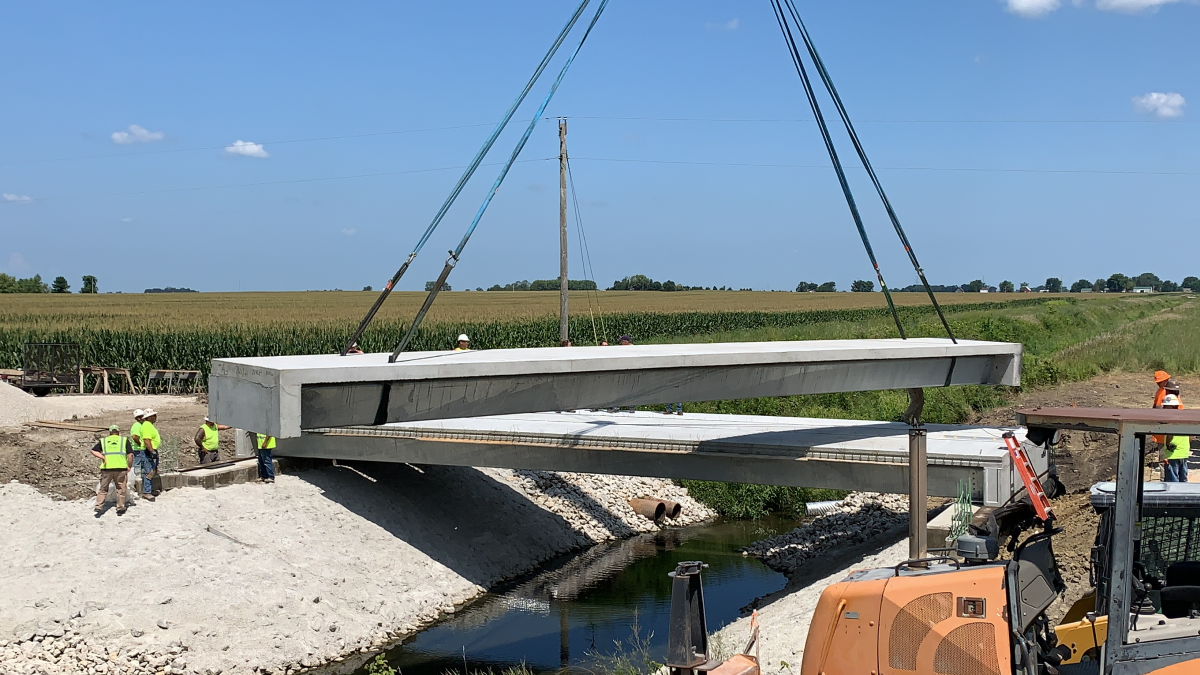
Press-brake-formed steel tub girder bridges can last 100 years or more, with minimal maintenance over their long service lives.
Steel bridges, particularly short span steel bridges (spans up to 140 feet), provide several advantages in addressing infrastructure challenges:
-
Cost-Effective and Rapid Construction: Prefabricated steel bridge components allow for accelerated bridge construction (ABC), reducing traffic disruptions and minimizing costs associated with lengthy detours.
-
Durability and Longevity: Advances in high-performance steel, corrosion-resistant coatings (such as galvanizing, metalizing and paint) and enhanced fabrication techniques ensure longer service life with minimal maintenance.
-
Resilience to Extreme Weather Events: Steel’s inherent strength and flexibility make it an ideal choice for bridges in areas prone to extreme weather events, enhancing overall resilience.
-
Sustainable Infrastructure Solutions: Steel bridges are sustainable, with a high percentage of recycled content and full recyclability at the end of their service life.
-
Innovative Design and Materials: The integration of high-performance steel, modular bridge systems, and cutting-edge monitoring technologies ensures long-term performance and reliability.
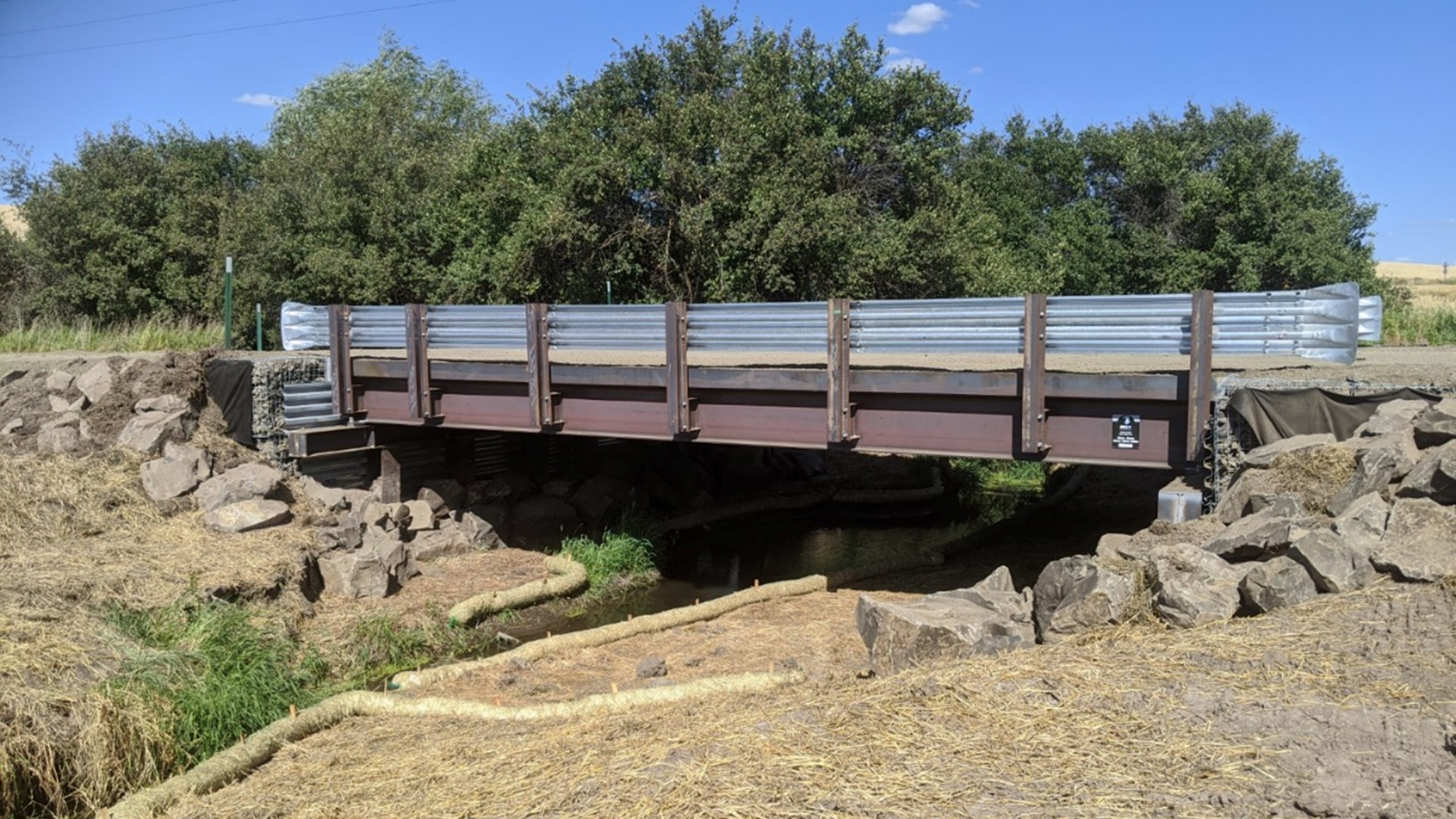
Whitman County, Washington, saved 32 percent over concrete by using a steel superstructure for this off system project.
The SSSBA collaborates with state and local agencies, engineers, and policymakers to promote best practices in steel bridge design, fabrication, and construction. Through its educational resources, research initiatives, and tools like eSPAN140, the SSSBA provides cost-effective and practical solutions that help address the nation’s bridge infrastructure needs efficiently and sustainably.
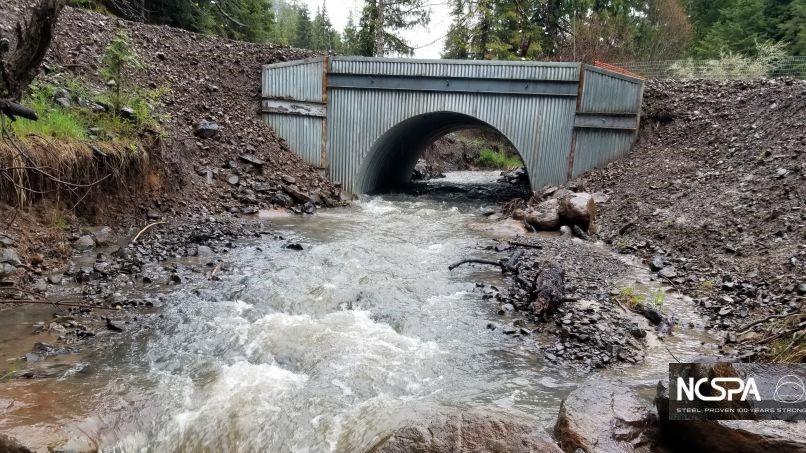
The Falcon Ridge buried steel bridge fish passage structure provided easy fish passage for the local spawning trout and steel head.
By leveraging the benefits of steel bridges and working with organizations like the SSSBA, transportation agencies can extend the life of bridge infrastructure, optimize limited funding, and enhance public safety—contributing to a stronger and more resilient transportation network.
For more information, please explore the SSSBA website or contact Dan Snyder at dsnyder@steel.org
 Events
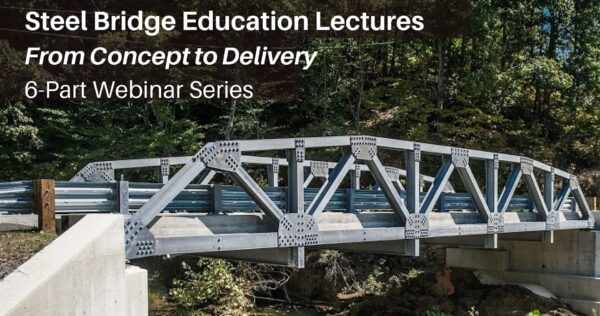
Free 6-Part Live Lecture Series: Steel Bridge Design — From Concept to Delivery (Starts Sept. 7)
SSSBA and the University of Wyoming are offering a free six-part lecture series, September 7–23. The series covers key aspects of steel bridge design, fabrication and construction, with live and recorded participation available.
 Design
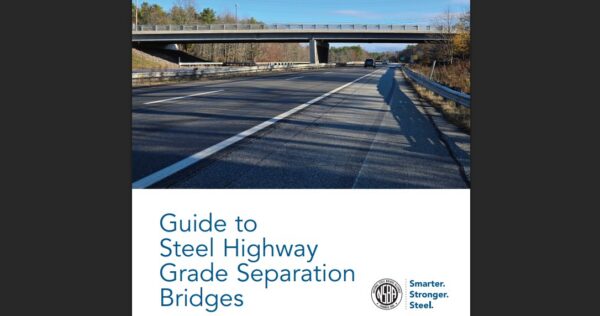
NSBA Releases Guide to Steel Highway Grade Separation Bridges
NSBA has released the new Guide to Steel Highway Grade Separation Bridges, a comprehensive industry resource designed to support the planning, design and construction of steel highway overpass structures.
 News
News
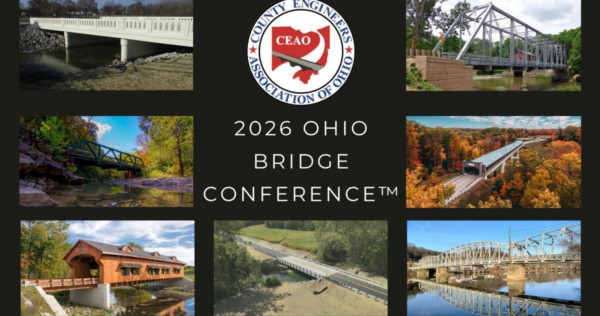
SSSBA to Present at 2026 CEAO Ohio Bridge Conference in Columbus, OH (Aug.11)
SSSBA will be featured at the 2026 County Engineers Association of Ohio (CEAO) Bridge Conference on August 11 in Columbus, Ohio. The session will introduce free design tools that help engineers develop efficient, economical short span steel bridge solutions.