 Short Span Steel Bridges
FHWA Accepting Applications for Accelerated Innovative Deployment (AID) Grants
On July 19, the U.S. Department of Transportation’s Federal Highway Administration (FHWA) announced that up to $10 million in grants will be made available through a Notice of Funding Opportunity (NOFO) for FHWA’s Accelerated Innovation Deployment (AID) Demonstration Program.
The funds are used to promote the deployment of proven innovations that can deliver road and bridge projects more cost-effectively among state, local and Tribal governments.
“Using innovative tools and techniques requires creativity and investment,” said Acting Federal Highway Administrator Stephanie Pollack. “These grants can help our partners access important resources to reduce the time and money needed to build and repair roads, bridges and highways, while improving safety and mobility.”
AID Grants Available for Highway Transportation Projects
AID grants are incentives to help in any phase of eligible highway transportation projects – from planning and financing to engineering and construction. Eligible entities include state departments of transportation (DOT), federal lands management agencies, and tribal governments. State DOTs may also apply on behalf of metropolitan planning organizations and local governments.
Since its creation in 2014, the AID Demonstration Program has awarded more than $86 million for 117 grants to accelerate the use of innovative practices and improve safety throughout the nation.
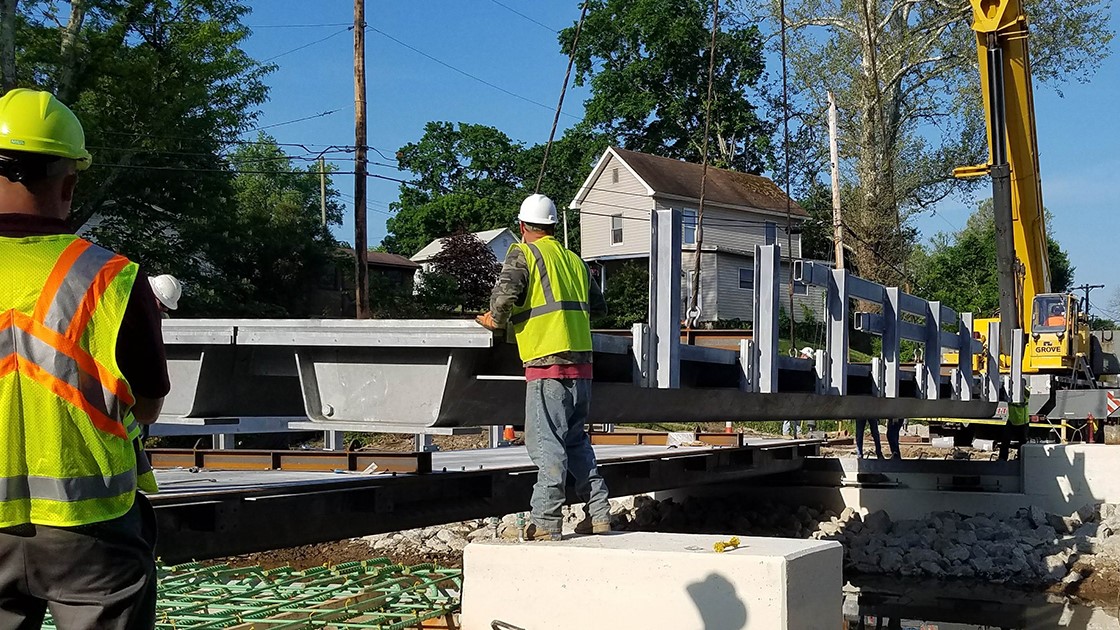
In 2015, the ODOT and Muskingum County received an AID Demonstration Grant to construct the Cannelville Road Bridge.
Short Span Steel Bridge Awarded $557,600 Grant
In 2015, the Ohio Department of Transportation (ODOT) and Muskingum County were selected as recipients of an AID Demonstration grant ($557,600) to replace a bridge on County Road 7 – Cannelville Road using an innovative press-brake-formed steel tub girder (PBTG) system and SPS bridge deck.
It was completed ahead of schedule in just 26 days, and is expected to have a service life of more than 100 years. The girder modules were erected and positioned on their abutments in just 22 minutes. This project provided an evaluation of new materials to reduce decking dead loads, reduce construction duration, and roadway closures.
Additional Information & Deadlines
Information on previous AID-funded projects can be found at www.fhwa.dot.gov/innovation/grants.
- Notice of Intent Deadline: August 3, 2021: 11:59 pm Eastern Time.
- Application Deadline: September 28, 2021; 11:59 pm Eastern Time.
The NOFO (Opportunity #: 693JJ321NF-AIDDP) and information on how to apply is available at www.grants.gov.
What are Press Brake Tub Girders?
Press-brake-formed tub girder (PBTG) is a new technology for short span bridge applications. It consists of modular galvanized shallow trapezoidal boxes fabricated from cold-bent structural steel plate (watch fabrication video). A concrete deck is recommended to be precast on the girder and the modular unit can be shipped by truck to the bridge site.
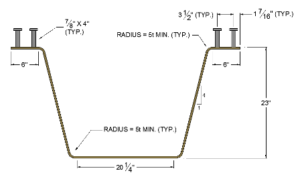
The system utilizes standard plate widths (based on availability) and is optimized to achieve maximum structural capacity, with most of the steel in the bottom flange and increased torsional stiffness. It is a closed system, since the girder is closed at the bottom. It is versatile for multiple-deck options.
The system utilizes Accelerated Bridge Construction practices, since it:
- Can be installed in one or two days
- Is modular, allowing the use of a precast deck
- Is cost-effective―as much as 1/3 less than a standard concrete girder structure
- Is simple to fabricate, requiring very little welding.
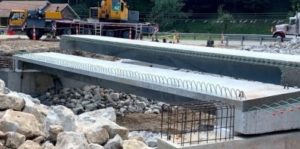
The Short Span Steel Bridge Alliance has developed standardized plans using standard plate sizes (60”, 72” 84”, 96”, 108”, 120”). The designs were developed to achieve maximum structural capacity and are available to use in the free-to-use, web-based design tool eSPAN140.
The press-brake-formed tub girder system is open source.
 News
News
Bridge Task Force and AASHTO Steel Leaders Meet in Alaska
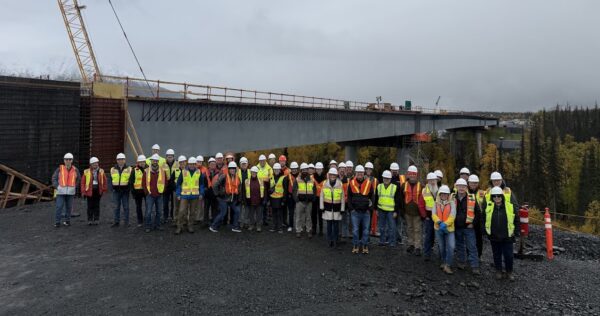
The Steel Bridge Task Force and AASHTO Steel and Metals Technical Committee met in Anchorage for technical presentations, project updates and industry recognition. The meetings concluded with an Alaska DOT hosted tour of the Juneau Creek Bridge and surrounding Sterling Highway construction.
 News
News
SSSBA to Present at North Central States Consortium in Omaha, NE (Sept. 28-30)
Dr. Michael Barker, University of Wyoming, will represent SSSBA at the North Central States Consortium (NCSC) in Omaha, Nebraska. His presentation (Tuesday, September 29, 1:30–2:15 p.m.) will explore how optimized plate girders can expand the range of steel solutions for bridges with spans of 60 to 100 feet.
 News
News
AISI Corrosion Advisory Group to Meet October 27 in Ohio
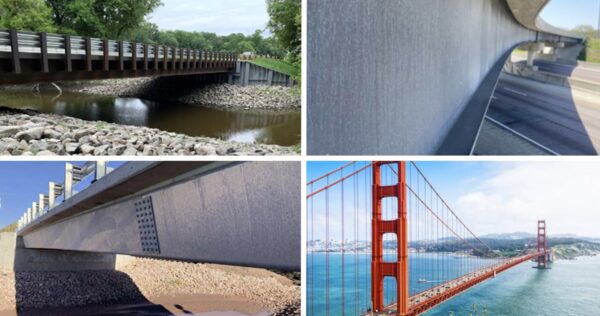
The AISI Corrosion Advisory Group (CAG) will meet October 27 at the Sherwin-Williams Research & Development Center in Ohio. Discussions will focus on corrosion research, coatings, steel durability and related industry needs.