 Short Span Steel Bridges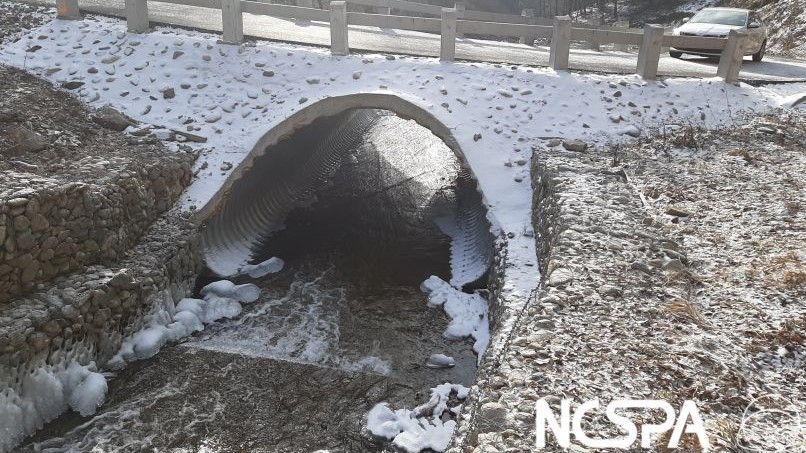
Buried Steel Bridge Selected Over Concrete to Reduce Environmental Impact
Article and photos provided by the National Corrugated Steel Pipe Association
The Ciocazeaua Bridge, built in 2020, is located in the touristic area of Gorj County, Romania, on a county road that crosses through the Ciocazeaua forest. Not only was this road built to improve tourism, but to also help keep the environment and natural habitats safe.
The area where the bridge was built is in Crasna, where altitudes can reach between 1640 ft and 3937 ft. The uniqueness and value of the natural geological phenomena combined with its scientific value determined that the area was to be included in the category of protected land.
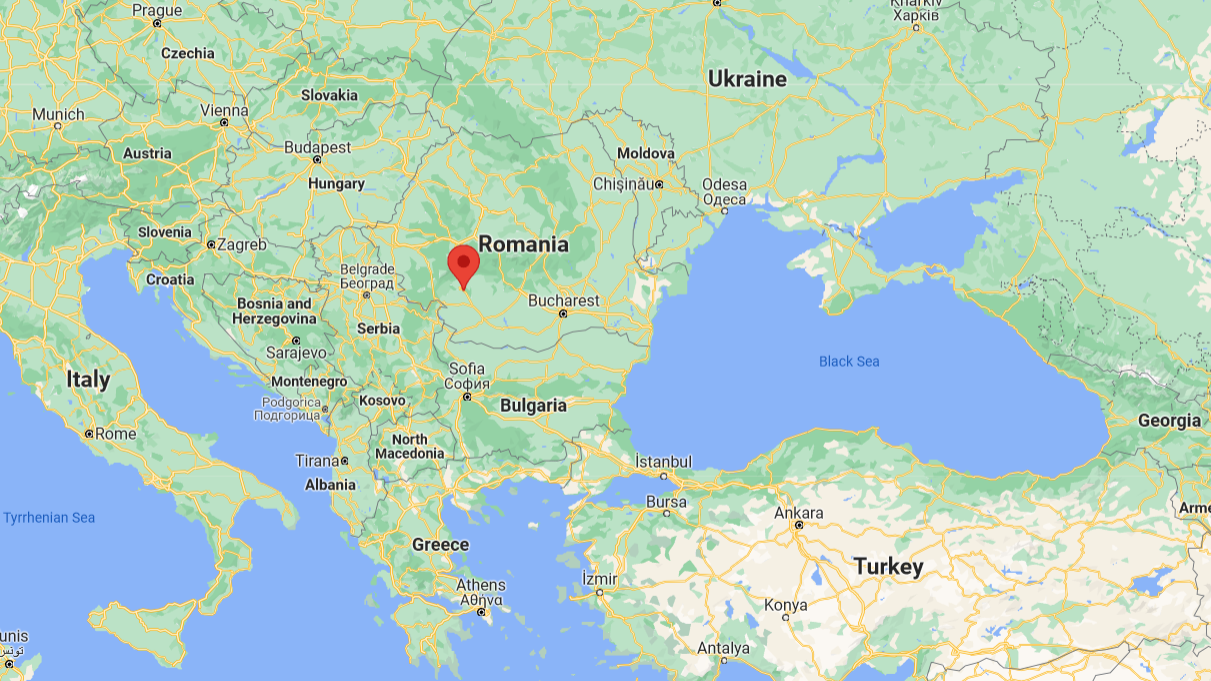
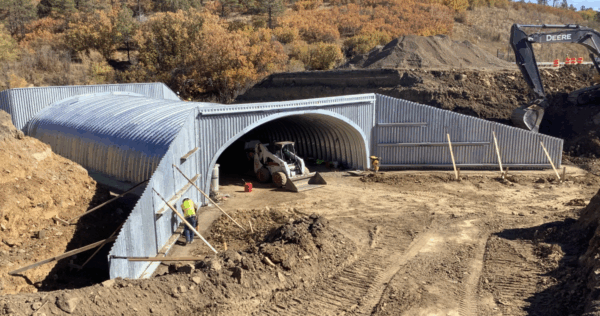
The Ciocazeaua buried steel bridge was built in the touristic area of Gorj County, Romania.
In order to achieve the objective of both the investors and the government, no demolition or diversion was able to take place. ViaCon Romania proposed a corrugated steel structure to the local authorities as an alternative to the standard concrete structure so as to reduce any disruptions to the surrounding environment and allow installation to happen quickly.

A buried steel bridge was constructed as an alternative to a concrete structure to reduce disruptions to the surrounding environment and allow quick installation.
The bridge structure consisted of 3 distinct parts:
- foundation
- actual structure
- connections with the embankments
The foundation is made of 30 cm thick ballast and is the connecting element of the bridge, over which lies the 10 cm thick layer of sand. A light, flexible structure was placed on a gabion mattress which integrated harmoniously with the natural environment. The entire project was a success and all parties involved were over joyed at the outcome of the new bridge structure.
What are buried steel bridges?
Buried steel bridges provide an economical choices for bridge replacement or bridge rehabilitation.
They essentially are a corrugated steel pipe or structural plate pipe systems that is “buried” with backfill to carry loads through soil-structure interaction. This means the bridge structure itself and the backfill soils surrounding the structure interact with each other to support the loads. In effect, the backfill material is part of the bridge.
Because of this interaction, the bridge structure is typically lighter, and there can be significant savings in structure costs.
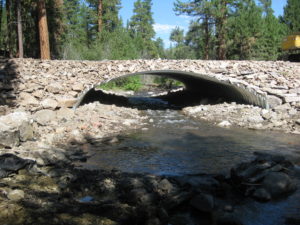
There are also many cases where buried bridges can carry heavier loads than traditional bridges because of the benefits of spreading vehicle loads through the fill. Buried bridges do not require abutments; and unless foundation soil conditions are poor, do not typically
require deep foundations.An additional benefit with buried bridges is that they can be tailored to site conditions and geometric requirements. The design includes inputs for site soils and backfill, meaning that locally available materials can often be used in construction and the structure can be tailored to fit the needs of the site and the owner’s requirements.
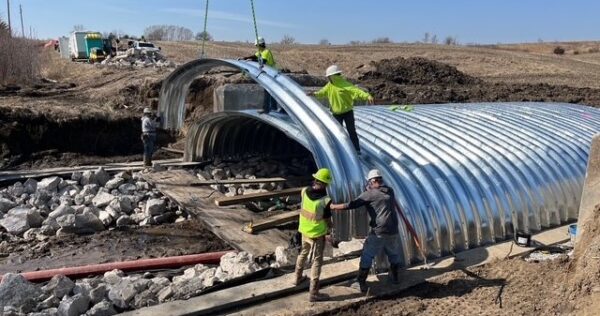 Buried Bridge
Buried Steel Bridge Preserves Streambed While Supporting Heavy Loads
A new galvanized buried steel bridge in Riverside, Iowa, supplied by SSSBA member Lane Enterprises, replaced a weight-restricted structure and restored direct access for local farmers. Its open-bottom steel design preserves the natural streambed, enhances durability, and provides a cost-effective solution for rural infrastructure.
 Buried Bridge
Buried Steel Bridge Protects Wildlife and Motorists in New Mexico DOT Project
The New Mexico DOT buried steel bridge project, featuring SSSBA member Contech’s custom structural plate design, was honored as the NCSPA Project of the Year for its innovative wildlife crossing solution on I-25 at Raton Pass.
 Case Study
Steel in Action: On-Demand Steel Bridge Video Series
Watch this four-part, on-demand video series featuring expert-led case studies on cost-effective, resilient short span bridge projects—now available with downloadable presentation materials.