 Short Span Steel Bridges
FHWA Releases Orthotropic Steel Deck Guide
The Federal Highway Administration’s Office of Bridges and Structures released the the final report, Guide for Orthotropic Steel Deck Level 1 Design (Publication No. FHWA-HIF-22-056).
The following is an excerpted foreword from Joseph L. Hartmann, PhD, P.E., Director, Office of Bridges and Structures

Joseph L. Hartmann, PhD, PE, Federal Highway Administration
Over the course of many decades and across the globe, orthotropic steel deck (OSD) bridges used around the world have proven to be safe, redundant, efficient, and durable. For this reason, efforts have increased in recent years to inform engineers in the United States about successful OSD applications to encourage broader implementation of them.
However, OSD applications in the United States have typically had higher relative costs associated with the complex analytical procedures and labor intensive fabrication design details usually employed.
In 2012, the Federal Highway Administration (FHWA) published the Manual for Design, Construction, and Maintenance of Orthotropic Steel Deck Bridges (Connor et al. 2012), which outlined three levels of design.
Guide Simplifies Complexity of OSD Bridges
In this Manual, each level is accompanied by a varying level of complexity, with Level 3 being the most complex and Level 1 being the least complex.
Level 1 design is “by little or no structural analysis, but by selection of details that are verified to have adequate resistance by experimental testing (new or previous)” and is effectively proven through full-scale qualification testing or historical in-service performance.
This Design Guide simplifies the level of complexity suggested to design, fabricate, and construct OSD bridges through Level 1 design.
This Design Guide provides general information and details for typical OSD bridges with either an open- or closed-rib system that satisfy American Association of State and Highway Transportation Officials (AASHTO) Load and Resistance Factor Design (LRFD) Bridge Design Specifications (AASHTO 2017).
Also included is information on the details of the deck plate, wearing surface, and floorbeam/diaphragm of an OSD.
The details presented are the result of an extensive review of in-service bridges that have a proven record of successful performance.
Short summaries of the performance of several in-service bridges are provided to further emphasize key points and to provide additional information to engineers, designers, owners, and fabricators.
Where to Find This Publication
The final report can be downloaded from FHWA’s website:
What is a bridge deck?
The decking system of a bridge can be defined as the surface upon which the traversing traffic drives. This is the surface which is used as a continuation of the driving surface on either side of the bridge.

Commonly, cast-in-place concrete is used as the method of placing a deck on a short span bridge, but due to the time of preparing formwork, it can be a very time-consuming process.
Prefabricated deck systems are some of the most commonly used applications of modular bridge technology.
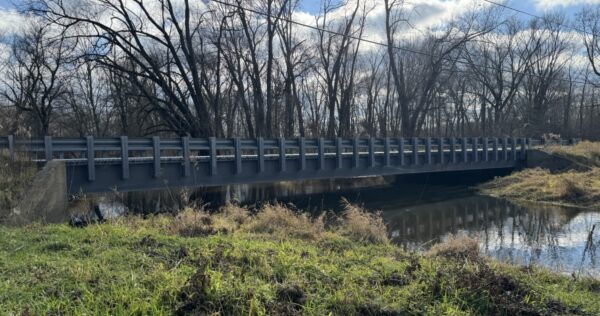 Decks
Decks
Pennsylvania County Selects Hot-Dip Galvanized Steel for Urgent Bridge Project
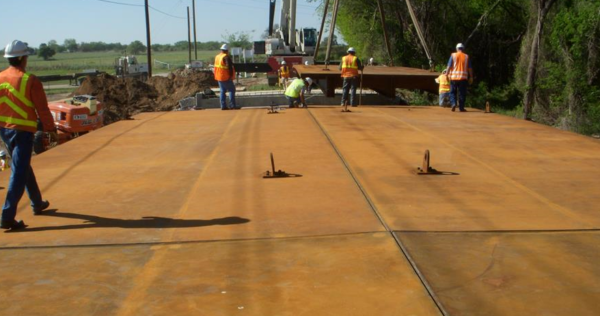
For a recent bridge replacement, Mercer County chose a hot-dip galvanized steel bridge to ensure a durable, cost-effective solution that could be delivered quickly and withstand a corrosive environment.
 Decks
Decks
12 Reasons to Use SPS Bridge Decks
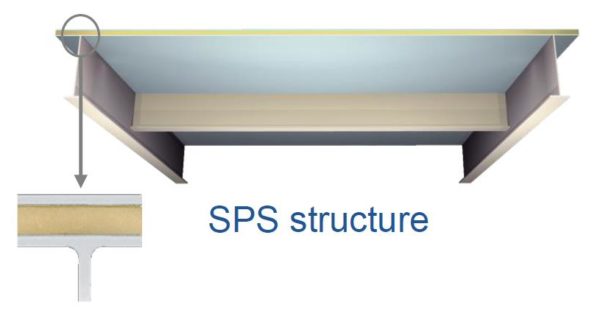
The Sandwich Plate System is a structural composite material used for bridge decks that is up to 70% lighter than reinforced concrete.
 Decks
Decks
Sandwich Plate System Deck
SPS is a structural material of two metal plates with a polyurethane elastomer core.
 Decks
Decks
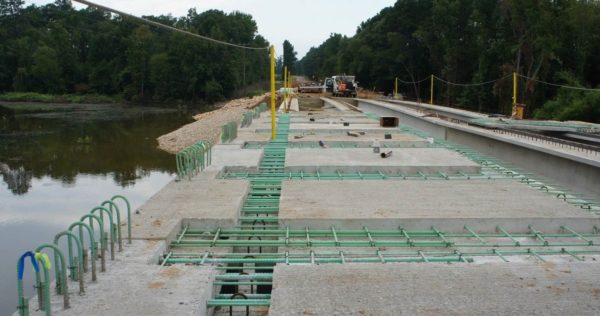
Steel Orthotropic Decks
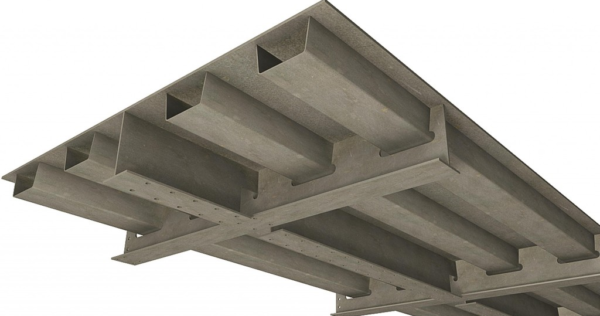
Orthotropic decks are composed of a steel plate that is covered by a shop-installed roadway surface.
 Decks
Decks
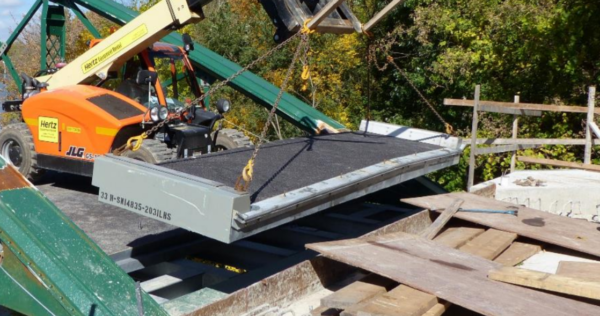
Partial Depth Precast Concrete Deck Panels
Partial-depth concrete panels span between girders and act as stay-in-place forms for cast-in-place concrete.
 Decks
Decks
Fiber Reinforced Polymer Decks
Open grid decks can be described as small-scale steel framing systems used as a bridge deck.