 Short Span Steel Bridges
 Hidden in Plain Sight–the Design, Cost and Maintenance Advantages of Steel Buried Bridges
Sometimes, the best solutions to challenges we face can be hidden in plain sight. A video released by the Short Span Steel Bridge Alliance (SSSBA), National Corrugated Steel Pipe Association (NCSPA) and Big R Bridge invites cash-strapped, time-challenged bridge designers and owners to look beyond traditional above-ground bridge design solutions and consider a proven durable, cost-effective alternative.
The five-minute video covers the construction of the 200th Street Bridge in Buchanan County, Iowa, where a steel buried bridge was chosen to replace a 40-foot-long, two-span timber stringer bridge built in 1956 that had rotting timbers. Interviews with Buchanan County Engineer Brian Keierleber, P.E.; Joel Hahm, P.E., Senior Engineer from Big R Bridge; and contractor Eric Zieser from Zieser Construction provide an interesting case study on the overall benefits of steel buried bridge systems and technical details on why this type of design was selected for this particular project.
Structural steel plate used as buried bridges is a viable design option in almost all cases where a traditional bridge is used due to industry advancements in design and analysis tools, as well as deeper corrugation profiles that allow for longer spans, heavier loads, and higher cover. This design is particularly useful in the 25-foot to 80-foot span range.

Buried bridges carry loads through soil-structure interaction. This means the bridge structure itself and the backfill soils surrounding the structure interact with each other to support the loads.
Design Advantages
Steel buried bridges are durable and resilient, with the ability to support very heavy loads. Cars, trucks and highway loads pose no problem, as these bridges can be designed to carry mining shovels and other equipment weighing over four million pounds, large off-road trucks weighing over one million pounds, and freight train loads. The secret to their success lies in taking advantage of the proven benefits of soil-structure interaction, where the backfill and structure work together to support the load.
Lead times on the design and material acquisition for a buried bridge are usually much faster than a traditional bridge, as the structure is pretty much designed by the time the project is awarded. Approval drawings can be prepared very quickly, and in many cases it can take just weeks to go from a signed contract to having a product on site.
Even better, potential buried bridge design solutions can be viewed free of charge with the website tool eSPAN140 developed by the SSSBA and several partners. The tool requires only three project inputs, and provides the user with contact information for SSSBA member companies that can quickly provide a customized design solution. Try it here.

Buried steel structures provide a tremendous amount of control over the entire process. They can be built in remote locations because the whole structure can be loaded onto one flatbed truck.
Cost Advantages
Buried bridges take advantage of Accelerated Bridge Construction (ABC) techniques and can be built with local crews using their own equipment. The four-man crew that worked on the 200th Street Bridge had no prior experience on this type of bridge, yet found it easy and manageable to construct using basic equipment. Many buried bridges can be built in two days or less, excluding foundation work.
Since the steel plates stack easily, in most cases they can be shipped to the project site on a single truck, saving shipping costs and reducing environmental impacts. At the site, individual plates can be handled with skid steer loaders, forklift trucks, backhoes, and other light equipment.
Because they are compact, structures can be shipped when ready and easily stored in the yard or at the site and built when the schedule permits.
Maintenance Advantages
There is no bridge deck to maintain on a buried bridge, and there are no joints or bearings to repair and replace, resulting in low maintenance and inspection costs.
Additionally, since there is little differential movement or settlement between the buried bridge and adjacent embankments, the “bump at the end of the bridge” that occurs with traditional bridges is effectively eliminated. As a result, maintenance at the surface is essentially the same as it would be for any other section of the road.
Additional Information
There are many more benefits to steel buried bridges. In addition to the video, the Short Span Steel Bridge Alliance includes a technical Q&A with Joel Hahm on its website. Click here to view the Q&A.
The National Corrugated Steel Pipe Association and Big R Bridge offer additional information on these bridge systems.
In Buchanan County, Iowa, the drivers and passengers of cars, trucks and heavy equipment who cross over the 200th Street Bridge may not even realize they’re on a bridge―but those who designed and built it can be confident that it will provide safe crossings for many years to come.
What are buried steel bridges?
Buried steel bridges provide an economical choices for bridge replacement or bridge rehabilitation.
They essentially are a corrugated steel pipe or structural plate pipe systems that is “buried” with backfill to carry loads through soil-structure interaction. This means the bridge structure itself and the backfill soils surrounding the structure interact with each other to support the loads. In effect, the backfill material is part of the bridge.
Because of this interaction, the bridge structure is typically lighter, and there can be significant savings in structure costs.
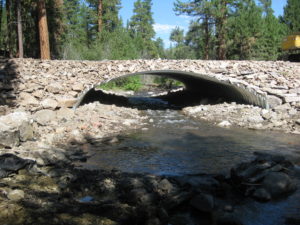
There are also many cases where buried bridges can carry heavier loads than traditional bridges because of the benefits of spreading vehicle loads through the fill. Buried bridges do not require abutments; and unless foundation soil conditions are poor, do not typically
require deep foundations.An additional benefit with buried bridges is that they can be tailored to site conditions and geometric requirements. The design includes inputs for site soils and backfill, meaning that locally available materials can often be used in construction and the structure can be tailored to fit the needs of the site and the owner’s requirements.
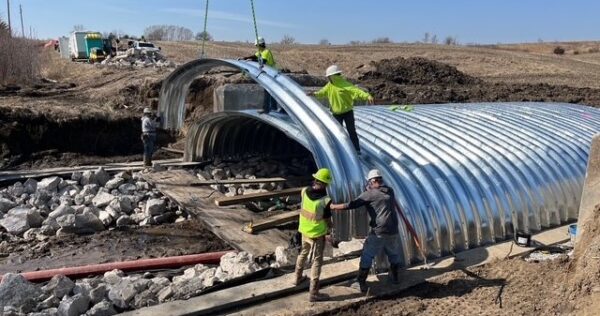 Buried Bridge
Buried Steel Bridge Preserves Streambed While Supporting Heavy Loads
A new galvanized buried steel bridge in Riverside, Iowa, supplied by SSSBA member Lane Enterprises, replaced a weight-restricted structure and restored direct access for local farmers. Its open-bottom steel design preserves the natural streambed, enhances durability, and provides a cost-effective solution for rural infrastructure.
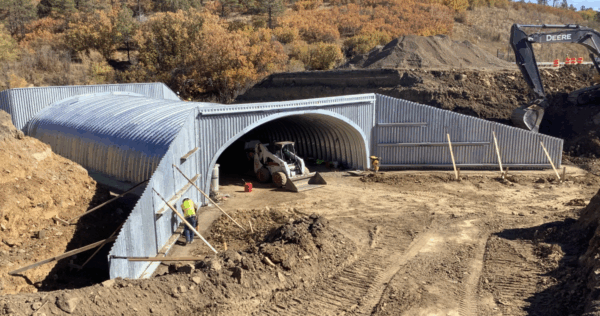 Buried Bridge
Buried Steel Bridge Protects Wildlife and Motorists in New Mexico DOT Project
The New Mexico DOT buried steel bridge project, featuring SSSBA member Contech’s custom structural plate design, was honored as the NCSPA Project of the Year for its innovative wildlife crossing solution on I-25 at Raton Pass.
 Case Study
Steel in Action: On-Demand Steel Bridge Video Series
Watch this four-part, on-demand video series featuring expert-led case studies on cost-effective, resilient short span bridge projects—now available with downloadable presentation materials.