 Short Span Steel Bridges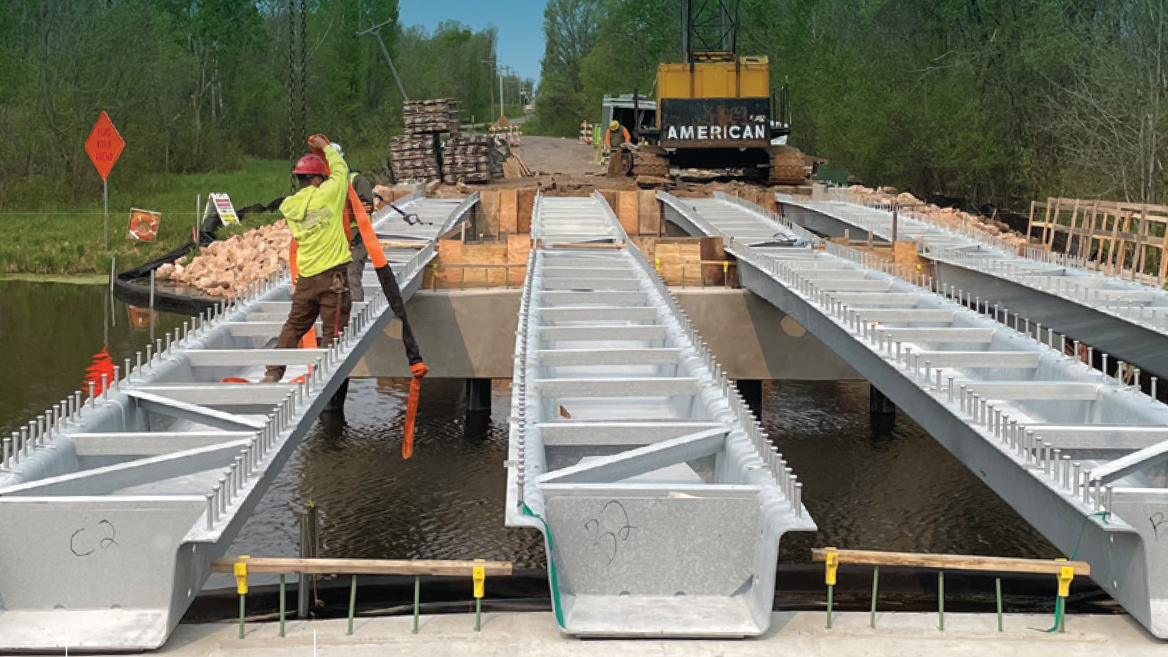
New Specs, New Opportunities for Press-Brake Tub Girders
The American Association of State Highway and Transportation Officials recently released the 10th edition of its LRFD Bridge Design Specifications for use in the design, evaluation and rehabilitation of bridges nationwide.
Developed by the AASHTO Committee on Bridges and Structures, these specifications employ Load and Resistance Factor Design or LRFD methodology, using factors developed from current statistical knowledge of loads and structural performance.
The 10th edition includes updates to almost all sections of the specifications, with extensive revisions made to several sections, including Section 6, Steel Structures.

In December 2024, AASHTO released the 10th edition of its LRFD Bridge Design Specifications.
SSSBA member Valmont Structures developed a summary to offer information on how the updates impact the use of press-brake tub girders (U-BEAMS) for construction.
The following information was provided by SSSBA member Valmont Structures.
Bent Plates
Section 6.7.8 – Structural steel plates shall be bent to the requirements of the AASHTO LRFD Steel Bridge Fabrication Specifications, which specifies 5.0t, where t is the thickness of the plate, and the radius is measured to the concave face of the plate.
- ASHTO BDS did not previously specify a bend radius
- The previous recommended bend radius in the AASHTO Construction Specifications was 3.5t
- Bend radius is no longer a barrier to designing or specifying PBTG
Shear Stud Spacing
Section 6.10.10.1.2 – The minimum spacing of sheer studs was reduced from six times the diameter of the stud to four times the diameter of the stud
- We can now get six 7/8” diameter studs per linear foot of beam instead of four
- This is a 50% increase in allowable studs on beam
- This spacing reduction allows for higher fatigue cycles
- We can accommodate 50% more truck traffic with a single row of studs per flange
Proportion Limits
Section 6.11.2.2 – Top flange to web proportion limits “shall only apply to built-up tub-section members” and “need not apply to tub-section members that are formed from a single plate”
- PBTG did not meet the previous proportion limit requirement
- AASHTO BDS did not previously recognize “tub-section members that are formed from a single plate”
- This eliminates a major obstacle from designing and specifying PBTG
Bottom Flange Proportion
Section 6.11.2.2 – Bottom flange proportion limits have now been included for tub girders in AASHTO BDS-10
- There were no previous bottom flange proportion requirements
- ALL Valmont U-Beams currently meet the new bottom flange proportion requirements
- No change
- This eliminates a major obstacle from designing and specifying PBTG
Bracing Requirements
Section 6.11.3.2 – Top flange bracing systems shall extend between 20 to 25 percent of the span length from each support.
- AASHTO BDS did not previous specify a bracing system length
- Previously Engineers needed to follow a rigorous analysis approach to determine bracing requirements
- This simple approach allows bracing design to no longer be an impediment to designing or specifying PBTG
- This eliminates a major obstacle from designing and specifying PBTG
Creep Reduction Factor
Section 6.13.2.8 – A creep factor taken equal to 0.80 for Class C galvanized faying surfaces
- Previously there we no AASHTO BDS creep reduction factor for galvanized surfaces
- However, Michigan DOT has already applied this creep reduction factor to their design requirements
- This will increase the number of bolts in a splice by about 20%
- We already have splice design standards for this change due to the MDOT requirement
Download the PDF version of this summary.
Learn more about Press-Brake Tub Girders
- History and Overview of Press Brake Tub Girders
- Research Reports: Development and Experimental Testing of Press Brake Tub Girders
- Michigan DOT Selects Steel for 19-Bridge Bundling Project
For More Information:
Kay Jimison
National Director Business Development and Sales
North America Transportation – Structures – Bridge
Valmont Industries, Inc.
15000 Valmont Plaza
Omaha, NE 68154 USA
Phone: +1 (503) 207-6400
Mobile: +1 (971) 416-7316
kay.jimison@valmont.com
www.valmontstructures.com
What are Press Brake Tub Girders?
Press-brake-formed tub girder (PBTG) is a new technology for short span bridge applications. It consists of modular galvanized shallow trapezoidal boxes fabricated from cold-bent structural steel plate (watch fabrication video). A concrete deck is recommended to be precast on the girder and the modular unit can be shipped by truck to the bridge site.

The system utilizes standard plate widths (based on availability) and is optimized to achieve maximum structural capacity, with most of the steel in the bottom flange and increased torsional stiffness. It is a closed system, since the girder is closed at the bottom. It is versatile for multiple-deck options.
The system utilizes Accelerated Bridge Construction practices, since it:
- Can be installed in one or two days
- Is modular, allowing the use of a precast deck
- Is cost-effective―as much as 1/3 less than a standard concrete girder structure
- Is simple to fabricate, requiring very little welding.

The Short Span Steel Bridge Alliance has developed standardized plans using standard plate sizes (60”, 72” 84”, 96”, 108”, 120”). The designs were developed to achieve maximum structural capacity and are available to use in the free-to-use, web-based design tool eSPAN140.
The press-brake-formed tub girder system is open source.
 Case Study
Steel in Action: On-Demand Steel Bridge Video Series
Watch this four-part, on-demand video series featuring expert-led case studies on cost-effective, resilient short span bridge projects—now available with downloadable presentation materials.
 Press Brake & Folded Plate
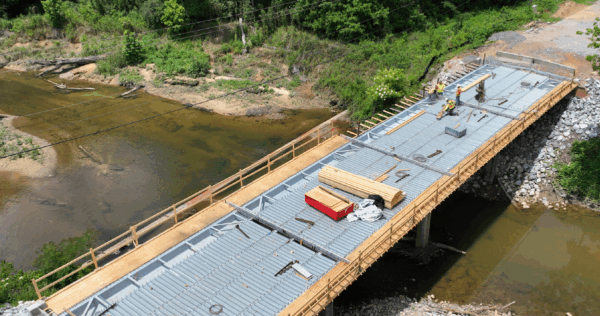
Press-Brake Tub Girder Delivers Modern Upgrade for Historic Alabama County Bridge
After over 80 years of wear from daily traffic, the Parkwood Road Bridge was upgraded with Valmont’s U-BEAM™ system to enhance safety and streamline construction.
 Press Brake & Folded Plate
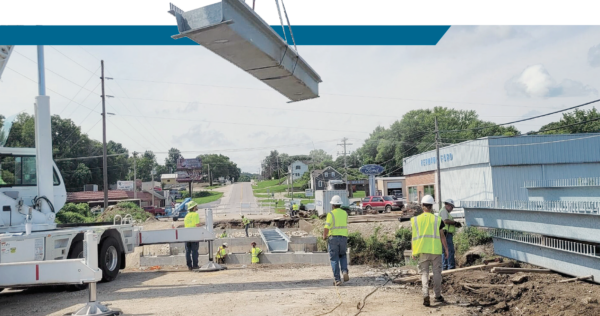
Missouri DOT Fast-Tracks Bridge Replacement with Steel Solution
The Missouri Department of Transportation (MoDOT) replaced an aging bridge to enhance safety and accessibility, using a press-brake tub girder bridge from SSSBA member Valmont Structures.
 Press Brake & Folded Plate
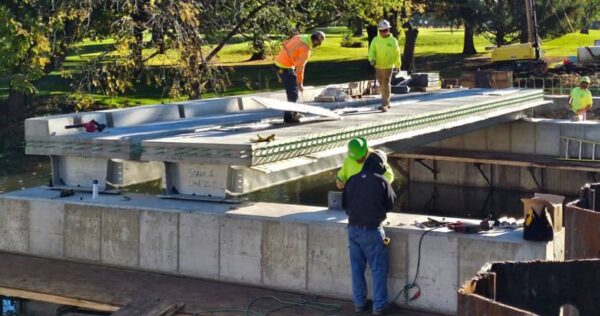
Whiteside County (IL) Selects Steel Bridge Solution for Short Lead Time
Russ Renner, Whiteside County Engineer, decided on a steel solution for an upcoming 105′ long bridge replacement project.
 Case Study
“Press Forward” – Modern Steel Construction
The durability and rapid installation of press-brake-formed tub girders made them the optimal choice for replacing a concrete short-span bridge in Illinois
 Innovation
Building Better Bridges: The Influence of SSSBA Workshops
Complimentary SSSBA workshops advance bridge construction practices with innovative techniques and collaborative learning – schedule yours today!