 Short Span Steel Bridges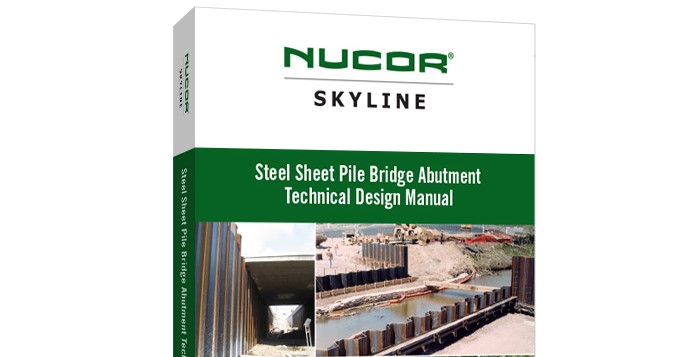
Nucor Skyline: FREE Steel Sheet Pile Bridge Abutment Technical Design Manual
Nucor Skyline has released a new technical design manual for steel sheet pile bridge abutments.
A FREE hardcopy of the manual is available from Nucor Skyline (only available in North America).
Please complete the form located on the Nucor Skyline website to receive a FREE copy of the technical design manual.
Benefits of Sheet Pile Bridge Abutments
- Steel sheet pile bridge abutments are considered an accelerated construction method, significantly reducing the overall construction time in many cases. With a concrete abutment, formwork must be built, concrete poured, and curing time allotted to enable the concrete to achieve its design strength. With a steel solution, the sheet piles are able to begin carrying loads on the day they are installed and do not require any formwork.
- A sheet pile bridge abutment solution is compact, allowing the abutments to be brought closer together to reduce the span length. Reduction of the span length provides overall reduction in the cost of the superstructure. Additionally, due to the compact nature of this solution, disruption of natural streams can be avoided and in-water permitting can be simplified or avoided altogether.
- Another added benefit to this solution is the built-in scour protection when crossing a river or stream. With traditional concrete bridge abutment and piles, significant scour can erode the soil under the concrete abutment, undermining its integrity and requiring repairs. Steel sheet piles are driven much deeper into the soil than a concrete abutment, providing significant automatic scour protection. Pile lengths can be specified and purchased at long lengths to meet long-term scour estimates, ensuring bridge durability.
Abutment Construction Process
There are many different construction methods for bridge abutments which utilize steel, concrete, geosynthetics, and other materials. Abutments can be integral, where the bridge and the abutment move together, or semi-integral, where the abutment and the superstructure move independently when responding to forces on the bridge. There are pros and cons to each type of bridge abutment and construction method. Review your local Department of Transportation’s guidance regarding types of bridges that are acceptable or recommended in your state.
Sheet pile abutments exhibit numerous advantages over conventional reinforced concrete abutments. In situations where an older bridge is to be replaced, the use of a sheet pile abutment may reduce or eliminate the need for costly shoring during multiple phases of construction. Sheet pile abutments have a significant cost advantage, by reducing excavation needs and construction time. In this era of emerging technologies associated with accelerated bridge construction, steel sheet pile abutments can play an important role.
Sheet pile bridge abutments are constructed by first installing the sheet piles for both the abutment face and the wing walls. Tie rods and a deadman wall are required in some high-load applications. Additional pilings behind the sheet piles can be used if insufficient bearing and skin friction capacity cannot be obtained with the sheet piles themselves. From there, soil backfills behind the sheet piles and construction of the concrete cap and bridge deck can proceed. As described, it’s clear to see that this solution eliminates a lot of construction stages, and therefore can eliminate a significant amount of time and show increased cost savings.
Sheet Piling Offerings
Nucor Skyline offers NZ, PZ, and SKZ sheet piles which are made in America and meet federal Buy America guidelines. This product range is suitable for any Department of Transportation (DOT) project you may have in design.
To see some examples of how sheet piling is used for bridge abutments, please click here to download free case studies.
Where is the substructure and/or foundation on a bridge?
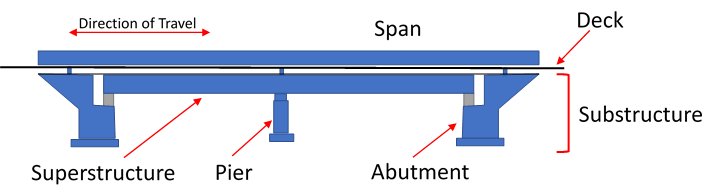
Substructure
The substructure consists of the portion of the bridge that supports the entire structure on the given surrounding soil. There are varying designs due to the different soil conditions for each bridge site and the different weights of the structures for each project.
Foundation
The role of the foundation of a bridge structure is to create a smooth transition allowing the internal forces to flow between the bridge and the ground. Foundations are the ‘bridges’ or links between the bridge and the ground.
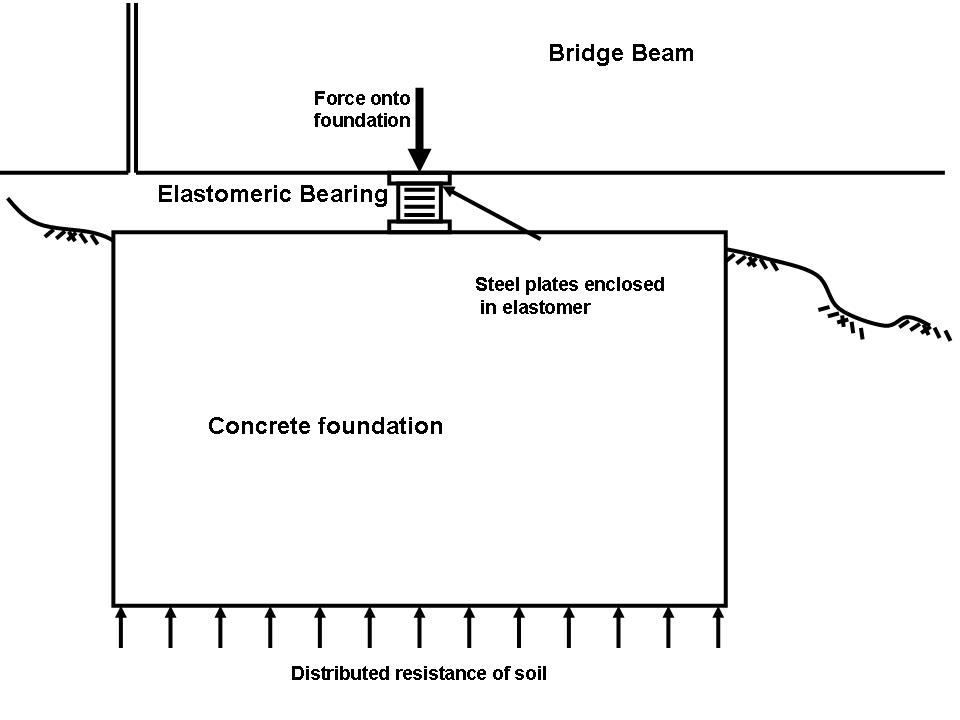
There are really only two types of bridge foundations – although each has many variations – ‘spread’ foundations and ‘piled’ foundations. Both types must transfer forces into the soil beneath the bridge.
Spread Foundation
Piles Foundation
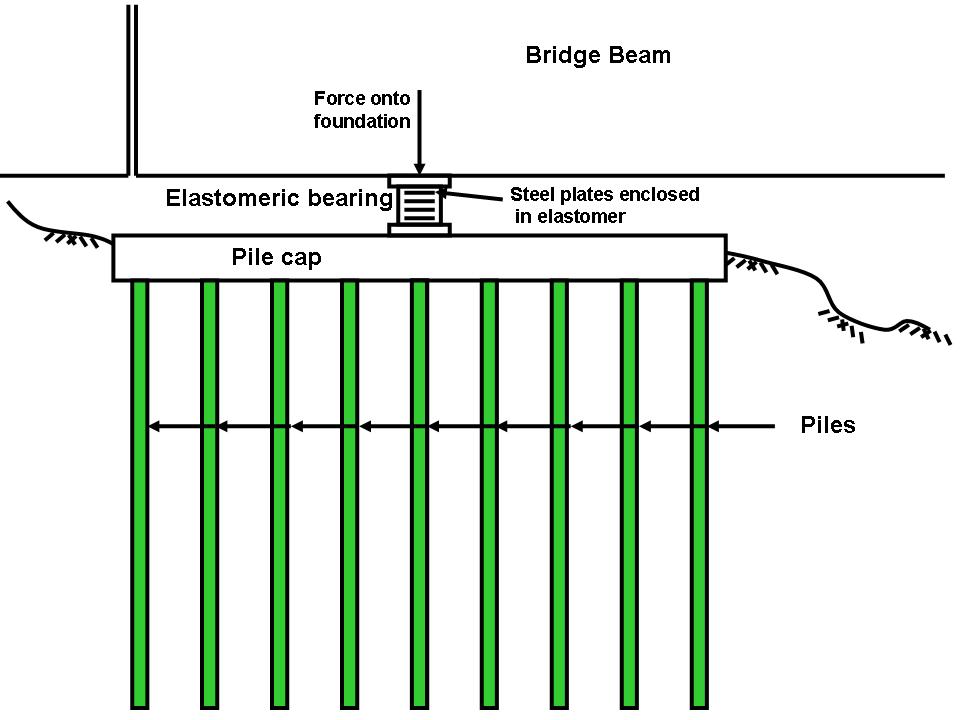
Photo Credit: Bridges
 Case Study
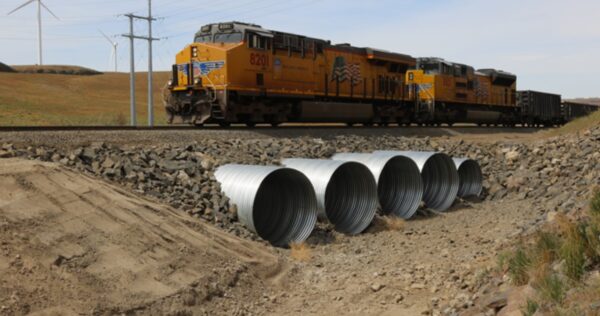
Corrugated Steel Pipe Safeguards Rail System from Excessive Storm Water
The National Corrugated Steel Pipe Association (NCSPA) spotlights a project that used corrugated steel pipe to provide a storm water solution in only 8 hours.
 Substructure & Foundation
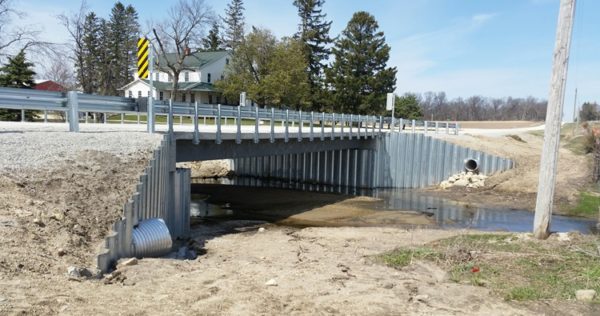
Sheet Pile Wall Abutments
Steel sheet piles prevents scour from becoming a problem.
 Substructure & Foundation
Driven Steel Piles
H-Piles beams are driven in the ground for deep foundation applications.