 Short Span Steel Bridges
Report Finds $198 billion Needed to Repair America’s Rural Transportation System
The following information was provided by TRIP, a national transportation research nonprofit.
America’s rural transportation system is in need of repairs and modernization to support economic growth and improve traffic safety, but the US faces a $198 billion backlog in funding for needed repairs and improvements to its rural transportation system. This is according to a new report released today by TRIP, a national transportation research nonprofit.
The report, Rural Connections: Examining the Safety, Connectivity, Condition and Funding Needs of America’s Rural Roads & Bridges, evaluates the safety and condition of the nation’s rural roads and bridges and finds that the nation’s rural transportation system is in need of immediate improvements to address deficient roads and bridges, high crash rates, and inadequate connectivity and capacity.
Roads, highways, rails and bridges in the nation’s rural areas face significant challenges: they lack adequate capacity, they fail to provide needed levels of connectivity to many communities, and they cannot adequately support growing freight travel in many corridors. Rural roads and bridges have significant deficiencies and deterioration, they lack many desirable safety features, and rural non-Interstate roads experience fatal traffic crashes at a rate far higher than all other roads and highways. The chart below ranks states with the highest share of rural pavements in poor condition, rural bridges rated poor/structurally deficient, and fatality rates on non-Interstate, rural roads. Data for all 50 states is included in the report Appendices.

The full report can be downloaded from the TRIP website.
Rural Roads and Bridge Face Significant Challenges
The report finds that the nation’s rural roads and bridges have significant deficiencies and high traffic fatality rates.
- Twelve percent of U.S. rural roads are rated in poor condition and 19 percent are in mediocre condition
- Eight percent of rural bridges in the U.S. are rated in poor/structurally deficient condition
- 48 percent are rated in fair condition
Bridges rated poor/structurally deficient have significant deterioration to the major components of the bridge and are often posted for lower weight or closed to traffic, restricting or redirecting large vehicles, including agricultural equipment, commercial trucks, school buses and emergency services vehicles.
IIJA Provides Significant Boost to Improve Transportation Systems
Signed into law in November 2021, the Infrastructure Investment and Jobs Act (IIJA) is providing a significant boost in federal investment in roads, bridges and transit and offers an opportunity for the nation to make progress in improving the safety, reliability and condition of America’s transportation system.
The IIJA will provide $454 billion over the five-year period from 2022 to 2026 for investment in highways and transit, resulting in a 31 percent increase in federal investment over the previous federal surface transportation program.
The IIJA includes a $2 billion Rural Surface Transportation Grant Program that will support projects to improve and expand the surface transportation infrastructure in rural areas to increase connectivity, improve the safety and reliability of the movement of people and freight, and generate regional economic growth and improve quality of life.

The chart above ranks states with the highest share of rural pavements in poor condition, rural bridges rated poor/structurally deficient, and fatality rates on non-Interstate, rural roads.
‘Unprecedented Opportunity’ to Modernize America’s Infrastructure
“Transportation infrastructure provides critical connections for our rural communities nationwide, supporting their health and driving commerce,” said John Drake, vice president for transportation, infrastructure, and supply chain policy at the U.S. Chamber of Commerce.
“Addressing the significant deficiencies outlined in this report is essential not only for safety but also for ensuring that our rural communities continue to succeed,” continued Drake. “With the support provided by the IIJA, we have an unprecedented opportunity to modernize these vital connections and strengthen the foundation of rural America’s economic future.”
Does steel provide an economical solution for bridge construction?

- Due to the light weight of steel, cost savings can be significant
- Studies show that weathering, A1010 (A709-50CR), and galvanized steel reduces both initial and life cycle costs.
- Steel can compete and even save costs when compared with nearly identical concrete structures. re.
- Steel bridges also have long lives, decreasing the need for replacement.
- Steel’s high strength permits longer spans, minimizing disruption to underlying habitats.
- Steel is highly resistant to extreme natural disasters such as earthquakes.
- Steel is the world’s most recycled material and is infinitely recyclable.
- Short span steel bridges can be designed with prefabricated elements which provide a simpler installation and cost savings.
 Design
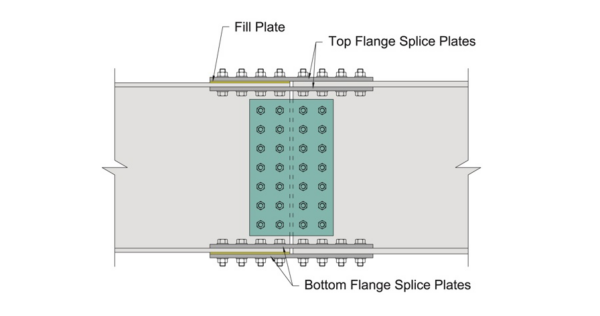
NSBA Releases Updated Bolted Splice Spreadsheet 4.01
NSBA’s Bolted Splice Spreadsheet 4.01 streamlines connection design with expanded options and updated AASHTO LRFD provisions for faster, more economical solutions.
 News
News
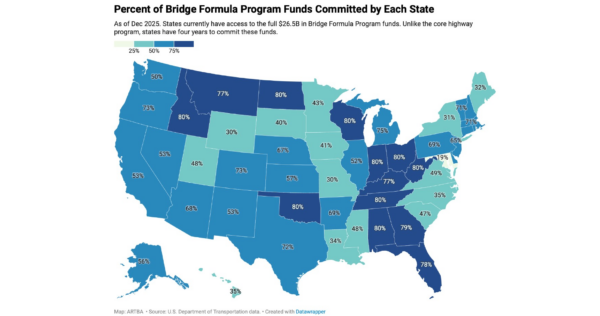
ARTBA Reports $15 Billion Committed Through Bridge Formula Program as Needs Remain
According to an ARTBA analysis, states have committed $15 billion through the bridge formula program, yet one in three bridges still needs work.
 News
News
State DOT CEOs Discuss Key Reauthorization Funding Issues, Investment in Local Programs
AASHTO recently held its 2026 Washington Briefing in D.C., featuring a panel of state DOT leaders discussing critical surface transportation funding and reauthorization issues.