 Short Span Steel Bridges
Revisions for Press-Brake-Formed Steel Tub Girder Bridges to be Included in AASHTO Specifications
The Short Span Steel Bridge Alliance (SSSBA) has initiated revisions affecting the use of press-brake-formed steel tub girder (PBTG) bridges that will be included in the 10th edition of the AASHTO LRFD Bridge Design Specifications, which will be published in 2023.
The Specifications employ Load and Resistance Factor Design (LRFD) methodology for use in the design, evaluation and rehabilitation of bridges and are used extensively in highway design and construction throughout the United States.
The revisions apply to Specification Equation 6.11.2.2-3, which is “intended to provide adequate boundary conditions at the web-top flange juncture of composite tub sections in flexure such that the web and compression-flange buckling formations with the specification are sufficiently accurate,” according to the ballot reviewed by the American Association of State and Highway Transportation Officials (AASHTO) T-14 Technical Committee for Structural Steel Design.
Essentially, the revisions exclude PBTG bridges from the requirements of Equation 6.11.2.2-3, which were originally intended only for application to built-up tub-section members that utilize different- sized flange and web plates. They were never intended to be applied to tub-section members fabricated from a single plate, such as press-brake-formed tub-section members, that have been successfully used on shorter-span steel bridges.
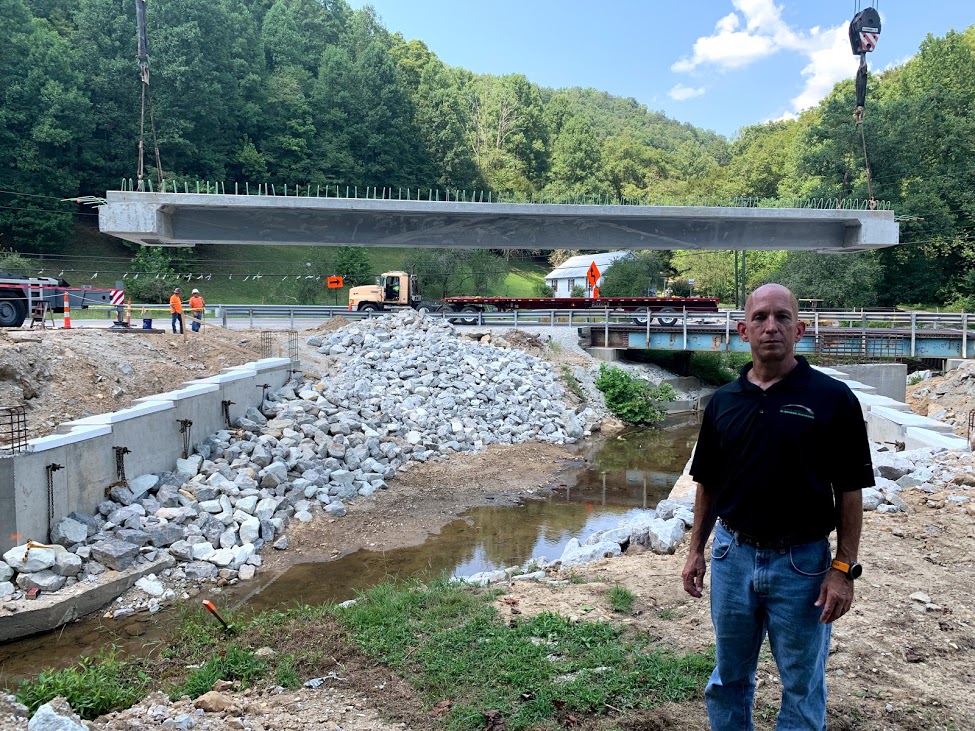
Karl Barth, Ph.D., West Virginia University, conducted extensive research on the PBTG system.
“This is great news for state and local Departments of Transportation that are looking for economical, sustainable and accelerated construction solutions for short span bridges, which make up over half of the U.S. bridge inventory,” said Karl Barth, Ph.D., associate professor of civil and environmental engineering at the Wadsworth Department of Civil and Environmental Engineering at West Virginia University and leader of the team that developed the PBTG system, who has conducted extensive research on the PBTG system.
“It was not practical to apply these requirements to PBTG bridges and would have unintentionally excluded them as cost-effective solutions to replacing short span bridges. This is especially important as funding provided by the Bipartisan Infrastructure Law becomes available to replace off-system bridges because it creates an additional option for fixing the nation’s infrastructure.”
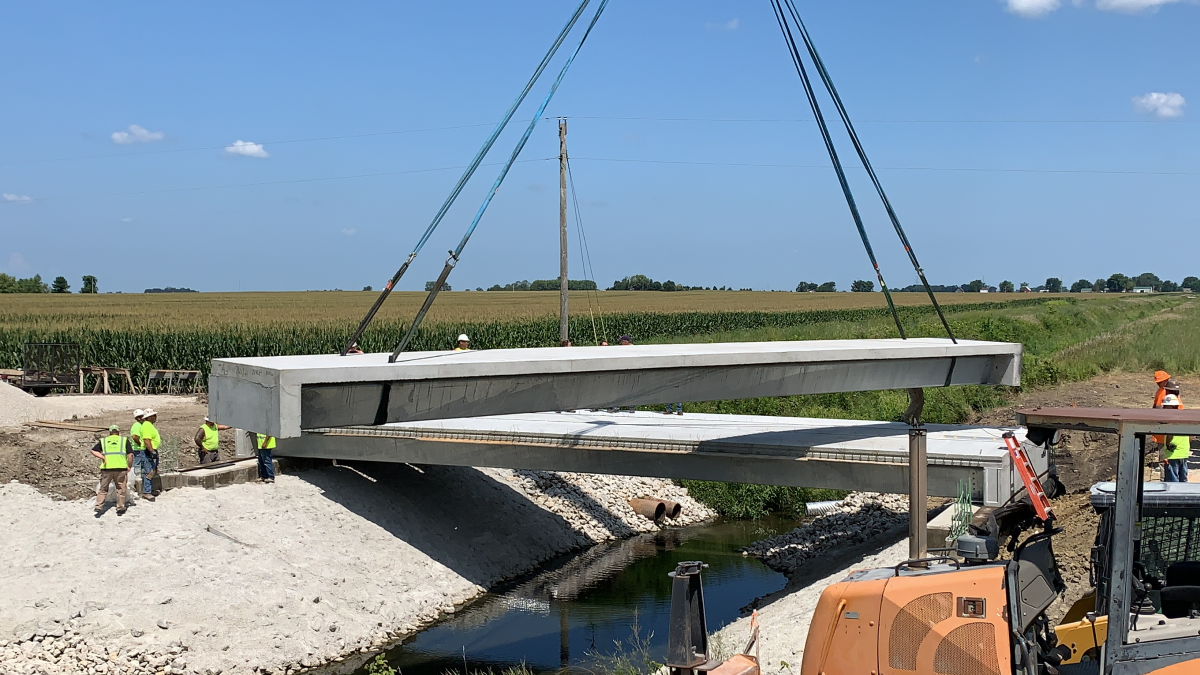
Press-brake-formed steel tub girder bridges can last 100 years or more, with minimal maintenance over their long service lives.
PBTG bridges provide an economical and sustainable solution for bridge owners because they are lighter than other materials, can be installed in hours by local crews using their own equipment, require minimal maintenance over their life spans, and can last 100 years or more. With shorter project times, PBTG bridge projects can reduce traffic disruption and provide sustainable benefits resulting from Life Cycle Analysis and recycling efficiencies.
What are Press-Brake-Formed Steel Tub Girder Bridges?
PBTG bridges consist of modular galvanized shallow trapezoidal boxes fabricated from cold-bent structural steel plate. A concrete deck or other deck option such as a steel sandwich plate system (SPS) may be placed on the girder, and the modular unit can be shipped by truck to the bridge site.
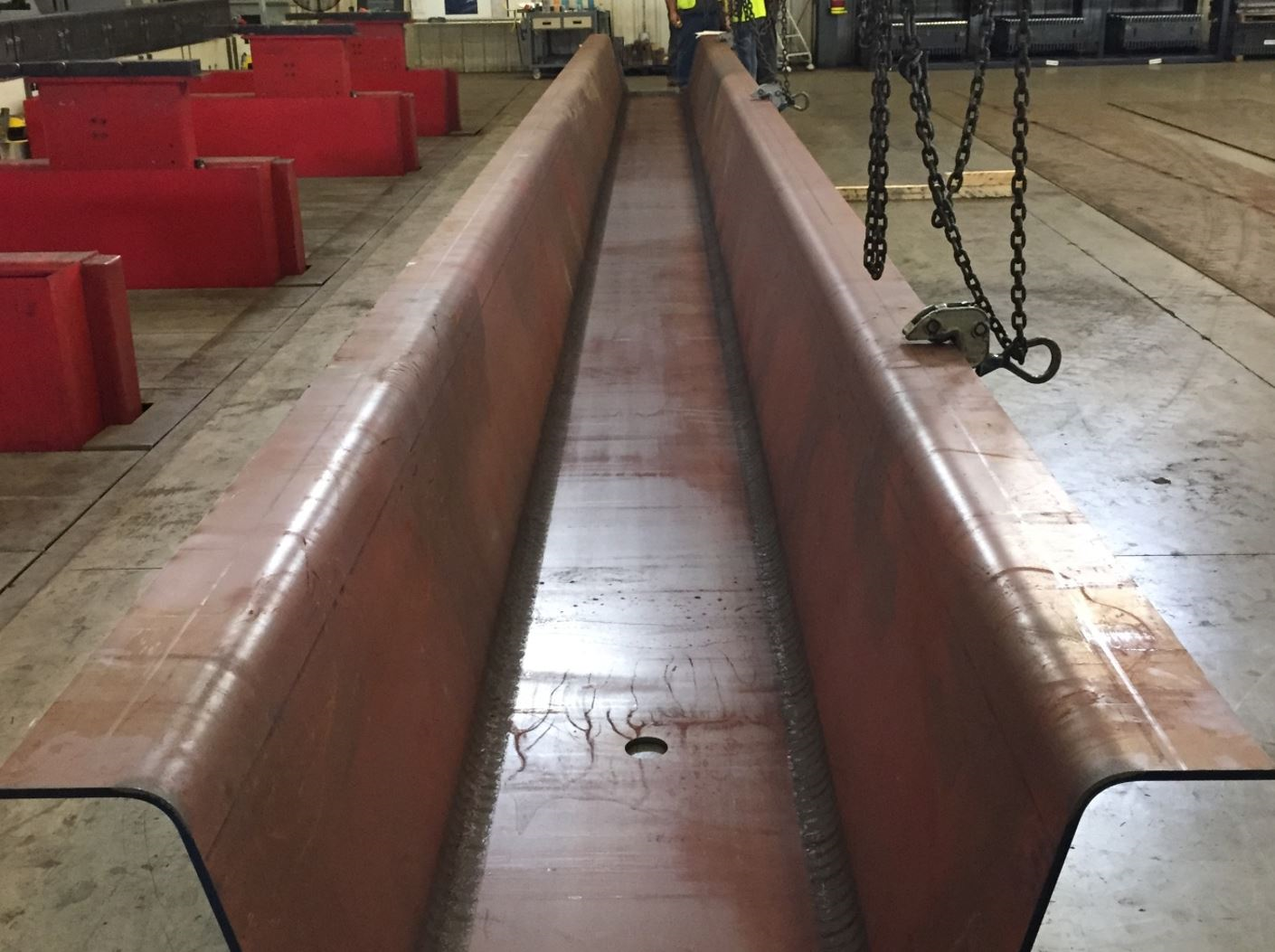
Press-brake-formed tub girder consists of modular galvanized shallow trapezoidal boxes fabricated from cold-bent structural steel plate.
The system utilizes standard plate widths (based on availability) and is optimized to achieve maximum structural capacity, with most of the steel in the bottom flange and increased torsional stiffness. It is a closed system, since the girder is closed at the bottom, and is versatile for multiple-deck options. The first PBTG bridge was constructed in 2015, and they are now in service in 11 states.
Read article in Roads & Bridges
 News
News
Bridge Task Force and AASHTO Steel Leaders Meet in Alaska
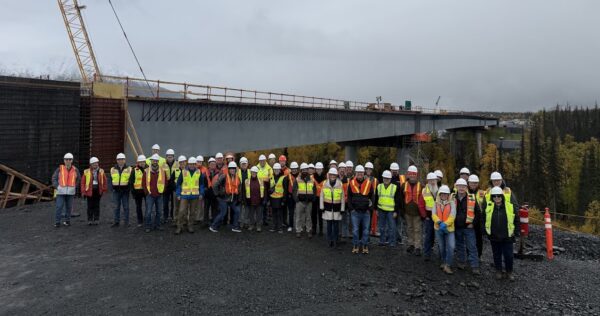
The Steel Bridge Task Force and AASHTO Steel and Metals Technical Committee met in Anchorage for technical presentations, project updates and industry recognition. The meetings concluded with an Alaska DOT hosted tour of the Juneau Creek Bridge and surrounding Sterling Highway construction.
 News
News
SSSBA to Present at North Central States Consortium in Omaha, NE (Sept. 28-30)
Dr. Michael Barker, University of Wyoming, will represent SSSBA at the North Central States Consortium (NCSC) in Omaha, Nebraska. His presentation (Tuesday, September 29, 1:30–2:15 p.m.) will explore how optimized plate girders can expand the range of steel solutions for bridges with spans of 60 to 100 feet.
 News
News
AISI Corrosion Advisory Group to Meet October 27 in Ohio
The AISI Corrosion Advisory Group (CAG) will meet October 27 at the Sherwin-Williams Research & Development Center in Ohio. Discussions will focus on corrosion research, coatings, steel durability and related industry needs.