 Short Span Steel Bridges
Contractor Saves $15,000 With Steel Structural Plate Arch
Article provided by Lane Enterprise’s Inc. and the National Corrugated Steel Pipe Association
“Save Time, Save Money, Everyday” is the apt slogan for Dollar General, one of the more popular dollar stores that are seemingly being built everywhere today, and this slogan is even more fitting for the steel structural plate arch that was recently installed at the new Dollar General Store located at the corner of North Diamond Street and High Street in Mount Pleasant Township, Pennsylvania.
The savings of time and money was realized as the installation contractor was able to successfully propose a value engineered alternate to the 7’-0” x 3’-6” reinforced concrete box culvert specified on the construction plans.
Having bid the concrete structure knowing how long the installation would take, the contractor was in a good position to foresee that a substantial savings could be realized when the alternate was initially prospected.
The 9’-0” x 3’-10½” single- radius steel structural plate arch was assembled by the contractor and installed in two days, one day less than originally anticipated. The steel structure was complete with a full invert and plate headwalls at each end.
With no multiple truck loads, no heavy lifting, and no cranes, the simpler solution paid off.
All in all, the contractor saved around $15,000 for what turned out to be a small two-day operation, Saving Time, Saving Money . . . The Dollar General way.
What are buried steel bridges?
Buried steel bridges provide an economical choices for bridge replacement or bridge rehabilitation.
They essentially are a corrugated steel pipe or structural plate pipe systems that is “buried” with backfill to carry loads through soil-structure interaction. This means the bridge structure itself and the backfill soils surrounding the structure interact with each other to support the loads. In effect, the backfill material is part of the bridge.
Because of this interaction, the bridge structure is typically lighter, and there can be significant savings in structure costs.
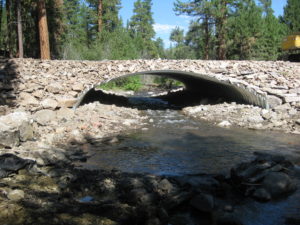
There are also many cases where buried bridges can carry heavier loads than traditional bridges because of the benefits of spreading vehicle loads through the fill. Buried bridges do not require abutments; and unless foundation soil conditions are poor, do not typically
require deep foundations.An additional benefit with buried bridges is that they can be tailored to site conditions and geometric requirements. The design includes inputs for site soils and backfill, meaning that locally available materials can often be used in construction and the structure can be tailored to fit the needs of the site and the owner’s requirements.
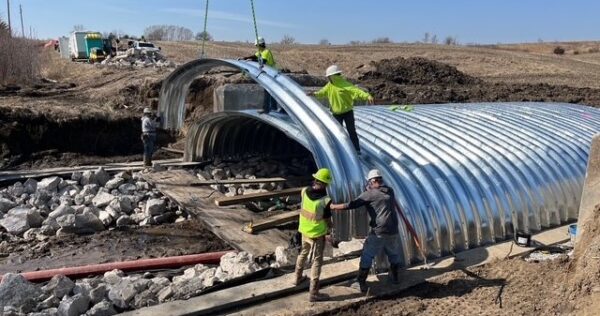 Buried Bridge
Buried Steel Bridge Preserves Streambed While Supporting Heavy Loads
A new galvanized buried steel bridge in Riverside, Iowa, supplied by SSSBA member Lane Enterprises, replaced a weight-restricted structure and restored direct access for local farmers. Its open-bottom steel design preserves the natural streambed, enhances durability, and provides a cost-effective solution for rural infrastructure.
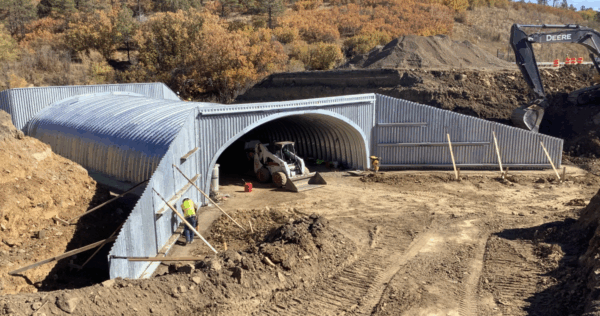 Buried Bridge
Buried Steel Bridge Protects Wildlife and Motorists in New Mexico DOT Project
The New Mexico DOT buried steel bridge project, featuring SSSBA member Contech’s custom structural plate design, was honored as the NCSPA Project of the Year for its innovative wildlife crossing solution on I-25 at Raton Pass.
 Case Study
Steel in Action: On-Demand Steel Bridge Video Series
Watch this four-part, on-demand video series featuring expert-led case studies on cost-effective, resilient short span bridge projects—now available with downloadable presentation materials.