 Short Span Steel Bridges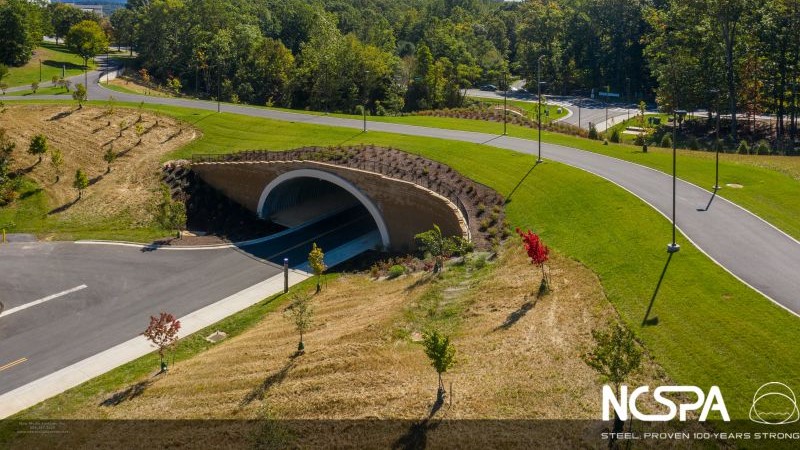
Buried Steel Bridge Combines Functionality with Green Design
Article provided by Contech Engineered Solutions and the National Corrugated Steel Pipe Association
As a growing public university in Virginia’s Shenandoah Valley, James Madison University (JMU) has taken on a number of exciting capital construction projects in recent years including a new basketball arena, convocation center and 500-bed residence hall, Paul Jennings Hall.
All of this work created over 160,000 yards of excess cut materials, soil that would need to find a new home. At the same time, the University was looking for ways to improve access between the Skyline area of campus and East Campus where the new Jennings hall is located as well as to provide a new green space and improve safety for its students.
The 128-foot long Land Bridge was constructed using a galvanized deep-corrugation structural plate arch system (60′-5″ span and 20′-8″ rise).
As an innovative approach to addressing these both of these issues, the project team, which included VMDO Architects and VHB proposed the JMU East Campus Land Bridge.
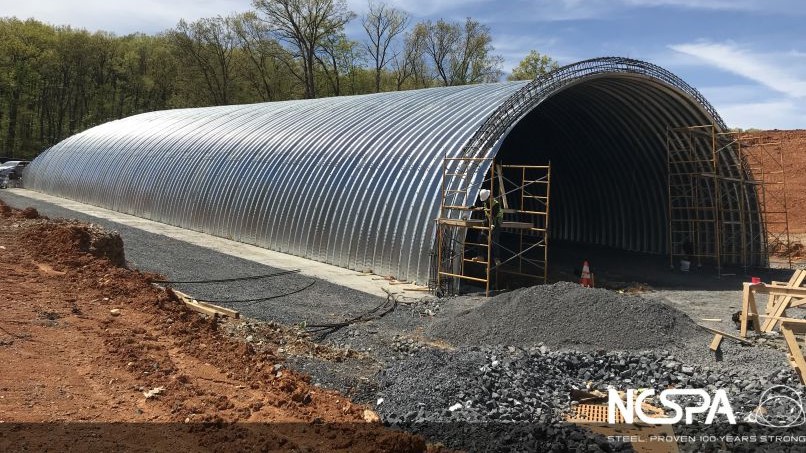
The Land Bridge was constructed using Contech’s galvanized, deep-corrugation structural plate arch system. The 128-foot long bridge-tunnel has a 60′-5″ span and 20′-8″ rise. It spans an existing 2-lane road and supports a 20′ wide, pedestrian footpath and bicycle path above.
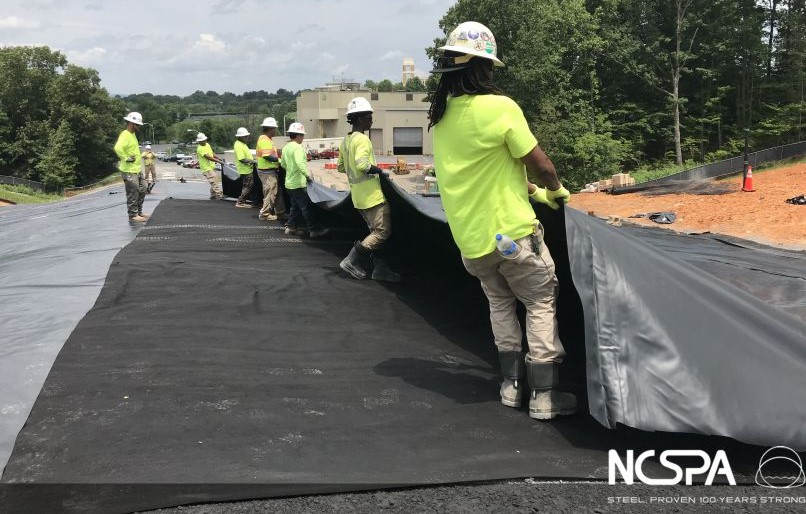
To help ensure long-term durability of the structure, an HDPE membrane was utilized in the engineered backfill above the arch.
To help ensure long-term durability of the structure, an HDPE membrane was utilized in the engineered backfill above the arch. significant amount of excavated soil and fill materials from another University construction site. Significant amount of excavated soil and fill materials from another University construction site was used in the area adjacent to the land bridge.
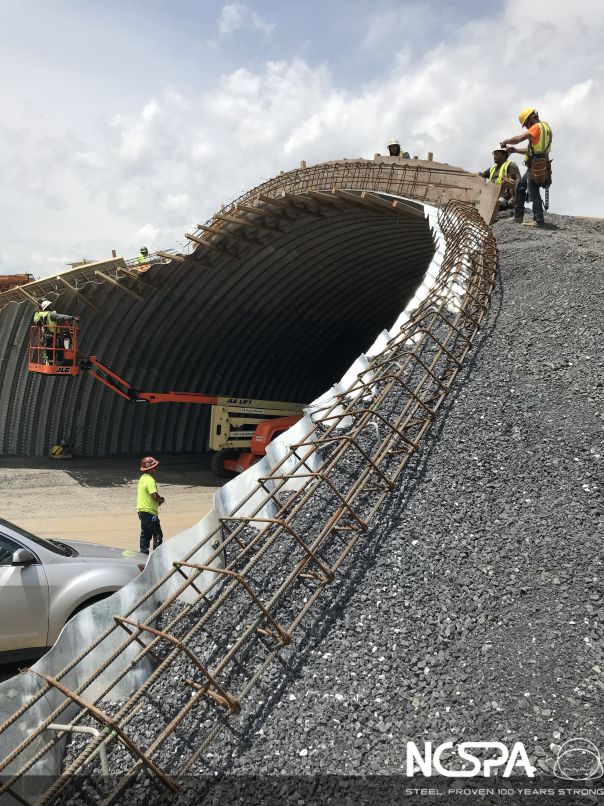
The Land Bridge features a decorative Keystone wall on one end and a step-beveled end treatment with a cast-in-place slope collar on the other.
Aesthetics were critical for this new campus landmark which features a decorative Keystone wall on one end and a step-beveled end treatment with a cast-in-place slope collar on the other. The crossing features plantings, fencing and lighting that seamlessly integrates it with its surroundings.
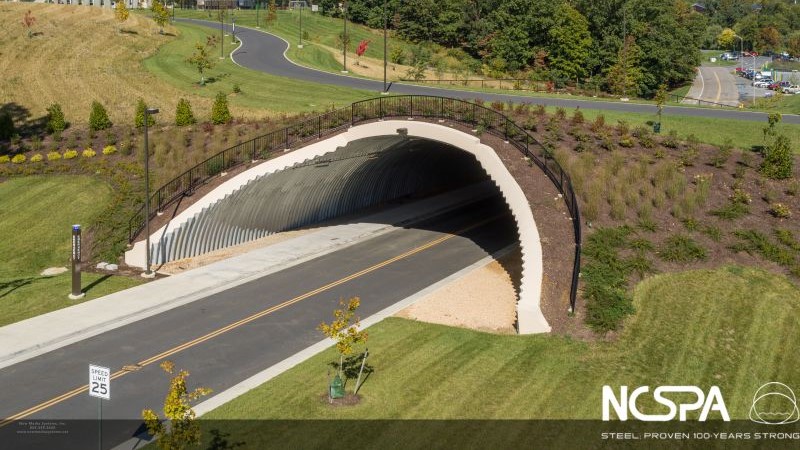
The Land Bridge features plantings, fencing and lighting that seamlessly integrates it with its surroundings.
The project because of its unique features has been extremely well received and has recently won two awards, an Engineering Excellence Award from The American Council of Engineering Companies (ACEC) of Virginia, and an Honorable Mention Award through the American Public Works Association (APWA) Mid-Atlantic Chapter’s Project of the Year Award category for structures $5-$25 million.
One of the first projects of its kind to ever be constructed, the new innovative Land Bridge enhances the university with its improved green space for the community and provides pedestrians and cyclists safe and easy access to the James Madison University campus.
What are buried steel bridges?
Buried steel bridges provide an economical choices for bridge replacement or bridge rehabilitation.
They essentially are a corrugated steel pipe or structural plate pipe systems that is “buried” with backfill to carry loads through soil-structure interaction. This means the bridge structure itself and the backfill soils surrounding the structure interact with each other to support the loads. In effect, the backfill material is part of the bridge.
Because of this interaction, the bridge structure is typically lighter, and there can be significant savings in structure costs.
There are also many cases where buried bridges can carry heavier loads than traditional bridges because of the benefits of spreading vehicle loads through the fill. Buried bridges do not require abutments; and unless foundation soil conditions are poor, do not typically
require deep foundations.An additional benefit with buried bridges is that they can be tailored to site conditions and geometric requirements. The design includes inputs for site soils and backfill, meaning that locally available materials can often be used in construction and the structure can be tailored to fit the needs of the site and the owner’s requirements.
 Buried Bridge
NCSPA Releases Industry-Wide Environmental Product Declaration for Corrugated Steel Pipe
NCSPA has released a third-party verified Environmental Product Declaration (EPD) for corrugated steel pipe, providing standardized environmental information for engineers, owners, contractors and public agencies.
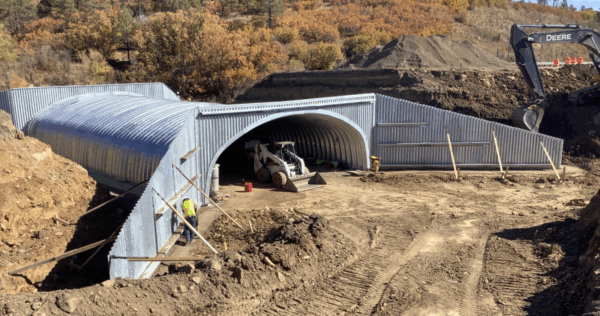 Buried Bridge
Buried Steel Bridge Protects Wildlife and Motorists in New Mexico DOT Project
To improve safety and preserve wildlife corridors, the New Mexico DOT installed two steel structural plate buried bridges beneath I-25 at Raton Pass. Supplied by SSSBA member Contech, the crossings offer a durable, low-maintenance solution for both transportation and conservation.
 Buried Bridge
Buried Steel Bridge Preserves Streambed While Supporting Heavy Loads
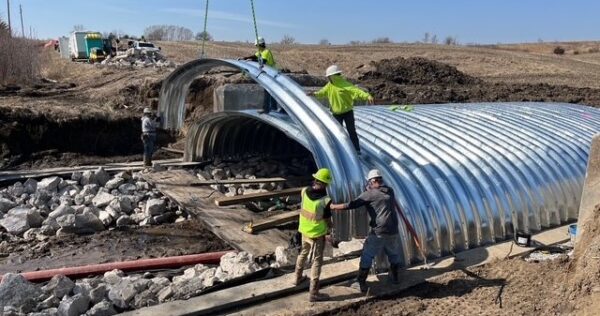
A new galvanized buried steel bridge in Riverside, Iowa, supplied by SSSBA member Lane Enterprises, replaced a weight-restricted structure and restored direct access for local farmers. Its open-bottom steel design preserves the natural streambed, enhances durability, and provides a cost-effective solution for rural infrastructure.
 Case Study
Steel in Action: On-Demand Steel Bridge Video Series
Watch this four-part, on-demand video series featuring expert-led case studies on cost-effective, resilient short span bridge projects—now available with downloadable presentation materials.
 News
News
NCSPA Announces 2025 Project of the Year Winners
The National Corrugated Steel Pipe Association announced the 2025 project of the year winners, including members of the Short Span Steel Bridge Alliance.
 Buried Bridge
Corrugated Steel Animal Overpass Reduces Wildlife-Vehicle Collisions
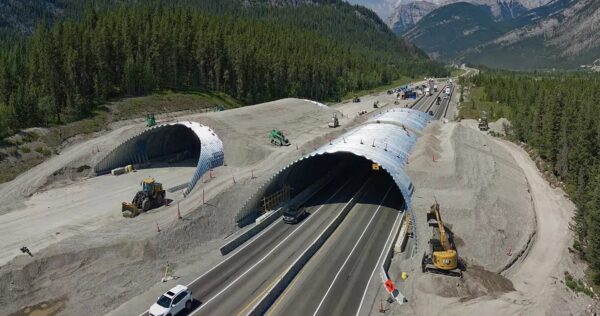
The corrugated steel Stoney Nakoda Exshaw Wildlife Arch in Western Canada showcases the balance of engineering and environmental stewardship, setting a new standard for wildlife-friendly infrastructure.