 Short Span Steel Bridges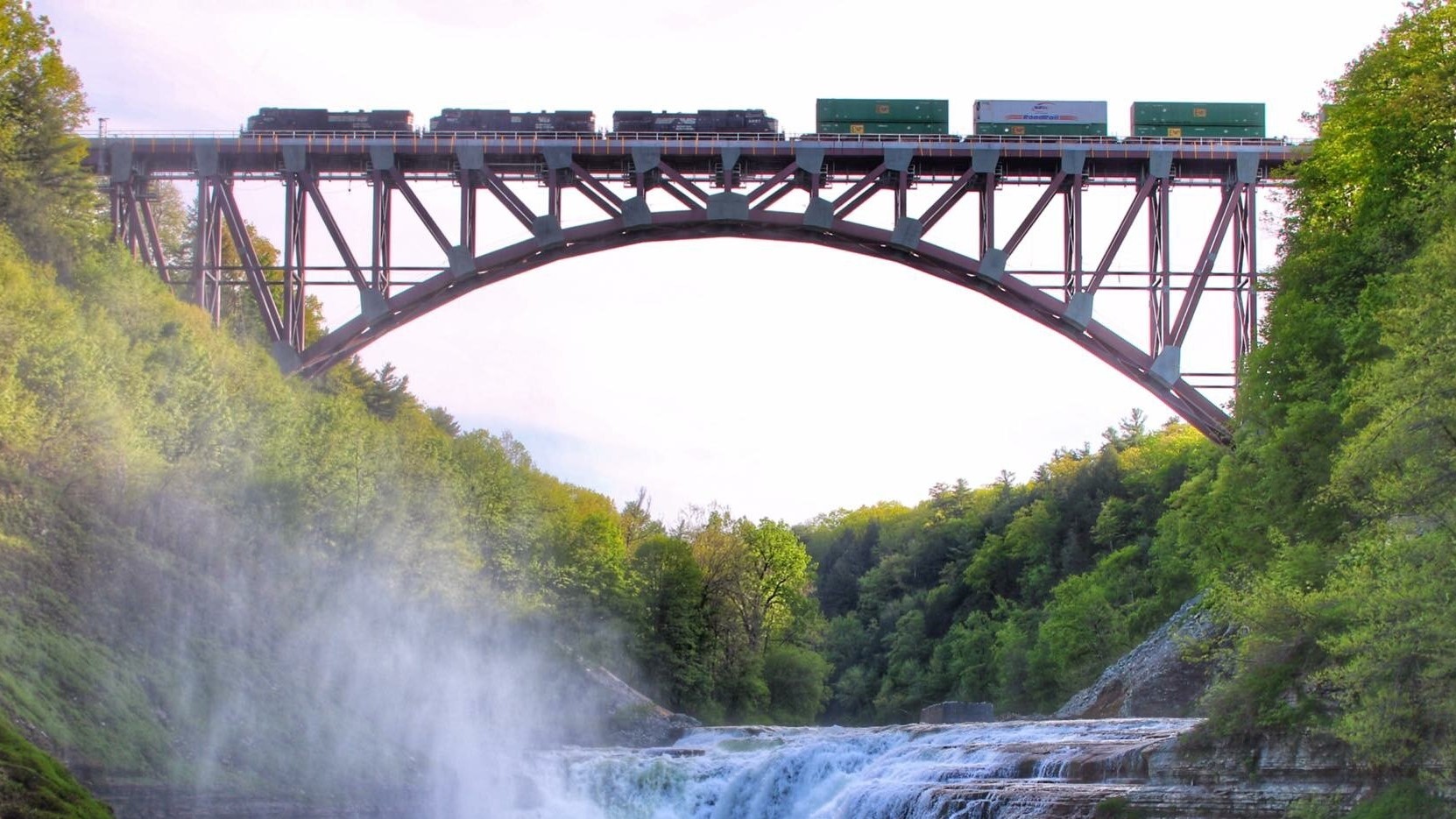
Funding On Its Way for Rail Bridges
The Biden administration announced a $16.4 billion investment for rail projects along Amtrak’s Northeast Corridor as part of the overall investments in infrastructure.
The funding will go to 25 passenger rail projects and will come from the bipartisan infrastructure law’s overall $66 billion investment in rail The projects are an effort to move “the United States closer to his vision for world-class passenger rail,” an official said.
Funding is Already Underway
Connecticut has been selected to receive $2 billion for 10 different rail bridge projects. This funding includes, but is not limited to:
- $827 million for the replacement of the 116-year-old Connecticut River Bridge in Old Saybrook and Old Lyme with a new resilient movable bridge.
- $465 million for the WALK Bridge Replacement Project.
- $245.92 million for the Devon Bridge Replacement Project.
Why Use Steel for Rail Bridges?
Today, there are roughly 400 miles of timber railway trestle in the U.S.
Railway timber trestles were extensively used in the 19th century, making up from 1 to 3 percent of the total length of the average railroad. These trestles now need replacement and are a growing challenge for the railways.
Shutting down the tracks is equivalent to shutting down the revenue stream, and the construction times associated with removal and replacement projects are extensive. As a result, the railways prefer to rehabilitate or even replace these structures in place while rail transports seamlessly continue.
Steel provides an accelerated bridge construction solution for these bridge types.
Additional advantages of using steel for rail bridges include:
- Sustainable
- Lightweight
- Reusable
- Recyclable
- Reliable
- Inspectable
- Repairable
- Efficient to Strengthen and Retrofit
Example of Steel Rail Bridge Rehabilitation
The Union Pacific Bridge identified as Rockport Sub. Culvert 11.50 is a classic example of how an existing bridge can be replaced without disrupting rail operations.
This project featured removal of a four-span timber trestle and the installation of structural steel pipe manufactured using polymer-coated steel sheets.
Structural plate pipe was field bolted in place, the exposed pipe on each side of the tracks was backfilled, and flowable fill was used beneath the tracks to complete the embedment.
This bridge was recognized with a 2023 Project of the Year award from the National Corrugated Steel Pipe Association (NCSPA).
Questions About Steel Solutions?
Steel provides cost-effective, time-saving solutions for many types of short span bridge design challenges. The Short Span Steel Bridge Alliance (SSSBA) provides tools, expertise and educational resources to convert plans into projects.
For more information, please explore the SSSBA website or contact Dustin Young at dyoung@steel.org.
What are buried steel bridges?
Buried steel bridges provide an economical choices for bridge replacement or bridge rehabilitation.
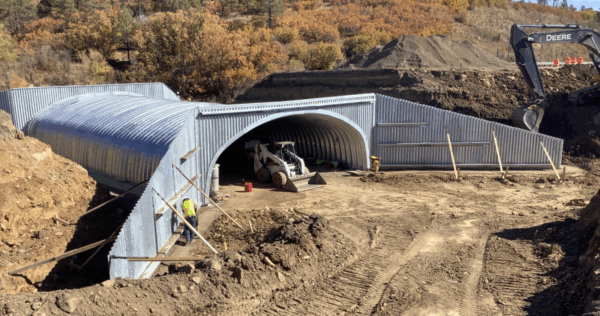
They essentially are a corrugated steel pipe or structural plate pipe systems that is “buried” with backfill to carry loads through soil-structure interaction. This means the bridge structure itself and the backfill soils surrounding the structure interact with each other to support the loads. In effect, the backfill material is part of the bridge.
Because of this interaction, the bridge structure is typically lighter, and there can be significant savings in structure costs.
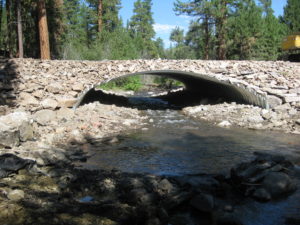
There are also many cases where buried bridges can carry heavier loads than traditional bridges because of the benefits of spreading vehicle loads through the fill. Buried bridges do not require abutments; and unless foundation soil conditions are poor, do not typically
require deep foundations.An additional benefit with buried bridges is that they can be tailored to site conditions and geometric requirements. The design includes inputs for site soils and backfill, meaning that locally available materials can often be used in construction and the structure can be tailored to fit the needs of the site and the owner’s requirements.
 Buried Bridge
NCSPA Releases Industry-Wide Environmental Product Declaration for Corrugated Steel Pipe
NCSPA has released a third-party verified Environmental Product Declaration (EPD) for corrugated steel pipe, providing standardized environmental information for engineers, owners, contractors and public agencies.
 Buried Bridge
Buried Steel Bridge Protects Wildlife and Motorists in New Mexico DOT Project
To improve safety and preserve wildlife corridors, the New Mexico DOT installed two steel structural plate buried bridges beneath I-25 at Raton Pass. Supplied by SSSBA member Contech, the crossings offer a durable, low-maintenance solution for both transportation and conservation.
 Buried Bridge
Buried Steel Bridge Preserves Streambed While Supporting Heavy Loads
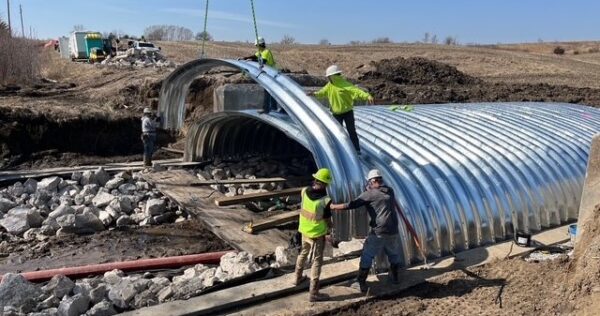
A new galvanized buried steel bridge in Riverside, Iowa, supplied by SSSBA member Lane Enterprises, replaced a weight-restricted structure and restored direct access for local farmers. Its open-bottom steel design preserves the natural streambed, enhances durability, and provides a cost-effective solution for rural infrastructure.
 Case Study
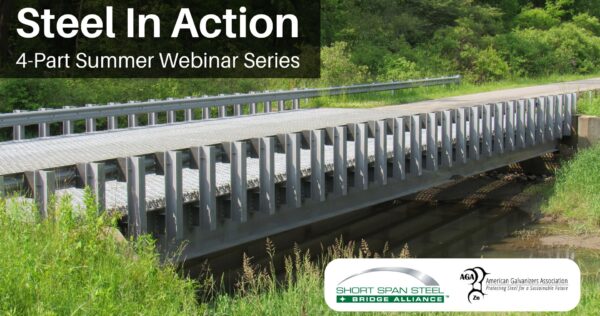
Steel in Action: On-Demand Steel Bridge Video Series
Watch this four-part, on-demand video series featuring expert-led case studies on cost-effective, resilient short span bridge projects—now available with downloadable presentation materials.
 News
News
NCSPA Announces 2025 Project of the Year Winners
The National Corrugated Steel Pipe Association announced the 2025 project of the year winners, including members of the Short Span Steel Bridge Alliance.
 Buried Bridge
Corrugated Steel Animal Overpass Reduces Wildlife-Vehicle Collisions
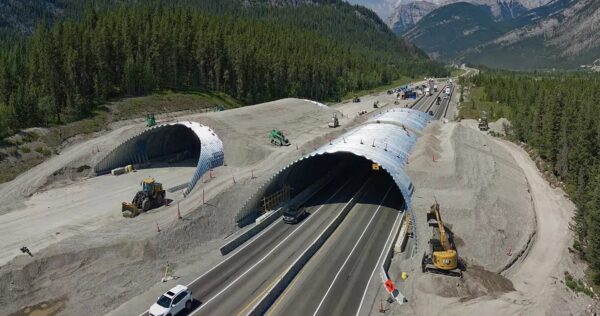
The corrugated steel Stoney Nakoda Exshaw Wildlife Arch in Western Canada showcases the balance of engineering and environmental stewardship, setting a new standard for wildlife-friendly infrastructure.