 Short Span Steel Bridges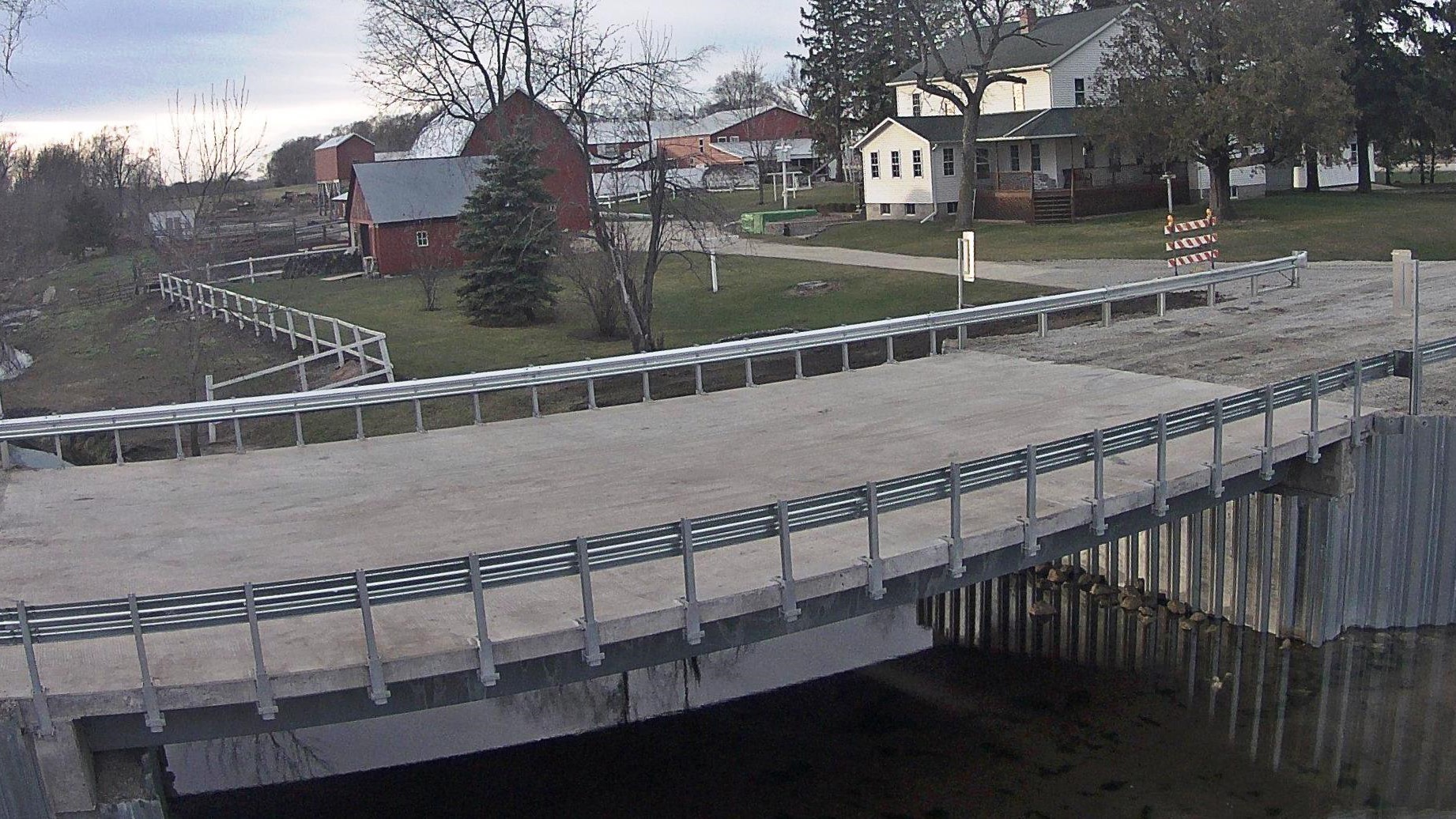
Amish Sawmill Bridge: An Innovative Steel Solution for Short Span Bridge Design
Project Overview
Visitors traveling near Fairbank, Iowa take a step back in time as they pass by large farms and horse-drawn buggies operated by the area’s large Amish population. At 1358 Dillon Avenue, they cross an unnamed creek via the Amish Sawmill Bridge. Newly constructed, this structure is the first of its kind in the United States and considered by experts to be the future of short span steel bridge design.

The original bridge was built in 1966.
A New, Cost-Effective Solution
Prior to the summer of 2015, the Amish Sawmill Bridge was a 24-foot by 30-foot timber structure with full concrete abutments and pier built in 1966 on the abutments from a prior bridge. Deemed structurally deficient and functionally obsolete by certified bridge inspectors, it was one of several bridges slated for replacement by Buchanan County, Iowa Engineer Brian Keierleber, P.E. and his team.
Through his involvement in the Short Span Steel Bridge Alliance (SSSBA), Keierleber learned about a new technology being developed for short span bridges (defined as 140 feet or less) that incorporated press-brake-formed steel tub girders and met the requirements for the Federal Highway Administration’s (FHWA) Innovative Bridge Research and Deployment (IBRD) program. In 2014, he applied for the $350,000 IBRD grant to replace the Amish Sawmill Bridge and received it on the basis of using a trapezoidal bent steel girder section supported on Geosynthetic Reinforced Soil (GRS).
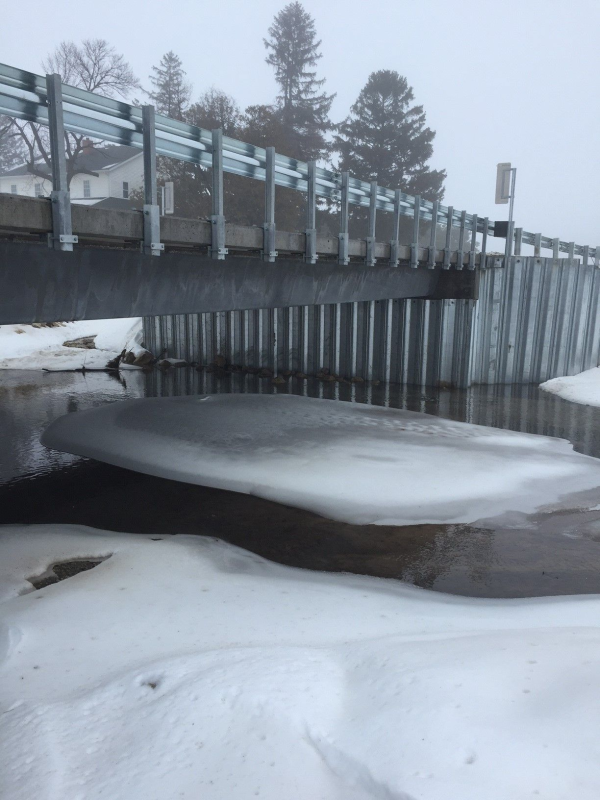
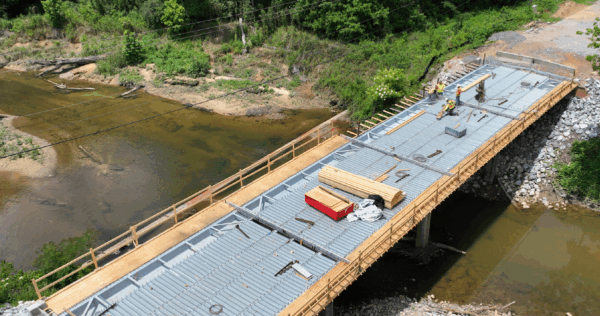
The project included the construction of GRS abutments with a sheet piling face.
The project included the construction of GRS abutments (which accelerates construction) with a sheet piling face and the placement of trapezoidal bent plate beams on the abutments. Stay-in-place forms were used prior to casting a deck in place. Local contractors were presented with different composite deck options for the bridge. The winning bid elected to utilize a cast-in-place option.
Construction on the Amish Sawmill Bridge began in late summer 2015 and was completed in December 2015. A local crew was not used since it was federally funded, but Keierleber notes: “The beauty of this project is that even though we were working with a new technology, no special expertise was required―it was standard bridge construction which could be undertaken by a local crew.”
The design was a collaborative effort between the SSSBA, the Iowa Department of Transportation and Buchanan County, Iowa. The bridge was built by Taylor Construction Inc. of New Vienna, Iowa. Funding was provided through the IBRD grant and supplemented by Buchanan County.
Brian Keierleber oversaw all aspects of the construction and installation of the new bridge, which is 52 feet long and 30 feet wide, and is pleased with the results. “We’re always looking for ways to cut costs because we have limited funding and lots of short span bridges that need replacing,” he said. “Some of the bridges in Buchanan County were in service when General Custer was alive, and we’ve had instances where they’ve collapsed under the weight of farm equipment. Press-brake-formed steel tub girder bridges offer us a durable and very cost-effective solution to meet our increasing transportation demands.”
The Amish Sawmill Bridge was dedicated on January 8, 2016, with several local and state legislators and media representatives present to witness bridge history.
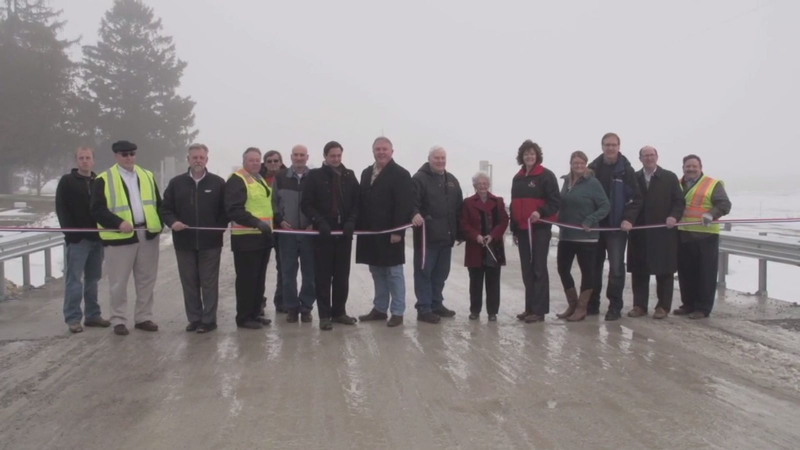
The Amish Sawmill Bridge was dedicated on January 8, 2016.
About Press-Brake-Formed Steel Tub Girder Technology
The press-brake-formed tub girder system consists of modular shallow trapezoidal boxes fabricated from cold-bent structural steel plate. Steel shapes are available in either hot-dipped galvanized or weathering steel options. Once the plate has been formed, shear studs are then welded to the top flanges. A reinforced concrete deck is then cast on the girder in the fabrication shop and allowed to cure, becoming a composite modular unit. Modules are then longitudinally joined using Ultra-High Performance Concrete (UHPC), a relatively new class of advanced cementitious composite materials.
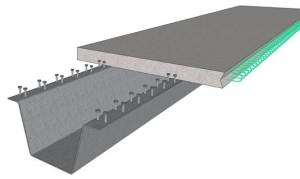
The press-brake-formed tub girder system consists of modular shallow trapezoidal boxes fabricated from cold-bent structural steel plate.
The system offers several advantages over traditional short span steel bridge solutions. The girder itself, which is available from the steel mill in standard plate thicknesses and widths, is simple to fabricate, requiring very little welding ― one girder can be produced in 45 minutes. Because of the system’s modular composite design, there is a reduced need for additional details such as stiffeners or cross-frames. Due to the system’s modular nature, the composite unit can be easily shipped to the bridge site, allowing for accelerated construction and reduced traffic interruptions.
While modular precast concrete decks are recommended, multiple deck options are available, such as the use of full-depth/partial-depth precast concrete deck panels,cast-in-place concrete decks, or more advanced composite decks such as the Sandwich Plate System, a structural composite material comprising two metal plates bonded with a polyurethane elastomer core.
The system offers significant cost savings. It is recommended for single spans up to 60 feet in length (due to plate availability and typical press-brake lengths), but girders can easily be spliced for spans up to 80 feet.
Ongoing Testing Documents Strength and Opportunity for Design Efficiencies
The new Amish Sawmill Bridge is providing valuable data to researchers from West Virginia University, Marshall University, the University of Wyoming and Iowa State University. Additional testing is being conducted to measure performance and identify further efficiencies that can be realized for future designs.
Testing initiated in June 2016 is demonstrating the strength and durability of the new technology, which exceeds AASHTO requirements for capacity. Based on early results, the researchers are confident that future design efficiencies can be achieved with this system.
Amish Sawmill Bridge Project Team:
County Engineer
Buchanan County, Iowa Secondary Roads Department
Brian Keierleber, P.E.
Tel: 319.334.6031
Email: engineer@co.buchanan.ia.us
http://www.co.buchanan.ia.us/
Bridge Contractor
Taylor Construction, Inc.
Krista Taylor
Tel: 563.921.2315
Bridge Fabricator
U.S. Bridge
Dan Rogovin
Tel: 740.421.9338
Email: drogovin@usbridge.com
http://www.usbridge.com
Press-Brake Forming
AT&F
Paul Horbaly
Tel: 216.225.2657
Email: horbalyp@atfco.com
http://www.atfco.com/
What are Press Brake Tub Girders?
Press-brake-formed tub girder (PBTG) is a new technology for short span bridge applications. It consists of modular galvanized shallow trapezoidal boxes fabricated from cold-bent structural steel plate (watch fabrication video). A concrete deck is recommended to be precast on the girder and the modular unit can be shipped by truck to the bridge site.

The system utilizes standard plate widths (based on availability) and is optimized to achieve maximum structural capacity, with most of the steel in the bottom flange and increased torsional stiffness. It is a closed system, since the girder is closed at the bottom. It is versatile for multiple-deck options.
The system utilizes Accelerated Bridge Construction practices, since it:
- Can be installed in one or two days
- Is modular, allowing the use of a precast deck
- Is cost-effective―as much as 1/3 less than a standard concrete girder structure
- Is simple to fabricate, requiring very little welding.

The Short Span Steel Bridge Alliance has developed standardized plans using standard plate sizes (60”, 72” 84”, 96”, 108”, 120”). The designs were developed to achieve maximum structural capacity and are available to use in the free-to-use, web-based design tool eSPAN140.
The press-brake-formed tub girder system is open source.
 Case Study
Steel in Action: On-Demand Steel Bridge Video Series
Watch this four-part, on-demand video series featuring expert-led case studies on cost-effective, resilient short span bridge projects—now available with downloadable presentation materials.
 Press Brake & Folded Plate
New Specs, New Opportunities for Press-Brake Tub Girders
Valmont Structures developed a summary outlining how the new AASHTO 10th Edition Bridge Design Specifications impact the use of press-brake tub girders (U-BEAMS) in bridge construction.
 Press Brake & Folded Plate
Press-Brake Tub Girder Delivers Modern Upgrade for Historic Alabama County Bridge
After over 80 years of wear from daily traffic, the Parkwood Road Bridge was upgraded with Valmont’s U-BEAM™ system to enhance safety and streamline construction.