 Short Span Steel Bridges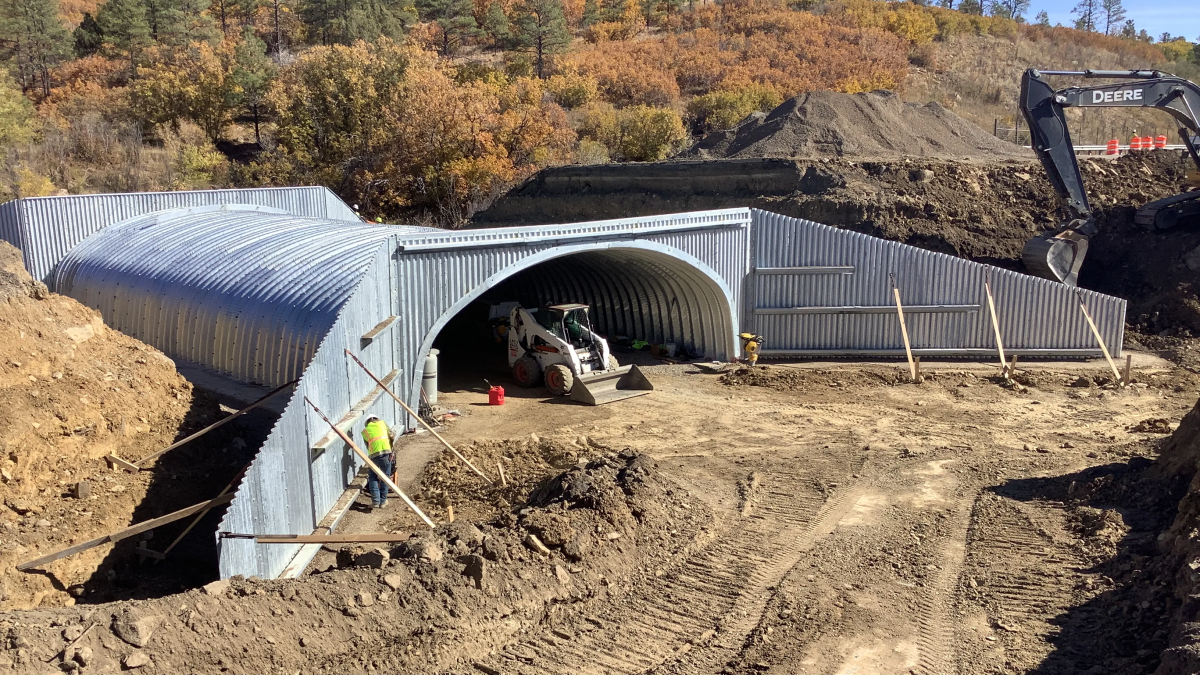
Buried Steel Bridge Protects Wildlife and Motorists in New Mexico DOT Project
Article provided by Contech Engineered Solutions and the National Corrugated Steel Pipe Association
The New Mexico DOT I-25 Raton project involved creating two animal passages using two deep corrugated structural plate buried bridges. One goes under the Northbound lanes and one goes under the Southbound lanes.
The Raton pass portion of I-25 is 21.8 miles long, linking the cities of Raton in Colfax County in northeastern New Mexico and Trinidad in Las Animas County, Colorado.
This area of the country is well known for its beautiful scenery and its ecosystem that is home to many species of wildlife.
Wildlife Safety and the Corridors Act
The Wildlife Corridors Act directs the New Mexico State Department of Transportation (NMDOT) and the New Mexico Department of Game and Fish to work together to prioritize wildlife-vehicle collision hot spots and critical wildlife corridors for the purposes of improving driver safety and maintaining habitat connectivity for elk, deer, black bear, bighorn sheep, pronghorn, and mountain lion.
Wildlife can create life-threatening hazards on roadways. In the United States, there are more than a million automobile accidents per year involving wildlife, racking up more than $8 billion in medical costs and vehicle repairs annually and also endanger the wildlife and ecosystem.
Steel Structural Plate Design Advantages
Instead of using conventional bridges with long term maintenance and ice issues on this dangerous stretch of highway, NMDOT decided to use custom size BridgeCor structures that met the wildlife openness ratio for the animal crossings under I-25 at Raton Pass and offered a savings over conventional bridges while protecting both drivers and especially the black bear population in the area.
Construction and Specifications
Although the project bid in late 2020 the construction of the first bridge under the Southbound lanes didn’t begin until the Fall of 2021. The buried bridges are both identical structures in terms of span, rise, gage, and corrugation pattern.
The Southbound lane bridge is 64′ long and the Northbound lane bridges is 70′ long. The structures are 32′ 10″ span x 11′ 7″ rise, 7 gage, Deep Corrugated Steel Structural Plate Box Culverts meeting AASHTO M 167 with 15″ x 5.5″ corrugations.
Since the span of the structures is in excess of 20′, this designates them as “bridges” and they are now on the New Mexico bridge inventory list as Bridges 9789 and 9790. Finite Element Analysis designed the structure using CANDE software. The structure, headwalls and wingwalls were all made from galvanized steel. They are Steel Structural Plate with 6″ x 2″ corrugations. The Northbound lanes structure was completed in the Fall of 2023.
What are buried steel bridges?
Buried steel bridges provide an economical choices for bridge replacement or bridge rehabilitation.
They essentially are a corrugated steel pipe or structural plate pipe systems that is “buried” with backfill to carry loads through soil-structure interaction. This means the bridge structure itself and the backfill soils surrounding the structure interact with each other to support the loads. In effect, the backfill material is part of the bridge.
Because of this interaction, the bridge structure is typically lighter, and there can be significant savings in structure costs.
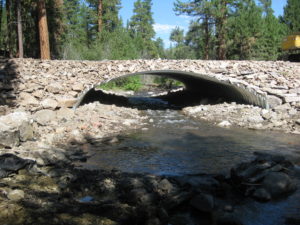
There are also many cases where buried bridges can carry heavier loads than traditional bridges because of the benefits of spreading vehicle loads through the fill. Buried bridges do not require abutments; and unless foundation soil conditions are poor, do not typically
require deep foundations.An additional benefit with buried bridges is that they can be tailored to site conditions and geometric requirements. The design includes inputs for site soils and backfill, meaning that locally available materials can often be used in construction and the structure can be tailored to fit the needs of the site and the owner’s requirements.
 Buried Bridge
Buried Steel Bridge Preserves Streambed While Supporting Heavy Loads
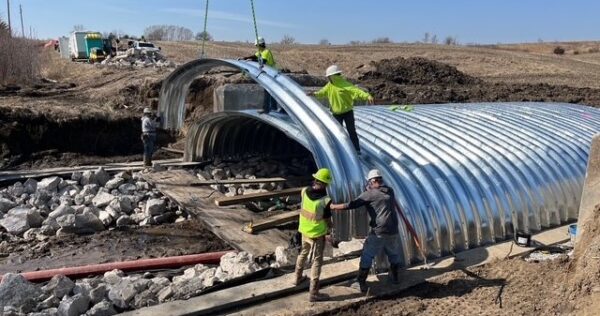
A new galvanized buried steel bridge in Riverside, Iowa, supplied by SSSBA member Lane Enterprises, replaced a weight-restricted structure and restored direct access for local farmers. Its open-bottom steel design preserves the natural streambed, enhances durability, and provides a cost-effective solution for rural infrastructure.
 Case Study
Steel in Action: On-Demand Steel Bridge Video Series
Watch this four-part, on-demand video series featuring expert-led case studies on cost-effective, resilient short span bridge projects—now available with downloadable presentation materials.
 News
News
NCSPA Announces 2025 Project of the Year Winners
The National Corrugated Steel Pipe Association announced the 2025 project of the year winners, including members of the Short Span Steel Bridge Alliance.
 Buried Bridge
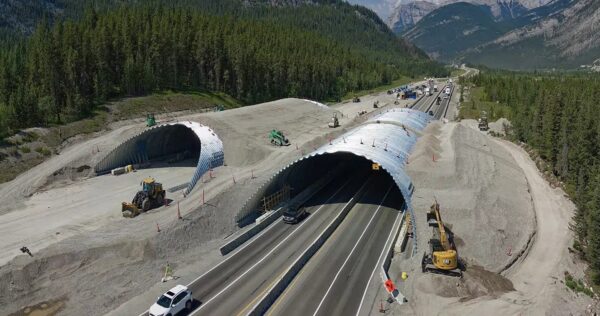
Corrugated Steel Animal Overpass Reduces Wildlife-Vehicle Collisions
The corrugated steel Stoney Nakoda Exshaw Wildlife Arch in Western Canada showcases the balance of engineering and environmental stewardship, setting a new standard for wildlife-friendly infrastructure.
 Buried Bridge
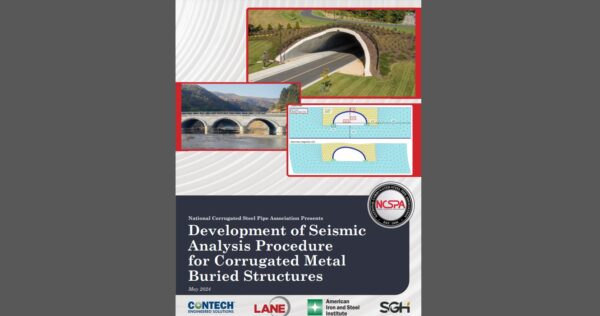
NCSPA Releases Report to Simplify the Seismic Design for Buried Structures
The National Corrugated Steel Pipe Association (NCSPA) released a groundbreaking report that simplifies the seismic design for buried structures including culverts, tunnels and buried steel bridges.
 Buried Bridge
Buried Steel Bridge Reconnects Aquatic Habitat for Alabama County
St. Clair County, Alabama, restored critical habitats for endangered species by replacing two polyethylene culverts with a buried steel bridge to reconnect a fragmented aquatic ecosystem.