 Short Span Steel Bridges
Buried Steel Bridge Reconnects Aquatic Habitat for Alabama County
Article provided by Contech Engineered Solutions and the National Corrugated Steel Pipe Association
In Alabama, several organizations have collaborated to improve habitats for endangered species. The Cawaco Resource Conservation & Development Council, U.S. Fish and Wildlife Service and other partners have been working together on projects that replace culverts.
These culvert replacement projects in Alabama aim to restore the natural flow of streams, helping aquatic species move freely through their habitats.
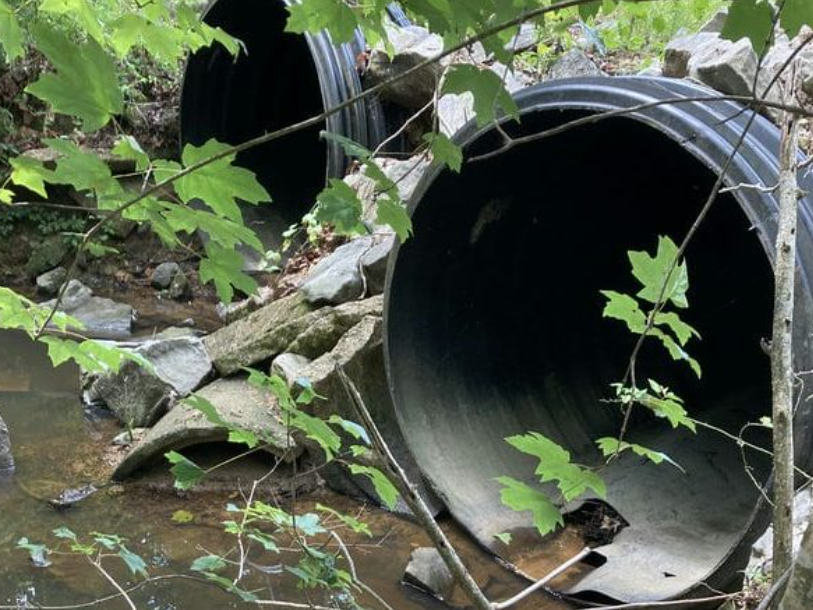
Funded primarily by the National Fish and Wildlife Foundation’s Southeast Aquatics Fund, the project used steel to replace two high-density polyethylene (HDPE) pipe culverts that had become perched, impeding fish passage.
Replacing Culverts for Better Fish Passage
The goal of the project is to reconnect fragmented aquatic habitats. This is done by replacing deteriorating or improperly sized culverts with structures that are more “fish-friendly.” The new designs help restore the natural hydrological conditions, allowing aquatic species to migrate more easily.
Additionally, the open-bottom culverts used in these projects tend to last longer. Without an invert in contact with water, they experience less wear and tear. In this context, culvert replacement in Alabama has proven to be an effective measure.
This particular project, funded primarily by the National Fish and Wildlife Foundation’s Southeast Aquatics Fund, replaced two culverts made of high-density polyethylene (HDPE) pipe. The original culverts had become perched, which made it difficult for fish to pass through.
Location and Importance of the Project
The St. Clair County Road Department Crew led the construction of the project in St. Clair County, Alabama. They installed a new culvert that now spans a stream, providing seasonal spawning habitat for the federally threatened Trispot Darter. The previous culvert design had blocked the darter’s migration route, disrupting its natural movement.
Native to streams in northern Georgia and southern Tennessee, the Trispot Darter was thought to be extinct for seven years until its rediscovery in 1967. Once common in the Alabama River system, its population has sharply declined due to human development. Efforts like culvert replacements in Alabama aim to reverse this trend. Now, the species primarily lives in Alabama’s Big Canoe Creek and the Conasauga River system. The survival of its eggs depends heavily on water quality, particularly silt levels and temperature.
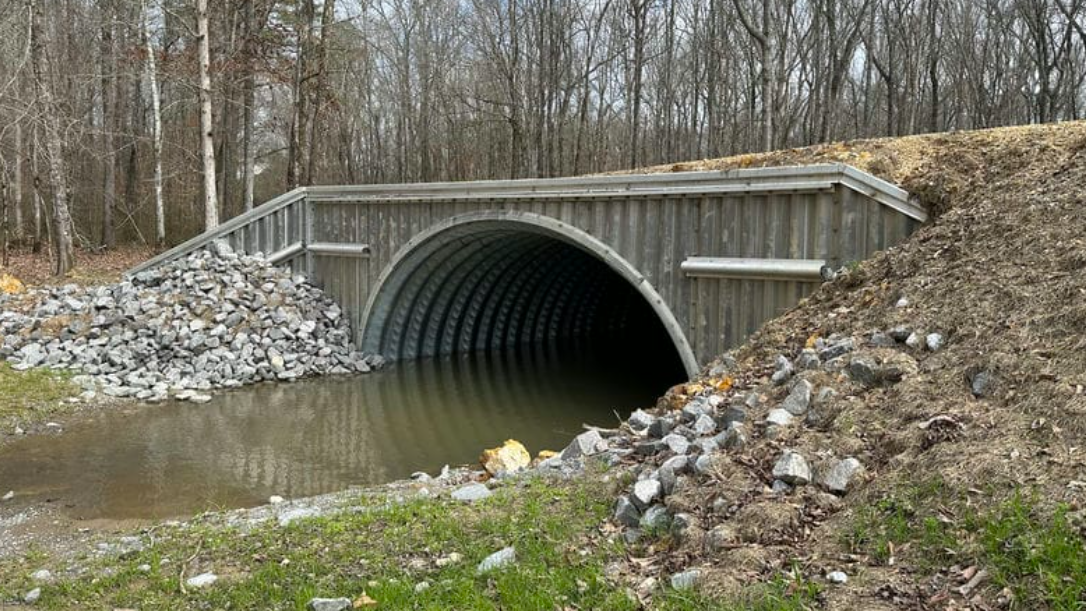
The project used Contech’s advanced deep-corrugated, galvanized structural plate arch and Steel Express Foundations. The prefabricated steel foundations eliminated the need for on-site formwork and reinforcing steel, significantly accelerating the installation process.
Construction Process and Materials
The project utilized advanced technology from Contech, featuring a deep-corrugated, galvanized structural plate arch. The bottomless culvert measured 56.5 feet long, with an 18-foot 5-inch span and an 8-foot 4-inch rise. This approach demonstrates the cutting-edge culvert replacement techniques being applied in Alabama.
The team used Contech’s Steel Express Foundations to accelerate installation. These prefabricated steel foundations, measuring 2 feet 9 inches wide by 2 feet deep, eliminated the need for on-site formwork and reinforcing steel, which significantly sped up the construction. They also installed aluminum structural plate headwalls and wingwalls as end treatments for the culvert.
Conclusion and Collaboration
Specialist contractor Platinum Erectors assembled the arch, foundations, and end treatments. The St. Clair County Road Department Crew then completed the backfilling and other installation tasks. This collaborative effort has not only improved fish passage but also restored an important habitat for the Trispot Darter and other aquatic species. The success of this project underscores the importance of culvert replacement initiatives in Alabama.
What are buried steel bridges?
Buried steel bridges provide an economical choices for bridge replacement or bridge rehabilitation.
They essentially are a corrugated steel pipe or structural plate pipe systems that is “buried” with backfill to carry loads through soil-structure interaction. This means the bridge structure itself and the backfill soils surrounding the structure interact with each other to support the loads. In effect, the backfill material is part of the bridge.
Because of this interaction, the bridge structure is typically lighter, and there can be significant savings in structure costs.
There are also many cases where buried bridges can carry heavier loads than traditional bridges because of the benefits of spreading vehicle loads through the fill. Buried bridges do not require abutments; and unless foundation soil conditions are poor, do not typically
require deep foundations.An additional benefit with buried bridges is that they can be tailored to site conditions and geometric requirements. The design includes inputs for site soils and backfill, meaning that locally available materials can often be used in construction and the structure can be tailored to fit the needs of the site and the owner’s requirements.
 Buried Bridge
Buried Steel Bridge Preserves Streambed While Supporting Heavy Loads
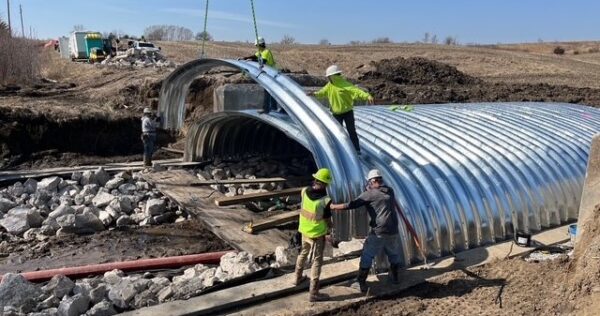
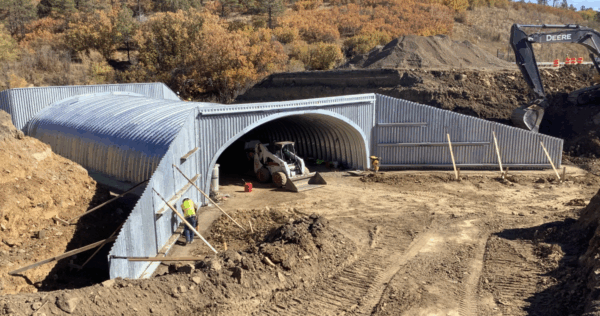
A new galvanized buried steel bridge in Riverside, Iowa, supplied by SSSBA member Lane Enterprises, replaced a weight-restricted structure and restored direct access for local farmers. Its open-bottom steel design preserves the natural streambed, enhances durability, and provides a cost-effective solution for rural infrastructure.
 Buried Bridge
Buried Steel Bridge Protects Wildlife and Motorists in New Mexico DOT Project
The New Mexico DOT buried steel bridge project, featuring SSSBA member Contech’s custom structural plate design, was honored as the NCSPA Project of the Year for its innovative wildlife crossing solution on I-25 at Raton Pass.
 Case Study
Steel in Action: On-Demand Steel Bridge Video Series
Watch this four-part, on-demand video series featuring expert-led case studies on cost-effective, resilient short span bridge projects—now available with downloadable presentation materials.
 News
News
NCSPA Announces 2025 Project of the Year Winners
The National Corrugated Steel Pipe Association announced the 2025 project of the year winners, including members of the Short Span Steel Bridge Alliance.
 Buried Bridge
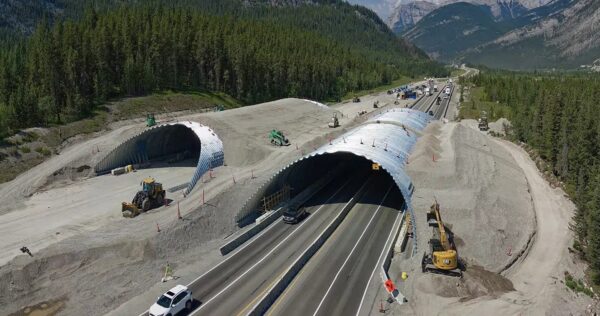
Corrugated Steel Animal Overpass Reduces Wildlife-Vehicle Collisions
The corrugated steel Stoney Nakoda Exshaw Wildlife Arch in Western Canada showcases the balance of engineering and environmental stewardship, setting a new standard for wildlife-friendly infrastructure.
 Buried Bridge
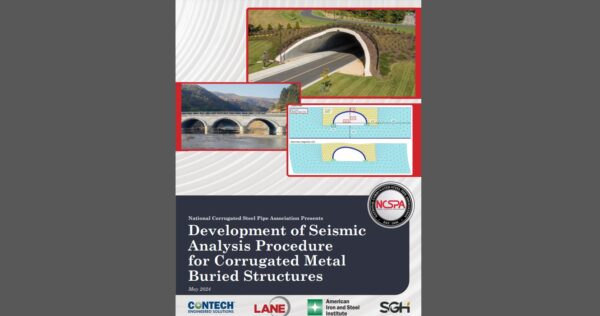
NCSPA Releases Report to Simplify the Seismic Design for Buried Structures
The National Corrugated Steel Pipe Association (NCSPA) released a groundbreaking report that simplifies the seismic design for buried structures including culverts, tunnels and buried steel bridges.