 Short Span Steel Bridges
Steel Plate Arch Buried Bridge Provides Natural Pathway for Fish to Spawn
Article provided by TrueNorth Steel and the National Corrugated Steel Pipe Association (NCSPA)
NCSPA Project Spotlight: Falcon Ridge 11.5′ Fish Passage Structure
The Idaho Soil and Water Conservation District sponsors various projects with grants and engineering for land owners with fish bearing streams to access their land and provide easy fish passage for the local spawning trout and steel head.
The engineer worked with TrueNorth Steel to develop a proper geometry for the site, cost estimates for project feasibility and selected an 11.5’ by 20’ – 10ga 3×1 ALT2 steel plate arch.

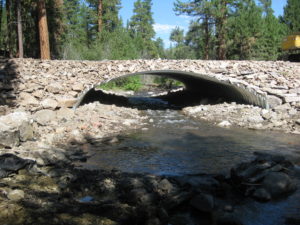
The Idaho Soil and Water Conservation District replaced this existing buried bridge with a bottomless structural steel plate arch fish passage structure to provide a natural pathway for fish to spawn annually.
The steel plate arch is a bottomless structure to provide a natural pathway for fish to spawn annually. Using this structural steel plate arch allows for either footing pads or spread footings and either option requiring embedment below scour depth.
In order to maintain the vertical rise of the structure, spread footings were chosen over the corrugated footing pads. The added benefit with the spread footings, it allowed the installing contractor to simulate the stream bed after the footings were installed and before the structural steel plate arch was installed. The contractor now the ability to place the river rock with an excavator, opposed to hand placement.

Based on cost estimates for project feasibility, a 11.5’ by 20’ – 10ga 3×1 ALT2 steel plate arch was selected for the replacement project.
With limited easement access, corrugated metal headwalls and wingwalls were used to maintain a maximum allowable travel way width for the gravel wearing surface. Dead man anchors and wale beams provided the fortitude for the headwalls and wingwalls.

The new Falcon Ridge fish passage structure provides for easy fish passage for the local spawning trout and steel head.
Special thanks to the following for making this project come alive:
- Major Sponsor: Idaho Soil and Water Conservation District
- Landowner Contact: Nathaniel Davis
- Technical Contact: Eileen Rowan and Bill Lillibridge, Idaho Soil and Water Conservation Commission
- Contractor: Gordon Eckel, Flash Excavation Inc.
What are buried steel bridges?
Buried steel bridges provide an economical choices for bridge replacement or bridge rehabilitation.
They essentially are a corrugated steel pipe or structural plate pipe systems that is “buried” with backfill to carry loads through soil-structure interaction. This means the bridge structure itself and the backfill soils surrounding the structure interact with each other to support the loads. In effect, the backfill material is part of the bridge.
Because of this interaction, the bridge structure is typically lighter, and there can be significant savings in structure costs.
There are also many cases where buried bridges can carry heavier loads than traditional bridges because of the benefits of spreading vehicle loads through the fill. Buried bridges do not require abutments; and unless foundation soil conditions are poor, do not typically
require deep foundations.An additional benefit with buried bridges is that they can be tailored to site conditions and geometric requirements. The design includes inputs for site soils and backfill, meaning that locally available materials can often be used in construction and the structure can be tailored to fit the needs of the site and the owner’s requirements.
 Events
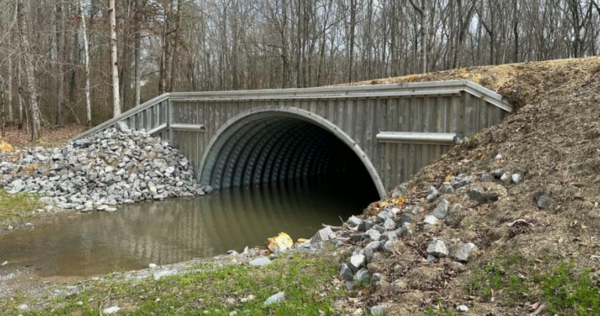
Free Webinar: Designing Stream Crossings to Improve Fish Passage and Flood Resiliency (April 23)
Join SSSBA member Contech Engineered Solutions for a webinar on Aquatic Organism Passage (AOP) and stream simulation design. Learn how properly sized bridges and culverts improve fish passage, strengthen flood resilience, and support long-term infrastructure performance.
 Buried Bridge
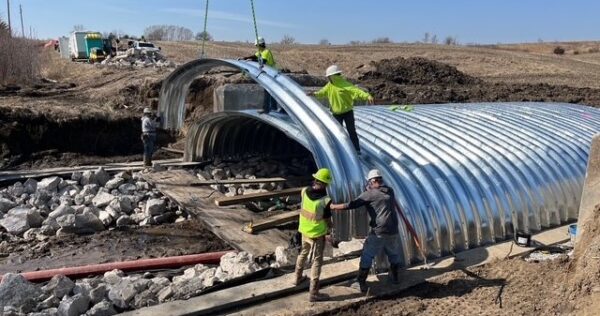
Buried Steel Bridge Preserves Streambed While Supporting Heavy Loads
A new galvanized buried steel bridge in Riverside, Iowa, supplied by SSSBA member Lane Enterprises, replaced a weight-restricted structure and restored direct access for local farmers. Its open-bottom steel design preserves the natural streambed, enhances durability, and provides a cost-effective solution for rural infrastructure.
 Buried Bridge
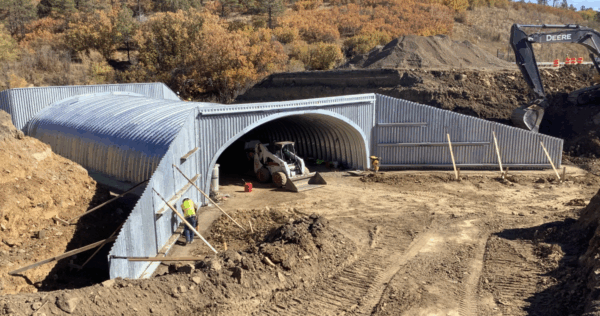
Buried Steel Bridge Protects Wildlife and Motorists in New Mexico DOT Project
The New Mexico DOT buried steel bridge project, featuring SSSBA member Contech’s custom structural plate design, was honored as the NCSPA Project of the Year for its innovative wildlife crossing solution on I-25 at Raton Pass.
 Case Study
Steel in Action: On-Demand Steel Bridge Video Series
Watch this four-part, on-demand video series featuring expert-led case studies on cost-effective, resilient short span bridge projects—now available with downloadable presentation materials.
 News
News
NCSPA Announces 2025 Project of the Year Winners
The National Corrugated Steel Pipe Association announced the 2025 project of the year winners, including members of the Short Span Steel Bridge Alliance.
 Buried Bridge
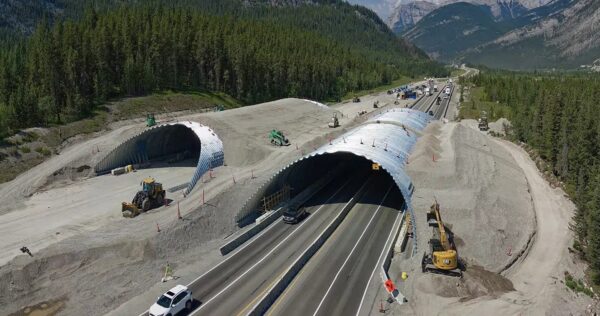
Corrugated Steel Animal Overpass Reduces Wildlife-Vehicle Collisions
The corrugated steel Stoney Nakoda Exshaw Wildlife Arch in Western Canada showcases the balance of engineering and environmental stewardship, setting a new standard for wildlife-friendly infrastructure.