 Short Span Steel Bridges
Flexible Buried Bridges: Advantages and Applications (Part 1)
Article provided by the Contech Engineered Solutions as seen in the December 2021 issue of Informed Infrastructure Magazine. Click here to access the full article and take the PDH quiz with AIA LU/PDH credit in all states.
What Are Structural-Plate Buried Structures?
Structural-plate buried structures consist of multiple metal plates that are corrugated, shaped to a specific curvature, hot-dipped galvanized (when made of steel), and bolted together in the field to construct large culvert or clear-span arch bridge crossings.
After assembly, they are back-filled using granular soil to complete the bridge crossing. They are considered flexible structures that work via soil-structure interaction, where the structure and surrounding engineered back-fill work together to support the design loads.

Figure 1. Assembly for a typical bridge installation. (Massachusetts DOT; Attleboro, Mass.)
The History of Flexible Buried Bridges
Structural plate has been in use for more than 90 years. It originally served as a large-diameter alternative to corrugated metal pipe (CMP) for use in hydraulic applications where CMP could not be efficiently built large enough to satisfy hydraulic requirements or where bottomless (arch- or box-shaped) structures were needed. Original corrugation profiles were relatively shallow (6” x 2” or 9” x 2.5”), which limited the available structural-plate span length.
Since the development of deep corrugation profiles (those with greater than 5” corrugation depth) about 40 years ago, there has been a gradual increase in the use of structural plate for longer-span hydraulic crossings and grade-separation applications where conventional bridges have historically been used. This has resulted in the emergence of “Flexible Buried Bridges,” which are structural-plate structures with a span of greater than 20 feet—the AASHTO definition for the minimum span of a structure considered a bridge.
Modern Applications
Today, flexible buried bridges are widely considered an attractive and economical alternative for short- to medium-span conventional bridge crossings. They offer a wide range of benefits, including basic economy, construction advantages, ease of transportation, environmental benefits, low maintenance costs, increased resilience and other factors. The use of these structures has been made possible by advancements in design and analysis tools, manufacturing capabilities, materials, and development of deeper corrugation profiles to allow for longer spans, heavier loads and higher cover.
Flexible buried bridges have demonstrated excellent performance in areas impacted by seismic events. These types of structures have historically performed very well compared to other bridge types in seismic events, typically remaining functional as a lifeline and often requiring little to no repair or remediation afterward. Recent studies on seismic demands have found that seismic loading does not govern most flexible buried bridge designs.
To date, flexible buried bridges have been constructed in spans exceeding 100 feet and have been designed to carry rail loads, large agricultural vehicles, mining equipment, large off-road construction equipment, and other special loads that are much heavier than typical highway design loading. Cover can range from as low as 2 feet to more than 50 feet, depending on the structure size and shape as well as project conditions.

Figure 2. A buried bridge supports a 2.7-million-pound mining shovel and 12-foot cover. (New Mexico DOT; Grants, N.M.)
There have been several webinars, workshops and articles sponsored by a number of organizations during the last several years addressing various aspects of design, construction and performance of flexible buried bridges. This article provides guidance on the considerations for design of flexible buried bridges and how they can be considered as an alternative to conventional bridge applications.
Why Consider Flexible Buried Bridges?
There is a flexible buried bridge option for just about any short- to medium-span crossing need. The most common applications have been bridges spanning across minor natural water courses.
However, because of the aforementioned recent advances, flexible buried bridges also are becoming more common for:
- Grade Separations (crossings where traffic passes through the bridge and over it)
- Wildlife Crossings (wildlife crossing over the bridge with traffic passing through it or vice versa)
- In-Place Bridge Replacements (building a new buried bridge beneath an existing conventional bridge without detouring traffic)
- Bridge Replacements in Remote Areas
- Other Applications
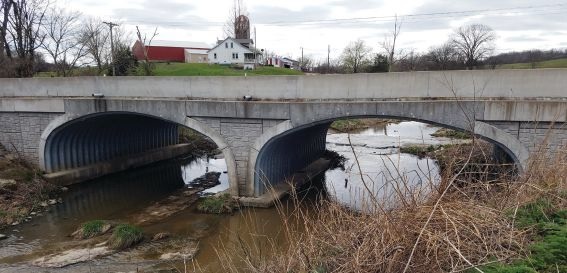
Figure 3. A bridge replacement with twin-span buried bridges. (Missouri DOT; Cape Girardeau County, Mo.)
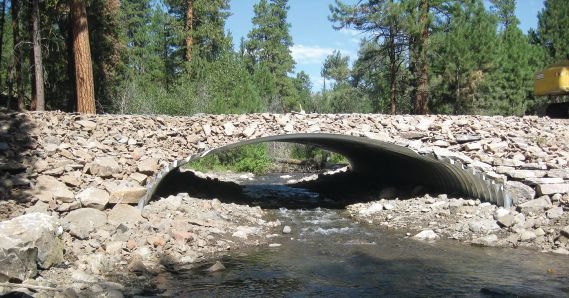
Figure 4. A bridge replacement in a remote location. (USDA Forest Service; Unity, Ore.)
Flexible Buried Bridge Advantages
The advantages of using flexible buried bridges will vary based on project-specific considerations. However, the most-common benefits of using flexible buried bridges as an alternative to conventional bridges tend to be lower overall project cost, better fit based on site geometric limitations, constructability, speed of construction, and design advantages. Additional benefits may include but are not limited to:
- Site geometric limitations (road alignment, right of way, grading challenges, minimizing project footprint)
- Project location (remote area, congested urban area)
- Project schedule/material availability (need to accelerate material delivery or design-submittal process)
- Skill or experience of construction labor force (desire to use local or inhouse labor)
- Completed project cost
- Long-term maintenance and inspection cost
- Construction equipment requirements (lack of space for cranes or need to reduce equipment costs)
- Design challenges and considerations (heavy loads, load rating, seismic/settlement concerns, clearance requirements)
- Speed of construction (minimize traffic disruption and/or onsite construction time)
- Aesthetics (blend with surroundings, achieve a desired look)
- Resilience and environmental factors (ability to function after an extreme event such as seismic, flooding and damage; design for future needs; sustainability)
- Improved safety (no bridge deck to ice up, wider shoulders and walkways with potential to economically increase bridge width)
- Other unique, project-specific factors
Additional Advantages
An additional advantage gaining more attention given shrinking agency budgets is lower long-term inspection and maintenance costs.
Flexible buried bridges consist of two basic bridge elements: the structure plates and connecting hardware (nuts and bolts). These structures eliminate bridge decks, which are a common maintenance challenge for bridge owners and expensive to rehabilitate.
There are no bearings, joints, drains, abutments or other common bridge details that need to be regularly inspected or maintained.
Inspection is simple, consisting of visual observations of the condition of the structure, spot measurements of the shape and general site observations.
Maintenance on the interior may involve periodic cleaning and/or removal of silt or unwanted vegetation, depending on the application (grade separation vs. hydraulic crossing). At the road level, only routine pavement maintenance is required, which is far less expensive than bridge-deck repair.
Continuing Reading Part 2 – Flexible Buried Bridges: Design and Construction (Part 2)
Author
Joel Hahm, P.E.
Contech Engineered Solutions
Joel.Hahm@ContechES.com
References
- AASHTO LRFD Bridge Design Specifications (9th Edition, 2020)
- AASHTO M145, Standard Specification for Classification of Soils and Soil-Aggregate Mixtures for Highway Construction Purposes
What are buried steel bridges?
Buried steel bridges provide an economical choices for bridge replacement or bridge rehabilitation.
They essentially are a corrugated steel pipe or structural plate pipe systems that is “buried” with backfill to carry loads through soil-structure interaction. This means the bridge structure itself and the backfill soils surrounding the structure interact with each other to support the loads. In effect, the backfill material is part of the bridge.
Because of this interaction, the bridge structure is typically lighter, and there can be significant savings in structure costs.
There are also many cases where buried bridges can carry heavier loads than traditional bridges because of the benefits of spreading vehicle loads through the fill. Buried bridges do not require abutments; and unless foundation soil conditions are poor, do not typically
require deep foundations.An additional benefit with buried bridges is that they can be tailored to site conditions and geometric requirements. The design includes inputs for site soils and backfill, meaning that locally available materials can often be used in construction and the structure can be tailored to fit the needs of the site and the owner’s requirements.
 Buried Bridge
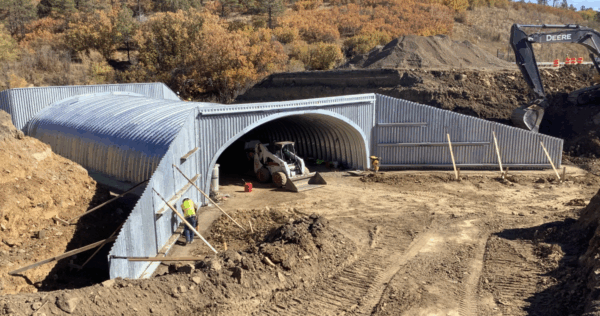
Buried Steel Bridge Preserves Streambed While Supporting Heavy Loads
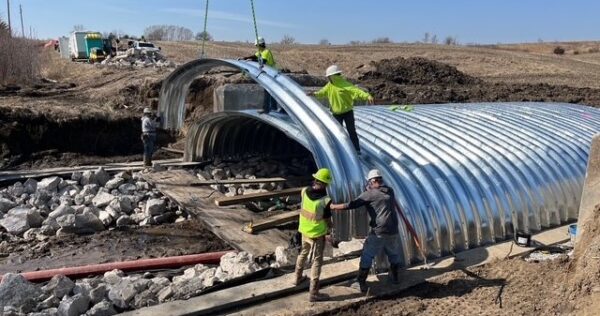
A new galvanized buried steel bridge in Riverside, Iowa, supplied by SSSBA member Lane Enterprises, replaced a weight-restricted structure and restored direct access for local farmers. Its open-bottom steel design preserves the natural streambed, enhances durability, and provides a cost-effective solution for rural infrastructure.
 Buried Bridge
Buried Steel Bridge Protects Wildlife and Motorists in New Mexico DOT Project
The New Mexico DOT buried steel bridge project, featuring SSSBA member Contech’s custom structural plate design, was honored as the NCSPA Project of the Year for its innovative wildlife crossing solution on I-25 at Raton Pass.
 Case Study
Steel in Action: On-Demand Steel Bridge Video Series
Watch this four-part, on-demand video series featuring expert-led case studies on cost-effective, resilient short span bridge projects—now available with downloadable presentation materials.
 News
News
NCSPA Announces 2025 Project of the Year Winners
The National Corrugated Steel Pipe Association announced the 2025 project of the year winners, including members of the Short Span Steel Bridge Alliance.
 Buried Bridge
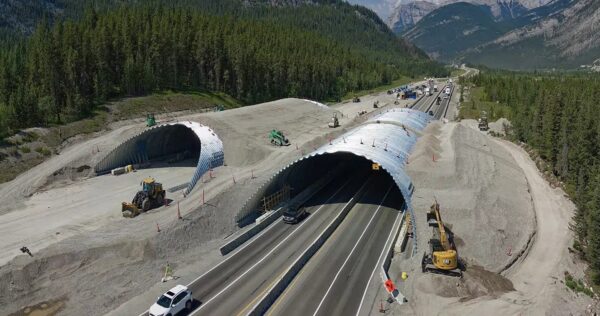
Corrugated Steel Animal Overpass Reduces Wildlife-Vehicle Collisions
The corrugated steel Stoney Nakoda Exshaw Wildlife Arch in Western Canada showcases the balance of engineering and environmental stewardship, setting a new standard for wildlife-friendly infrastructure.
 Buried Bridge
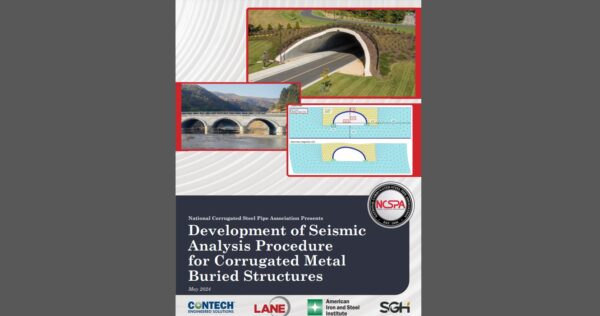
NCSPA Releases Report to Simplify the Seismic Design for Buried Structures
The National Corrugated Steel Pipe Association (NCSPA) released a groundbreaking report that simplifies the seismic design for buried structures including culverts, tunnels and buried steel bridges.