 Short Span Steel Bridges
Leadership of the American Steel Industry in the Green Economy
The American Iron and Steel Institute develop a new blog, the American Steel Chronicles. It was created to discuss important issues and current events in the American steel industry. The following is a repost of the first topic – sustainability (read original blog post)
Sustainability – and the Leadership of the American Steel Industry in the Green Economy

Kevin Dempsey is the President and CEO of the American Iron and Steel Institute.
By Kevin Dempsey, President and CEO of the American Iron and Steel Institute
Even though Earth Day 2023 has ended, every day is Earth Day for the American Steel Industry. Steel is the EnviroMetal™ and here’s why:
The American steel industry is the cleanest of the leading steel industries in the world. Of the major steel-producing countries, the U.S. has the lowest CO₂ emissions per ton of steel produced. By contrast, Chinese steel production creates carbon emissions that are nearly twice that of the U.S. per ton of steel produced.
The global steel industry contributes eight percent of total world greenhouse gas (GHG) emissions, whereas the U.S. steel industry only accounts for one-to-two percent of total U.S. GHG emissions.
Leadership in Decarbonization
There are several reasons for the American steel industry’s leadership in decarbonization. A key factor is that the American steel industry has adopted electric arc furnace (EAF) technology at a much more accelerated rate than the global industry. A little over 69.2 percent of the steel produced in the U.S. in 2021 was from EAFs, compared to 28.9 percent globally.
In addition, the American steel industry operates blast furnaces that are among the most carbon efficient in the world. Integrated steel mills in the U.S. are almost entirely fed by domestically sourced iron ore pellets compared to CO2-intensive sintered ore used in China and elsewhere, resulting in significantly lower emissions of CO₂, as well as lower emissions of NOx, SO₂ and particulate matter.
Also, the emissions factors associated with the energy mix used for steelmaking in the United States are lower than in other steel-producing locations in the world, with much more reliance on natural gas and renewable energy. This cleaner energy mix helps produce the lowest CO2 emissions steel. The American steel industry is continuing to invest in clean energy to provide the electricity needed to run our mills —a number of steel producers in the U.S. have developed projects that employ renewable energy to supply all or most of specific facilities’ energy requirements.
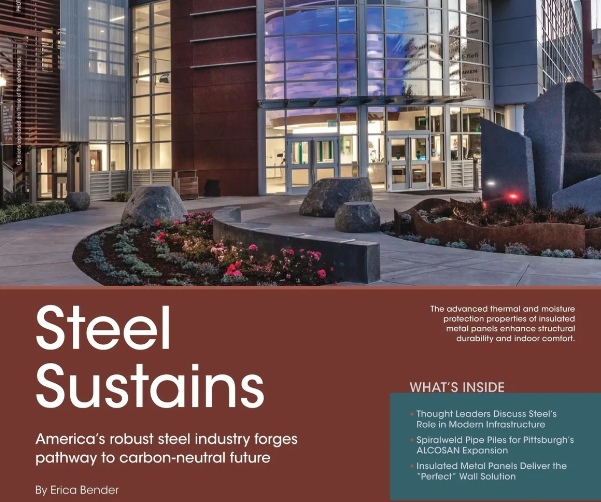
Industry thought leaders discuss key trends and innovations in steel construction in the August 22, 2022 edition of Engineering News-Record.
Investments in Sustainability
The steel industry in the U.S. also continues to make other key investments to further decrease its carbon emissions and advance its leadership position on sustainability. American steelmakers have made investments to increase the use of direct reduced iron (DRI) and hot briquetted iron (HBI), which can lower emissions for both integrated blast furnace-basic oxygen furnace steel mills and EAF steel mills.
Additionally, new DRI and HBI facilities are being designed and have recently been built to be hydrogen-ready once clean hydrogen is available on an industrial scale and commercially viable.
In addition, steel is a critical component in the continued development of all clean energy technologies to reduce America’s carbon footprint. According to a recent study by McKinsey & Co, steel is the only material critical to all low-carbon technologies.
Wind, solar, and tidal renewable energy systems, zero-emission electric vehicles, electric grid transmission, hydrogen production, and carbon capture systems all highly depend on steel. For example, steel comprises over 70 percent of the weight of a typical wind turbines. Grain-oriented electrical steel (GOES) is a critical and irreplaceable material used in the production of power and distribution transformers that will be necessary for the greening and modernization of the domestic electric grid. American non-oriented electrical steel (NOES) is used for electric motors, including those that will power the growing electric vehicle (EV) market.

Steel comprises over 70 percent of the weight of a typical wind turbines
Environmental Product Declarations
The American steel industry and its construction partners have also proactively and voluntarily published verified Environmental Product Declarations, which report the carbon footprint and other potential environmental impacts, for nearly every steel construction product available in the marketplace today.
Furthermore, when steel construction products have outlived their current intended use, they can be recycled into new steel to be used for any variety of new products. Steel is the most recycled material in the world and can be continually recycled into new products. Today’s steel beam can become tomorrow’s refrigerator, soup can or car door.
Sustainable Steelmaking, Number One Commitment
Sustainable steelmaking is the American steel industry’s number one commitment – for our customers and all Americans. Our entire industry is continuing to make key investments and innovations to further decrease carbon emissions and advance our leadership position on sustainability.
Dive deeper into steel sustainability by reading AISI’s latest fact sheet: American Steel’s Carbon Advantage.
Does steel provide a sustainable option for bridges?
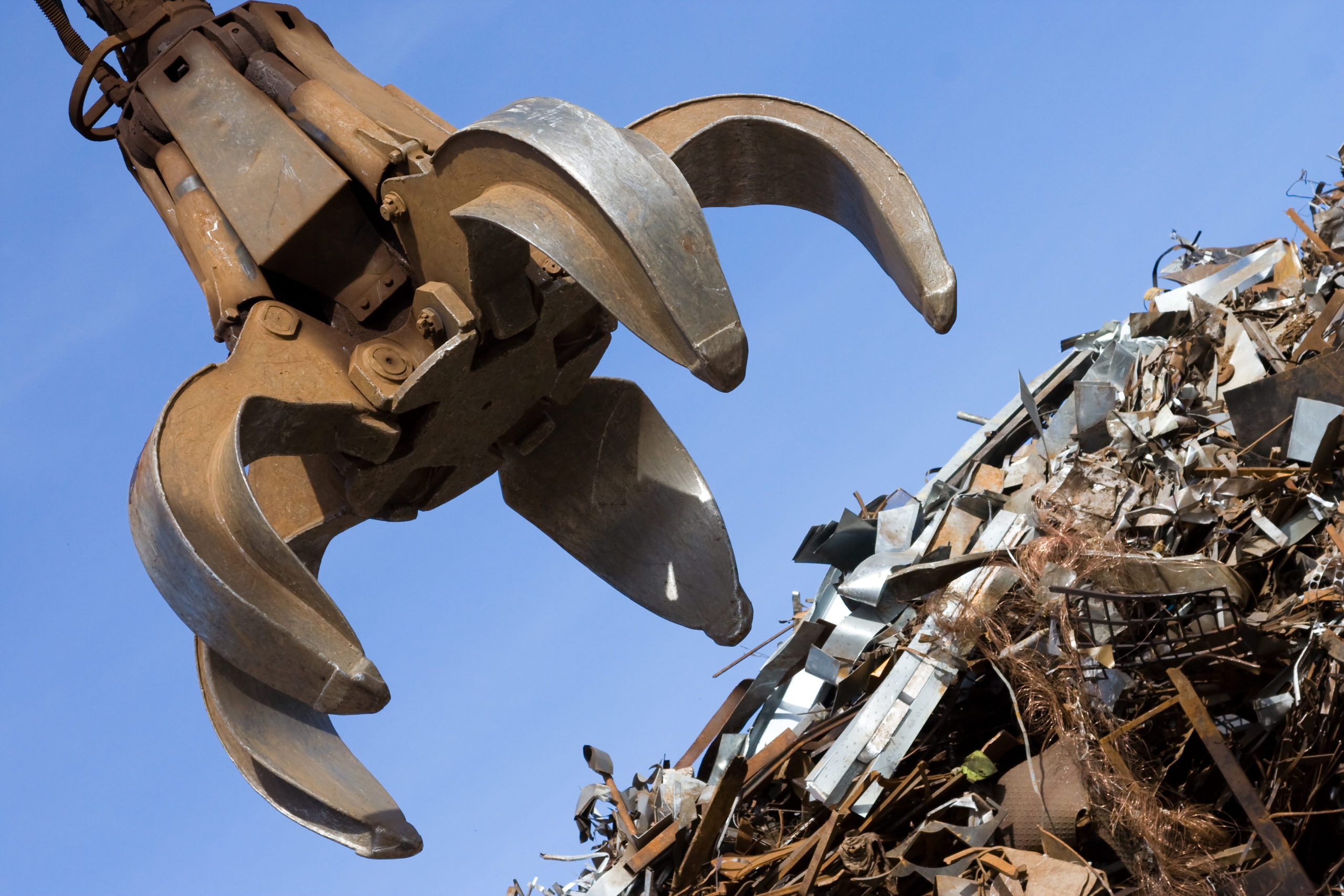
Steel is the most recycled material on the planet. Some of the sustainable advantages of steel include:
- Steel from a disassembled bridge can be used again for another project.
- Steel bridges can last 100 years or more, with minimal maintenance over their long service lives.
- The high strength of steel permits longer spans, which minimizes disruption to underlying habitats.
- Steel is highly resistant to extreme natural disasters such as earthquakes.
- The American steel industry has achieved a 31 percent reduction in energy intensity and a 36 percent reduction in greenhouse gas intensity since 1990.
 News
News
State DOT CEOs Discuss Key Reauthorization Funding Issues, Investment in Local Programs
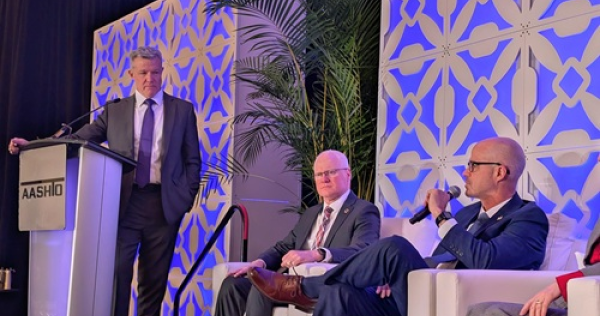
AASHTO recently held its 2026 Washington Briefing in D.C., featuring a panel of state DOT leaders discussing critical surface transportation funding and reauthorization issues.
 News
News
SSSBA Gathers Industry Leaders to Advance Steel Bridge Solutions in Washington, DC
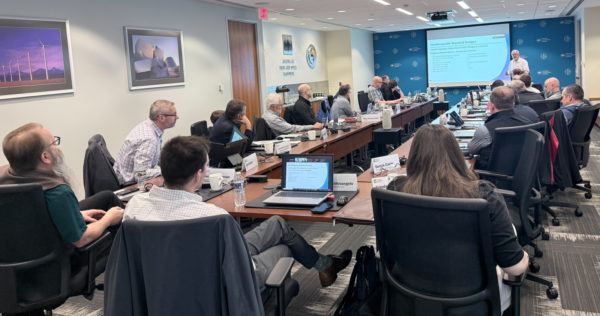
The SSSBA March Semi-Annual meeting in Washington, DC unites industry experts to exchange ideas and advance steel solutions for short span bridges.
 News
News
Dr. Robert Connor Featured on Road Less Traveled Podcast
In a recent episode of the Road Less Traveled podcast, Dr. Robert Connor of Purdue reflects on his path to becoming a national leader in steel bridge fatigue and fracture, and shares his vision for advancing bridge engineering and inspection across the United States.