 Short Span Steel Bridges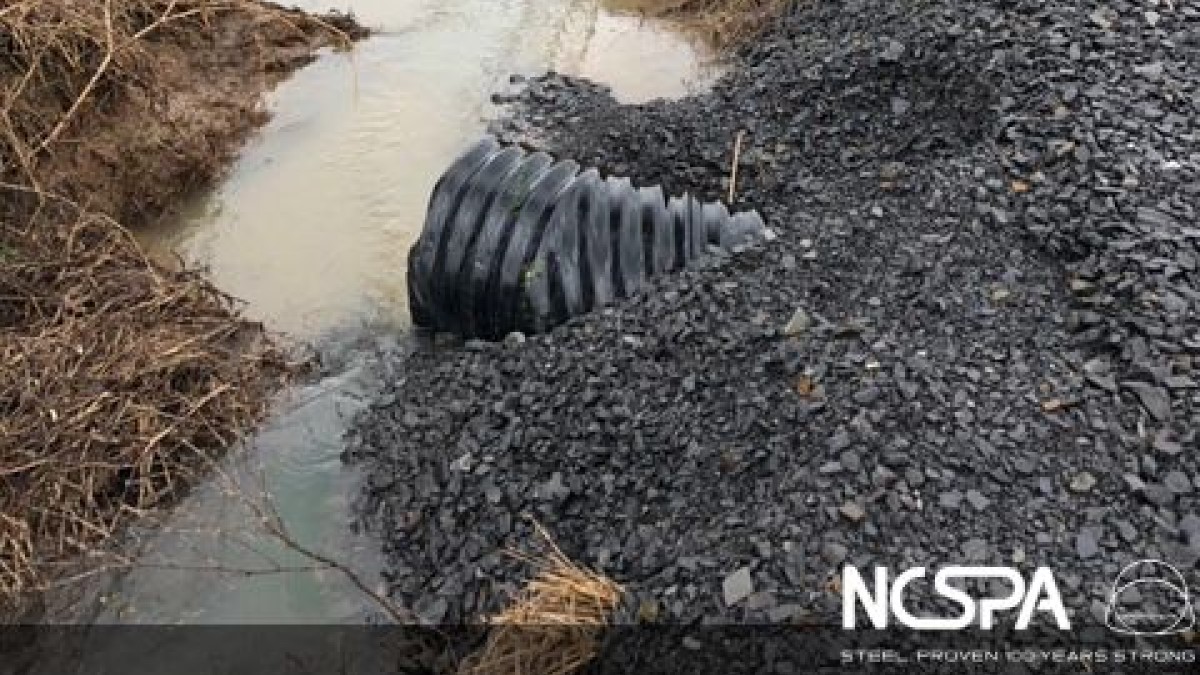
NCSPA Project Spotlight: Corrugated Steel Used for Culvert Rehabilitation Project
Article provided by the National Corrugated Steel Pipe Association
Lonoke County, Arkansas is a rural county located in Central Arkansas having a geography that ranges from steep rolling hills in the northern parts of the county to large Arkansas River flood plains in the southern portion. Because of this diverse topography, land use in the county varies from recreational use and timber production in the hillier northern areas to intensive agricultural practices in the southern lying flood plain areas.
Managing infrastructure on such a wide range of lands has been a challenge for county highway department officials who manage approximately 750 miles of roads within the county.
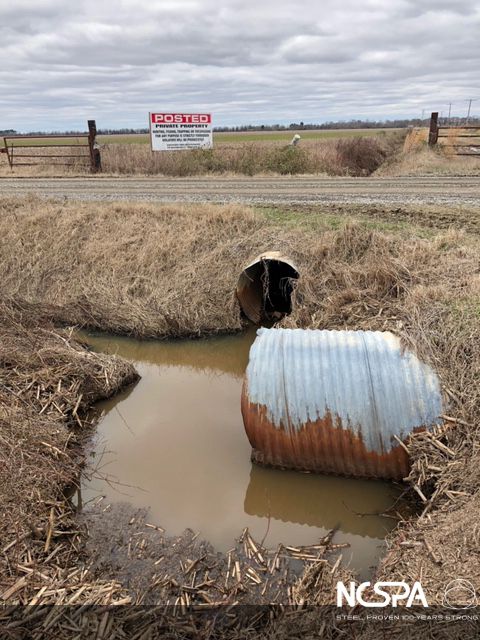
Project Location: Lonoke County, Arkansas (Central Arkansas)
Project Background
County road officials were tasked with the responsibility of finding a culvert material that would be able to handle the high abrasion loads present in the rocky rolling hills, meet the increasingly heavier equipment loads being placed on the roads from ag and forestry equipment, as well as withstanding corrosion from increasing agricultural runoff containing high fertilizer, pesticide, and insecticide concentrations.
While county officials and decision makers understood and appreciated the strength of galvanized steel culverts, extremely harsh environmental conditions in the county created situations where galvanized CMP products were reaching 10-12 years of service life-well below their desired levels.
Jared Davis, Superintendent of Roads for the Lonoke County Highway Department, became a leading proponent for converting the county’s pipe usage over to polymer coated CMP as it was a steel product he was familiar installing, it had the strength he knew would be required, and it would be able to resolve their service life issues.
In Mr. Davis’s words:
“Switching to polymer coated pipes was the best decision I have made with regards to culverts in this county and I’m confident when we install a pipe, I won’t have to deal with it again on my watch (unless something catastrophic happens).”

Corrugated Metal Pipe used for the project.
Construction Phase
In an effort to continuously provide its customers with the best products available, Metal Culverts Inc was eager to obtain coil coated with the gray polymer film.
Metal Culverts Inc. ran the 16 gauge gray polymer coated coil into 18”; 24”; & 30” diameters of pipe for the county in various run lengths.
The pipe ran perfectly in both helical and annular riveted pipe production with no manufacturing differences noted from the black polymer coil. Jared Davis with Lonoke County was impressed with the pipe’s aesthetics and specifically noted the pipes similar appearance to the traditional galvanized coated cmp.
Final Project Outcome
What are buried steel bridges?
Buried steel bridges provide an economical choices for bridge replacement or bridge rehabilitation.
They essentially are a corrugated steel pipe or structural plate pipe systems that is “buried” with backfill to carry loads through soil-structure interaction. This means the bridge structure itself and the backfill soils surrounding the structure interact with each other to support the loads. In effect, the backfill material is part of the bridge.
Because of this interaction, the bridge structure is typically lighter, and there can be significant savings in structure costs.
There are also many cases where buried bridges can carry heavier loads than traditional bridges because of the benefits of spreading vehicle loads through the fill. Buried bridges do not require abutments; and unless foundation soil conditions are poor, do not typically
require deep foundations.An additional benefit with buried bridges is that they can be tailored to site conditions and geometric requirements. The design includes inputs for site soils and backfill, meaning that locally available materials can often be used in construction and the structure can be tailored to fit the needs of the site and the owner’s requirements.
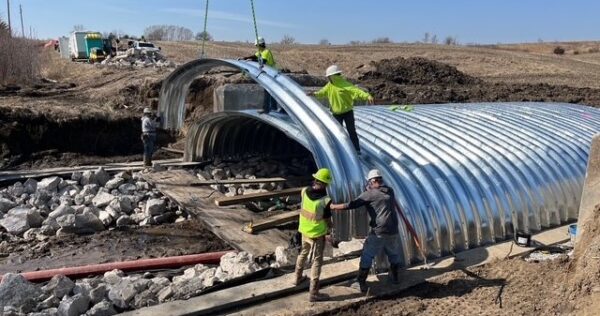 Buried Bridge
Buried Steel Bridge Preserves Streambed While Supporting Heavy Loads
A new galvanized buried steel bridge in Riverside, Iowa, supplied by SSSBA member Lane Enterprises, replaced a weight-restricted structure and restored direct access for local farmers. Its open-bottom steel design preserves the natural streambed, enhances durability, and provides a cost-effective solution for rural infrastructure.
 Buried Bridge
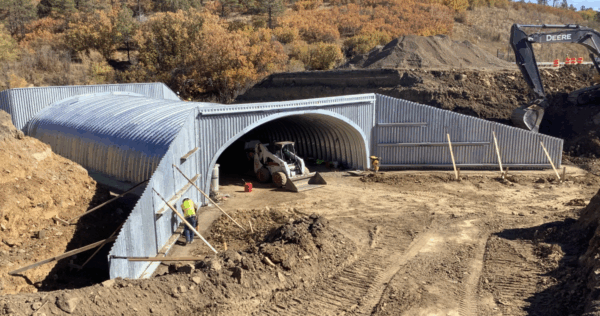
Buried Steel Bridge Protects Wildlife and Motorists in New Mexico DOT Project
The New Mexico DOT buried steel bridge project, featuring SSSBA member Contech’s custom structural plate design, was honored as the NCSPA Project of the Year for its innovative wildlife crossing solution on I-25 at Raton Pass.
 Case Study
Steel in Action: On-Demand Steel Bridge Video Series
Watch this four-part, on-demand video series featuring expert-led case studies on cost-effective, resilient short span bridge projects—now available with downloadable presentation materials.
 News
News
NCSPA Announces 2025 Project of the Year Winners
The National Corrugated Steel Pipe Association announced the 2025 project of the year winners, including members of the Short Span Steel Bridge Alliance.
 Buried Bridge
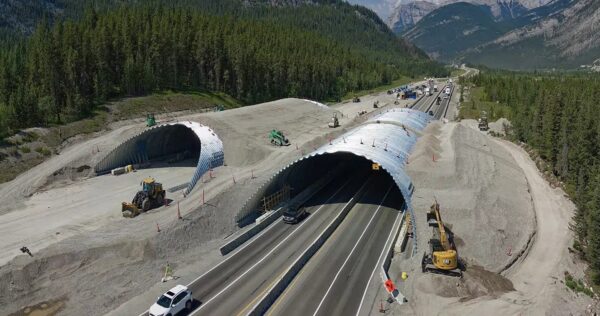
Corrugated Steel Animal Overpass Reduces Wildlife-Vehicle Collisions
The corrugated steel Stoney Nakoda Exshaw Wildlife Arch in Western Canada showcases the balance of engineering and environmental stewardship, setting a new standard for wildlife-friendly infrastructure.
 Buried Bridge
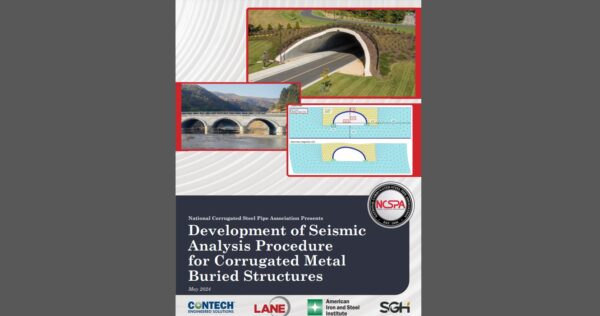
NCSPA Releases Report to Simplify the Seismic Design for Buried Structures
The National Corrugated Steel Pipe Association (NCSPA) released a groundbreaking report that simplifies the seismic design for buried structures including culverts, tunnels and buried steel bridges.