 Short Span Steel Bridges
NCSPA Project Spotlight: Corrugated Steel Used to Rehabilitate Railroad Bridge Piers
Article provided by the National Corrugated Steel Pipe Association
Bridge rehabilitation projects come in all shapes and sizes. The foundations for this active Rapid City, Pierre & Eastern Railroad bridge were performing well. To extend the service life of the foundations, engineers decided to protect the existing piers by drilling micro piles extending into the shale bedrock below.
These piles were advanced a minimum of 20 feet to provide deep and stable support for the existing bridge piers. Several feet of the channel bottom were removed around the foundations to allow the toe of the corrugated steel caisson sheets to be buried after installation and to fully encase the existing pier structures. The structural plates sections were sized to allow enough clearance and spacing for the double mat of reinforcing steel.
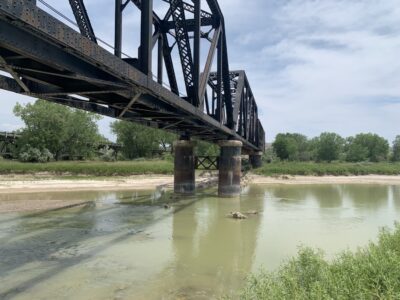
Rapid City, Pierre & Eastern Railroad Bridge Wasta, SD
Galvanized Structural Steel Plates
After the galvanized structural steel plates were assembled, bolted together, and tightened, they were ready to be placed in the concrete. The contractor elected to place the nuts of the bolts on the inside of the structural plates forms for consistent esthetically pleasing exterior finish. The concrete was placed in the forms, consolidated, and allowed to cure around the existing bridge supporting piers.
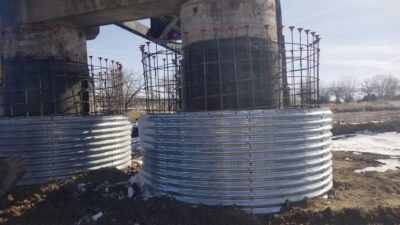
Galvanized Steel Plates
Steel Reinforced Concrete Caps were Installed
New cast in place, steel reinforced concrete caps were placed over each protective corrugated steel form. The stream bed around the new protective forms was backfilled and reshaped to maintain its hydraulic capacity during peak events.
Much of the rehabilitation work occurred in February 2022.
What are buried steel bridges?
Buried steel bridges provide an economical choices for bridge replacement or bridge rehabilitation.
They essentially are a corrugated steel pipe or structural plate pipe systems that is “buried” with backfill to carry loads through soil-structure interaction. This means the bridge structure itself and the backfill soils surrounding the structure interact with each other to support the loads. In effect, the backfill material is part of the bridge.
Because of this interaction, the bridge structure is typically lighter, and there can be significant savings in structure costs.
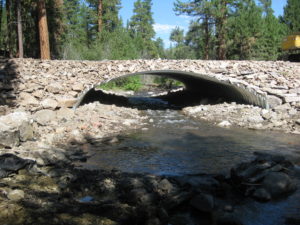
There are also many cases where buried bridges can carry heavier loads than traditional bridges because of the benefits of spreading vehicle loads through the fill. Buried bridges do not require abutments; and unless foundation soil conditions are poor, do not typically
require deep foundations.An additional benefit with buried bridges is that they can be tailored to site conditions and geometric requirements. The design includes inputs for site soils and backfill, meaning that locally available materials can often be used in construction and the structure can be tailored to fit the needs of the site and the owner’s requirements.
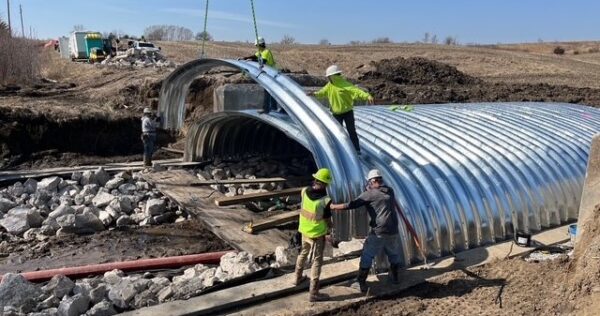 Buried Bridge
Buried Steel Bridge Preserves Streambed While Supporting Heavy Loads
A new galvanized buried steel bridge in Riverside, Iowa, supplied by SSSBA member Lane Enterprises, replaced a weight-restricted structure and restored direct access for local farmers. Its open-bottom steel design preserves the natural streambed, enhances durability, and provides a cost-effective solution for rural infrastructure.
 Buried Bridge
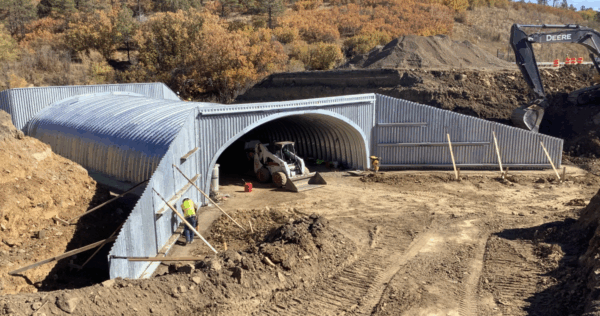
Buried Steel Bridge Protects Wildlife and Motorists in New Mexico DOT Project
The New Mexico DOT buried steel bridge project, featuring SSSBA member Contech’s custom structural plate design, was honored as the NCSPA Project of the Year for its innovative wildlife crossing solution on I-25 at Raton Pass.
 Case Study
Steel in Action: On-Demand Steel Bridge Video Series
Watch this four-part, on-demand video series featuring expert-led case studies on cost-effective, resilient short span bridge projects—now available with downloadable presentation materials.
 News
News
NCSPA Announces 2025 Project of the Year Winners
The National Corrugated Steel Pipe Association announced the 2025 project of the year winners, including members of the Short Span Steel Bridge Alliance.
 Buried Bridge
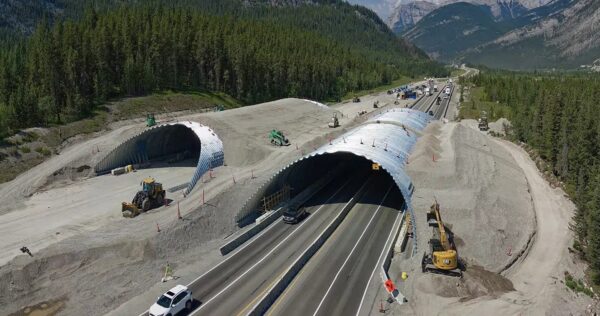
Corrugated Steel Animal Overpass Reduces Wildlife-Vehicle Collisions
The corrugated steel Stoney Nakoda Exshaw Wildlife Arch in Western Canada showcases the balance of engineering and environmental stewardship, setting a new standard for wildlife-friendly infrastructure.
 Buried Bridge
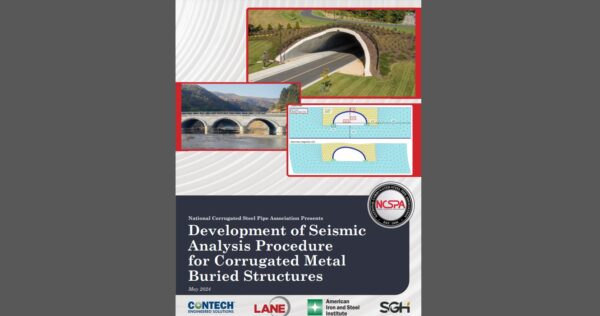
NCSPA Releases Report to Simplify the Seismic Design for Buried Structures
The National Corrugated Steel Pipe Association (NCSPA) released a groundbreaking report that simplifies the seismic design for buried structures including culverts, tunnels and buried steel bridges.