 Short Span Steel Bridges
Corrugated Steel Pipe Safeguards Rail System from Excessive Storm Water
Article provided by the National Corrugated Steel Pipe Association
When the third largest landfill in the United States was having its garbage transportation rail system interrupted due to excessive storm water over the tracks, they were pressed into an emergency to correct the problem. Columbia Ridge Landfill processes 2.74 million tons of waste per year. It’s a modern landfill that creates renewable energy from both municipal solid waste and industrial and special waste which is received in by rail cars from Portland, OR and Seattle, WA.
Two trains, with up to 90 cars each, enter and exit the landfill each day on a very strict schedule. While the track was cautiously passable, another severe storm could wash out the tracks. To compound matters, this flooding was occurring in multiple areas of their tracks located about 1/2 mile away from each other. It became critical that a solution be developed in short order and the solution be installed quickly.
Developing the Right Solution
The pipe would not only need to be larger in diameter than the current 48” system, but also strong enough to withstand the weight of trains pulling dozens of waste-filled cars.
After reviewing all the data, the best solution was:
- Develop and deliver 420 feet of 108″ 8 gage 5 x 1 galvanized CSP manufactured in 60′ lengths.
- Additionally, there was a need for 60 feet of 96” and 84” 8 gage 5 x 1 pipe to complete the two systems.
- The pipe would be placed in five pipe runs for one section and four pipe runs for the second section with each pipe running parallel to each other.
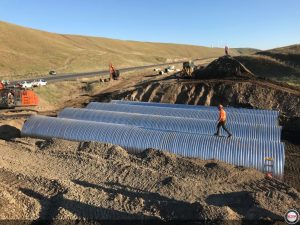
Corrugated steel pipe used for the project
The Construction Phase
So, with a plan in place, the landfill enlisted Pacific Corrugated Pipe Company (PCPC) to quickly fabricate the new storm water solution. The logistics and coordination of installing the solution became the next challenge. PCPC was able to quickly produce the material and worked closely with the freight and landfill company to deliver and install the new solution. After extracting the existing 48″ pipes, which were clearly under designed, the new solutions were installed in a period of about 8 hours so as not to interrupt any deliveries to the landfill. The elimination of couplers and the use of 60′ lengths proved to be the right choice.
The contractor was able to install and backfill all replacement pipe and reassemble the tracks before the next scheduled train, so the daily deliveries were not interrupted. The strength, efficiency and rapid production of CMP comes to the rescue again.
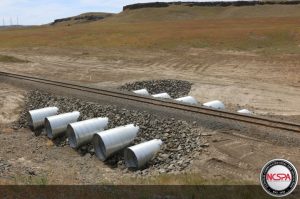
Final Project Outcome
What are buried steel bridges?
Buried steel bridges provide an economical choices for bridge replacement or bridge rehabilitation.
They essentially are a corrugated steel pipe or structural plate pipe systems that is “buried” with backfill to carry loads through soil-structure interaction. This means the bridge structure itself and the backfill soils surrounding the structure interact with each other to support the loads. In effect, the backfill material is part of the bridge.
Because of this interaction, the bridge structure is typically lighter, and there can be significant savings in structure costs.
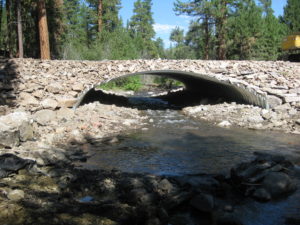
There are also many cases where buried bridges can carry heavier loads than traditional bridges because of the benefits of spreading vehicle loads through the fill. Buried bridges do not require abutments; and unless foundation soil conditions are poor, do not typically
require deep foundations.An additional benefit with buried bridges is that they can be tailored to site conditions and geometric requirements. The design includes inputs for site soils and backfill, meaning that locally available materials can often be used in construction and the structure can be tailored to fit the needs of the site and the owner’s requirements.
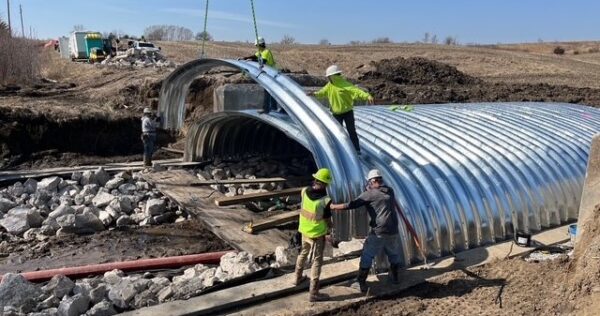 Buried Bridge
Buried Steel Bridge Preserves Streambed While Supporting Heavy Loads
A new galvanized buried steel bridge in Riverside, Iowa, supplied by SSSBA member Lane Enterprises, replaced a weight-restricted structure and restored direct access for local farmers. Its open-bottom steel design preserves the natural streambed, enhances durability, and provides a cost-effective solution for rural infrastructure.
 Buried Bridge
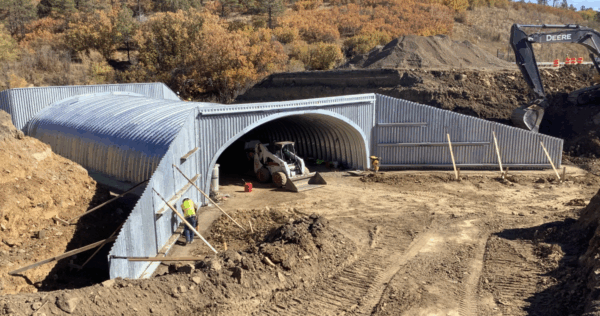
Buried Steel Bridge Protects Wildlife and Motorists in New Mexico DOT Project
The New Mexico DOT buried steel bridge project, featuring SSSBA member Contech’s custom structural plate design, was honored as the NCSPA Project of the Year for its innovative wildlife crossing solution on I-25 at Raton Pass.
 Case Study
Steel in Action: On-Demand Steel Bridge Video Series
Watch this four-part, on-demand video series featuring expert-led case studies on cost-effective, resilient short span bridge projects—now available with downloadable presentation materials.
 News
News
NCSPA Announces 2025 Project of the Year Winners
The National Corrugated Steel Pipe Association announced the 2025 project of the year winners, including members of the Short Span Steel Bridge Alliance.
 Buried Bridge
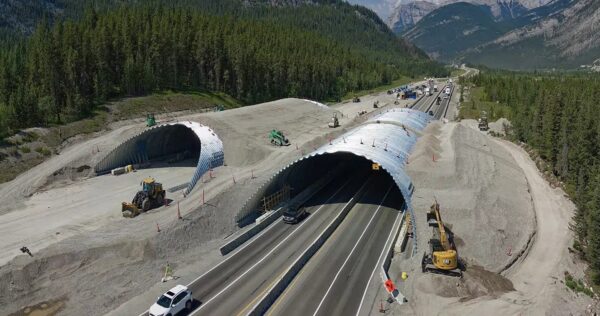
Corrugated Steel Animal Overpass Reduces Wildlife-Vehicle Collisions
The corrugated steel Stoney Nakoda Exshaw Wildlife Arch in Western Canada showcases the balance of engineering and environmental stewardship, setting a new standard for wildlife-friendly infrastructure.
 Buried Bridge
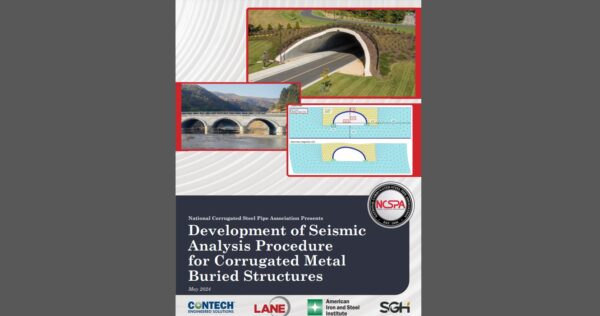
NCSPA Releases Report to Simplify the Seismic Design for Buried Structures
The National Corrugated Steel Pipe Association (NCSPA) released a groundbreaking report that simplifies the seismic design for buried structures including culverts, tunnels and buried steel bridges.