 Short Span Steel Bridges
NCSPA Releases Report to Simplify the Seismic Design for Buried Structures
The following information was provided by SSSBA member National Corrugated Steel Pipe Association
The National Corrugated Steel Pipe Association (NCSPA), in collaboration with leading industry experts, has released a groundbreaking report that simplifies seismic design for buried structures like culverts, tunnels, and bridges. This research fills a critical gap in current design codes, offering practical and easy-to-use equations to assess seismic demands and ensure the resilience of vital infrastructure.
Download the full report and discover how this innovative approach can help you design safer, more robust buried structures in earthquake-prone regions. Click the link below to access your free copy and learn more about this game-changing research.
In this video lecture, Joel Hahm (Contech Engineered Solutions LLC) and Michael McGough (National Corrugated Steel Pipe Association) provide an overview of buried steel bridges including:
What’s the Goal of the Report?
The report aims to develop closed-form equations to estimate seismic demand on typical geometries of bottomless corrugated metal buried bridges. The equations are intended to simplify the screening of seismic demands and be consistent with the existing AASHTO design methods for these types of structures.
Why This is Important?
The motivation for this research stems from the fact that current codes do not require seismic design of buried structures, such as culverts or buried bridges, based on their historical performance relative to above-ground structures. However, there are cases where seismic demand on buried structures should be considered in design, especially for structures with spans greater than 20 ft and those with life-safety implications.
What’s Missing?
The report highlights that previous research has developed simplified seismic analysis approaches for rigid box structures and simplified closed-form seismic demand equations for rigid and flexible circular pipes. However, there is no simplified design method available for typical geometries of buried large-span corrugated metal arches on footings.
What We Learned
To address this gap, the report details the development of closed-form equations based on the results of detailed parametric finite element analyses. The recommended equations estimate seismic demand due to lateral accelerations on typical arch-shaped corrugated metal buried structures. The equations consider parameters such as structure span, rise, fill depth, profile, thickness, structure material, native soil, and seismic lateral acceleration coefficient.
The report provides the specific equations for estimating the seismic design thrust and moment. The applicability of these equations is limited to typical structures and installations meeting certain conditions, as specified in a table provided in the report. Installations outside these conditions still require finite element analysis to determine seismic demands.
This new research report concludes that installations with larger structure span, deep cover, poor native soil, or high site seismicity are most likely to be controlled by seismic demand. It also notes that the design equations may be overly conservative for installations in very good native soils, but seismic demands are unlikely to control design in these cases based on AASHTO load combinations.
The report includes appendices that provide a summary of relevant literature and current practice, a design example demonstrating the use of the equations, and recommended changes to AASHTO to implement the equations.
Putting it into Practice
In summary, the report presents closed-form equations for estimating seismic demand on typical arch-shaped corrugated metal buried structures. These equations provide a simplified screening method and are intended to be consistent with existing AASHTO design methods. The equations are applicable to typical structures and installations meeting specific conditions. Installations outside these conditions require finite element analysis. The report recommends further research to extend the findings and improve the understanding of seismic behavior in buried structures.
What are buried steel bridges?
Buried steel bridges provide an economical choices for bridge replacement or bridge rehabilitation.
They essentially are a corrugated steel pipe or structural plate pipe systems that is “buried” with backfill to carry loads through soil-structure interaction. This means the bridge structure itself and the backfill soils surrounding the structure interact with each other to support the loads. In effect, the backfill material is part of the bridge.
Because of this interaction, the bridge structure is typically lighter, and there can be significant savings in structure costs.
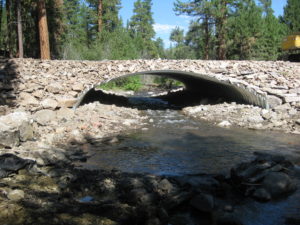
There are also many cases where buried bridges can carry heavier loads than traditional bridges because of the benefits of spreading vehicle loads through the fill. Buried bridges do not require abutments; and unless foundation soil conditions are poor, do not typically
require deep foundations.An additional benefit with buried bridges is that they can be tailored to site conditions and geometric requirements. The design includes inputs for site soils and backfill, meaning that locally available materials can often be used in construction and the structure can be tailored to fit the needs of the site and the owner’s requirements.
 Buried Bridge
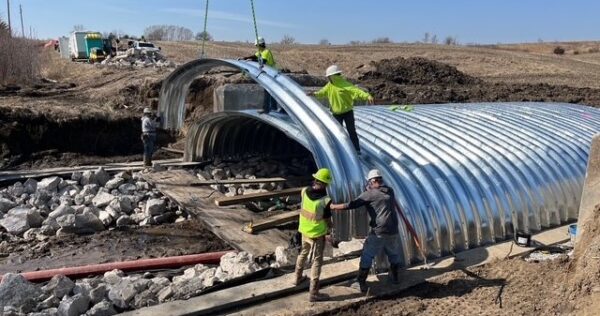
Buried Steel Bridge Preserves Streambed While Supporting Heavy Loads
A new galvanized buried steel bridge in Riverside, Iowa, supplied by SSSBA member Lane Enterprises, replaced a weight-restricted structure and restored direct access for local farmers. Its open-bottom steel design preserves the natural streambed, enhances durability, and provides a cost-effective solution for rural infrastructure.
 Buried Bridge
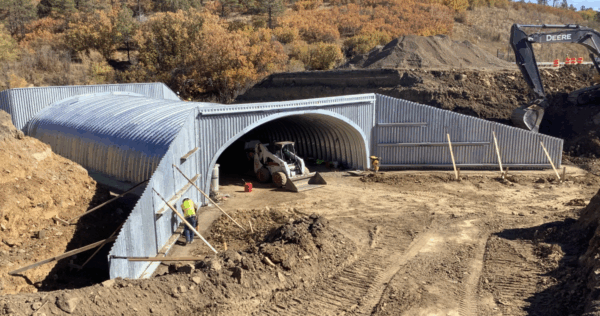
Buried Steel Bridge Protects Wildlife and Motorists in New Mexico DOT Project
The New Mexico DOT buried steel bridge project, featuring SSSBA member Contech’s custom structural plate design, was honored as the NCSPA Project of the Year for its innovative wildlife crossing solution on I-25 at Raton Pass.
 Case Study
Steel in Action: On-Demand Steel Bridge Video Series
Watch this four-part, on-demand video series featuring expert-led case studies on cost-effective, resilient short span bridge projects—now available with downloadable presentation materials.
 News
News
NCSPA Announces 2025 Project of the Year Winners
The National Corrugated Steel Pipe Association announced the 2025 project of the year winners, including members of the Short Span Steel Bridge Alliance.
 Buried Bridge
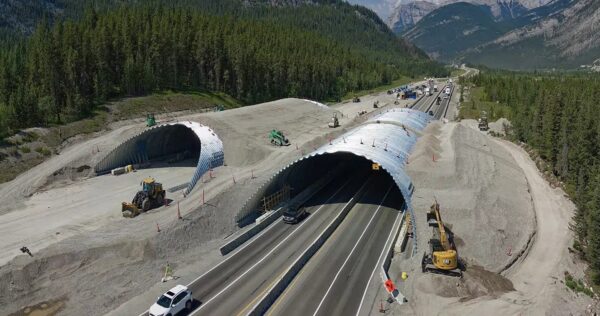
Corrugated Steel Animal Overpass Reduces Wildlife-Vehicle Collisions
The corrugated steel Stoney Nakoda Exshaw Wildlife Arch in Western Canada showcases the balance of engineering and environmental stewardship, setting a new standard for wildlife-friendly infrastructure.
 Buried Bridge
Buried Steel Bridge Reconnects Aquatic Habitat for Alabama County
St. Clair County, Alabama, restored critical habitats for endangered species by replacing two polyethylene culverts with a buried steel bridge to reconnect a fragmented aquatic ecosystem.