 Short Span Steel Bridges
SSSBA Publishes New Research Report in Technical Series On Innovative Press-Brake Formed Steel Tub Girder Bridge Technology
The Short Span Steel Bridge Alliance (SSSBA) has added a new research report to its series on the development and experimental testing of the innovative press-brake-formed steel tub girder (PBTG) bridge system.
The new report, “Volume VII: Field Evaluation of a Modular Press-Brake-Formed Steel Tub Girder in an Application That Includes Skew and Superelevation,” is available for free download.
The report evaluates the field performance of the Fourteen Mile Bridge in Lincoln County, West Virginia, a modular PBTG steel bridge topped with a precast reinforced concrete deck that was constructed in August 2019.
The testing was performed by researchers from Marshall University and West Virginia University and served to determine what effect skew and superelevation have on the distribution of live load to each girder.
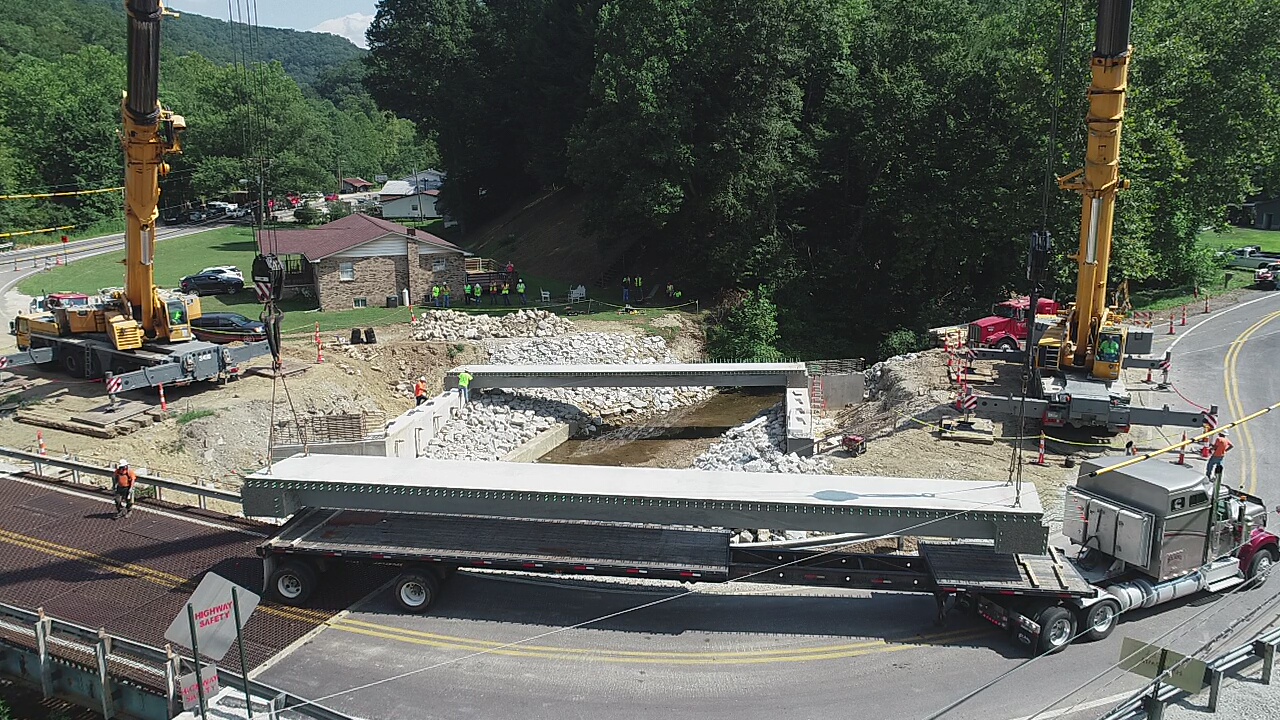
Fourteen Mile Bridge in Lincoln County, West Virginia
To make that determination, a live load field test was performed, a finite element model was developed to verify the recorded data, and the results were used to compute live load distribution factors (LLDF). The LLDF data was then compared to data following the AASHTO LRFD specifications.
“The test results demonstrate that AASHTO live load distribution factors are conservative, and therefore safe to use in the design of press-brake-formed steel tub girder bridges,” said Karl Barth, Ph.D., the Jack H. Samples Distinguished Professor at West Virginia University, one of the researchers on the team who also led the task group responsible for developing the PBTG technology.
Dr. Barth was joined in the Fourteen Mile Bridge research by Greg Michaelson, Ph.D., P.E., associate professor at Marshall University, who was involved in the early research on the new technology; and by Robert Tennant, Ph.D. and Adam Roh, engineering students at West Virginia University. Barth and Michaelson also provide expert assistance to bridge design professionals through the SSSBA’s Bridge Technology Center.

Left-to-Right: Dr. Greg Michaelson (Marshall University), Dr. Karl Barth (West Virginia University), Adam Roh (West Virginia University) and Dr. Robert Tennant (West Virginia University)
“This result underscores the value of the PBTG system, which provides significant cost and time savings in the design and construction of short span steel bridges up to 60 feet,” said David Stoddard, Senior Applications Engineer at SSAB Americas and Chairman of the Short Span Steel Bridge Alliance. “The PBTG system is practical for accelerated bridge construction (ABC) applications, can last for an estimated 100 years, and is compatible with various deck designs as modular units.”
Stoddard added that PBTG bridges are currently in service in Alabama, Iowa, Michigan, Minnesota, Missouri, Ohio, Oregon, Pennsylvania, Texas and West Virginia.
The Fourteen Mile Bridge research report is designated as Volume VII in the “Development and Experimental Testing of Press-Brake-Formed Steel Tub Girders for Short Span Bridge Applications” series which are all available for free download. The full series includes:
- Volume I – “Development and Feasibility Assessment of Shallow Press-Brake-Formed Steel Tub Girders for Short Span Bridge Applications”
- Volume II – “Experimental Evaluation of Non-Composite Shallow Press-Brake-Formed Steel Tub Girders”
- Volume III – “Evaluation of Modular Press-Brake-Formed Tub Girders With UHPC Joints”
- Volume IV – “Field Performance Assessment of Press-Brake-Formed Steel Tub Girder Superstructures”
- Volume V – “Fatigue Performance of Uncoated and Galvanized Composite Press-Brake-Formed Tub Girders”
- Volume VI – “Field Performance and Rating Evaluation of a Modular Press-Brake-Formed Steel Tub Girder With a Steel Sandwich Plate Deck”
- Volume VII – “Field Evaluation of a Modular Press-Brake-Formed Steel Tub Girder in an Application That Includes Skew and Superelevation”
What are Press Brake Tub Girders?
Press-brake-formed tub girder (PBTG) is a new technology for short span bridge applications. It consists of modular galvanized shallow trapezoidal boxes fabricated from cold-bent structural steel plate (watch fabrication video). A concrete deck is recommended to be precast on the girder and the modular unit can be shipped by truck to the bridge site.

The system utilizes standard plate widths (based on availability) and is optimized to achieve maximum structural capacity, with most of the steel in the bottom flange and increased torsional stiffness. It is a closed system, since the girder is closed at the bottom. It is versatile for multiple-deck options.
The system utilizes Accelerated Bridge Construction practices, since it:
- Can be installed in one or two days
- Is modular, allowing the use of a precast deck
- Is cost-effective―as much as 1/3 less than a standard concrete girder structure
- Is simple to fabricate, requiring very little welding.

The Short Span Steel Bridge Alliance has developed standardized plans using standard plate sizes (60”, 72” 84”, 96”, 108”, 120”). The designs were developed to achieve maximum structural capacity and are available to use in the free-to-use, web-based design tool eSPAN140.
The press-brake-formed tub girder system is open source.
 Case Study
Steel in Action: On-Demand Steel Bridge Video Series
Watch this four-part, on-demand video series featuring expert-led case studies on cost-effective, resilient short span bridge projects—now available with downloadable presentation materials.
 Press Brake & Folded Plate
New Specs, New Opportunities for Press-Brake Tub Girders
Valmont Structures developed a summary outlining how the new AASHTO 10th Edition Bridge Design Specifications impact the use of press-brake tub girders (U-BEAMS) in bridge construction.
 Press Brake & Folded Plate
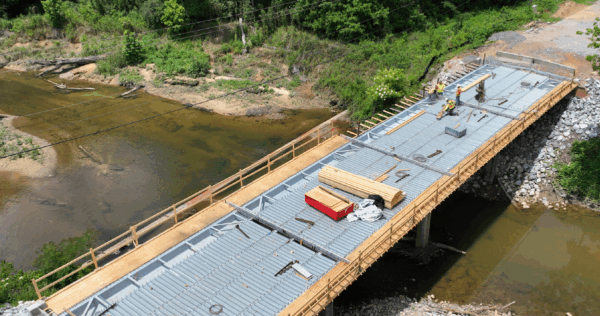
Press-Brake Tub Girder Delivers Modern Upgrade for Historic Alabama County Bridge
After over 80 years of wear from daily traffic, the Parkwood Road Bridge was upgraded with Valmont’s U-BEAM™ system to enhance safety and streamline construction.