 Short Span Steel Bridges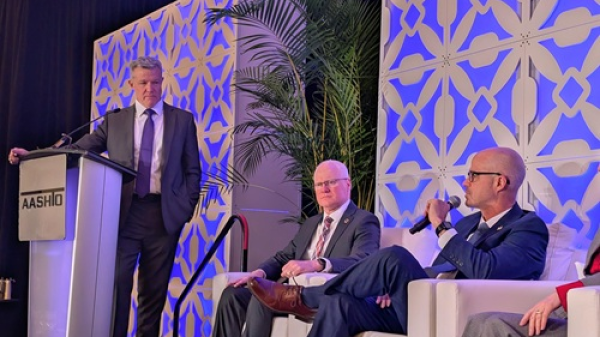
State DOT CEOs Discuss Key Reauthorization Funding Issues, Investment in Local Programs
The following image and information was provided by the American Association of State Highway and Transportation Officials (AASHTO).
March 6, 2026
The American Association of State Highway and Transportation Officials recently hosted a panel discussion that examined key surface transportation funding authorization issues at its 2026 Washington Briefing, held in Washington, D.C.
Jim Tymon, AASHTO’s executive director, moderated the panel of state department of transportation chief executives, who delved into the critical stability reauthorization of federal highway, highway safety, transit, and rail program funding delivers to the nation – usually in five-year legislative packages.
“We are at a unique time where Congress and the Trump administration are knee deep in the reauthorization process to get this across the finish line,” Tymon said, noting that the current reauthorization measure – contained within the Infrastructure Investment Jobs Act or IIJA – expires on September 30.
“What we want to see is the total amount of federal [surface transportation] funding to increase – the goal is for the dollar amount go up in part because of the impact of inflation, which has watered down the buying power of those dollars,” he explained.
Importance of Federal Surface Transportation Funding
In line with the organization’s 2026 Policy Action Agenda, Russell McMurry – commissioner of the Georgia Department of Transportation and AASHTO’s 2025-2026 president – said maintaining if not growing consistent formula funding is vital.
“Formula funding is how we deliver infrastructure across all the modes – it allows us to do long range planning, giving us the consistency to deliver projects,” he said.
“Alongside that, we must not retreat from current [federal] funding levels,” he added. “The reality is that over the last five years, there have been unprecedented increases in infrastructure construction costs. There is a big divergence in cost and revenue – and that reality needs to be acknowledged.”
Maintaining Consistent Formula Funding
Marc Williams – executive director of the Texas Department of Transportation and AASHTO’s 2025-2026 vice president – stressed that state DOTs serve “as the backbone” for building and maintaining the nation’s transportation infrastructure and thus need to remain “the key mechanism” for delivering the majority of the funding supporting it.
“Congress and the administration count on us to get the work done and done effectively, and we should not be ashamed to talk about that,” he explained.
“We need to continue the importance of maintaining and growing [surface transportation] formula funding due to the needs out there and the tremendous impact of inflation because we cannot plan around discretionary grants,” he said. “We also need funding flexibility – the ability to redirect funding based on needs and emergencies.
Those are things states get called upon to do – and we need the funding and flexibility to do it. And we have the proven accountability that we can do it.”
State DOTs as the Backbone of Infrastructure Delivery
Dina El-Tawansy, director of the California Department of Transportation, added that efforts to “water down” the formula funding for states by directing more of it to localities – a tactic proposed by the recently-introduced Bridges and Safety Infrastructure for Community Success or “BASICS” Act – could needlessly hamper efforts to continually improve the nation’s transportation system.
“We have been providing a lot of background help to localities; we’ve worked closely with them on projects for a long time,” she said. “But the BASICS bill is a disconnect to doing that. We need to work on ways to improve outcomes without legislation.”
Concerns Over Proposed Funding Shifts to Localities
AASHTO’s Tymon noted that states already provide over $24 billion annually to fund local projects, with another $9.4 billion in federal money suballocated to localities as well.
“Congressional delegations may not know significant amount of state and federal money that’s already being invested in local programs,” he said.
“We work closely with local agencies and tribal partners already,” added Nancy Daubenberger, commissioner of the Minnesota Department of Transportation. “We work hand-in-hand and support each other. But we have concerns about such [proposed] funding shifts – this make it harder to keep up with NHS [National Highway System] needs and would result in additional pressure being put on local systems.”
The Need for Flexibility and Accountability in Funding
Georgia DOT’s McMurry noted that robust formula funding “allows for planning for statewide and national outcomes – and there are performance standards we need to meet in doing that. But if we start allocating dollars by silo and take away flexibility, then things will not advance. We have to remember formula dollars fund federal investments for federal purposes.”
McMurry emphasized, however, that the debate over surface transportation funding allocation “is not an us and them proposition; we are all in this together” as states already broadly support local and Metropolitan Planning Organization projects.
“That is why we need flexibility to maximize federal dollars – it allows us to fund the right project at the right time in the right place,” he stressed. “States want to help MPOs and localities succeed.”
Read the full article from AASHTO.
 News
News
U.S. Department of Transportation Awards $1.73 Billion in BUILD Funding
The U.S. Department of Transportation announced $1.73 billion in BUILD grant funding for 127 transportation infrastructure projects nationwide, including $1.3 billion dedicated to roadway and bridge improvements.
 News
News
Steel Bridge Design Tools Featured at IBC Sessions Support Streamlined Bridge Delivery
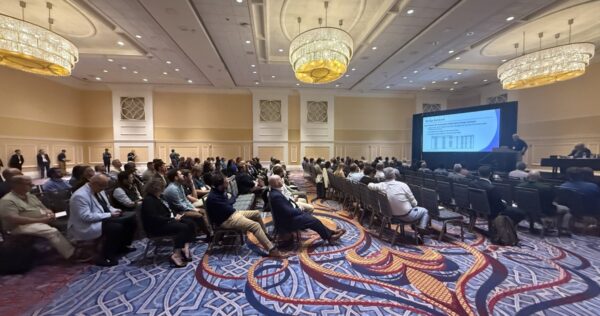
SSSBA supported sessions at the 2026 International Bridge Conference highlighted integrated steel bridge design tools that support efficient project delivery. Presenters showcased resources including eSPAN140, eBEAM140, LRFD Simon and AISC NSBA Standard Bridge Plans, drawing strong interest from bridge owners and designers.
News
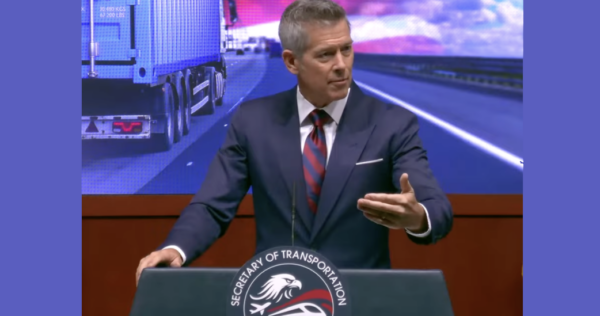
USDOT Makes $626M Available for Infrastructure Projects
U.S. Transportation Secretary Sean P. Duffy announced a $626.7 million investment in America’s infrastructure. Eligible projects include repairing highways and bridges to reduce traffic congestion and freight bottlenecks.