 Short Span Steel Bridges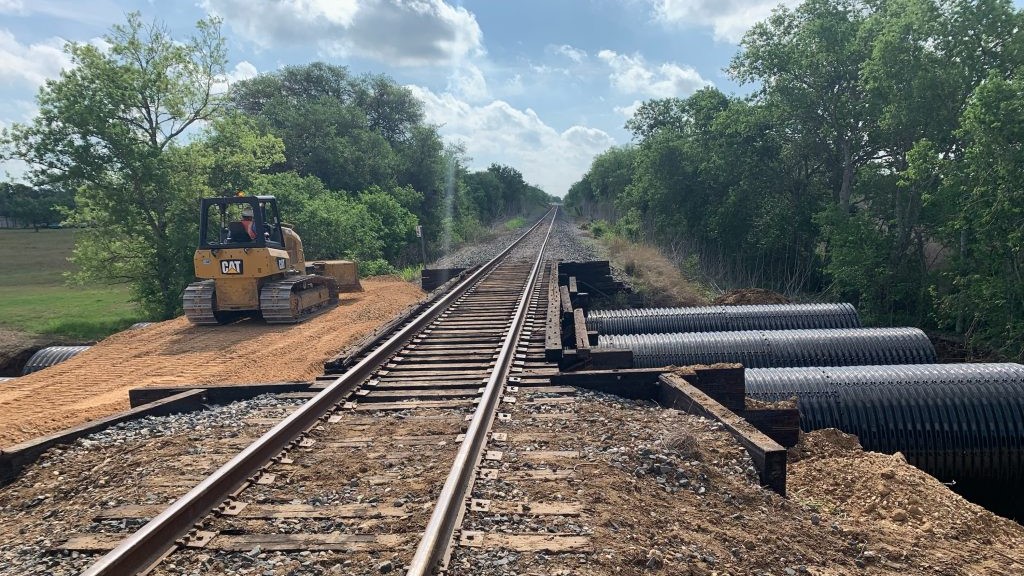
Union Pacific Bridge Replacement Wins NCSPA Project of the Year Award
Article and images provided by the National Corrugated Steel Pipe Association
Railway timber trestles were extensively used in the 19th century, making up from 1 to 3 percent of the total length of the average railroad. These trestles are a growing focus for the railways, as the 21st century is witnessing their need for replacement.
Shutting down the tracks is equivalent to shutting down the revenue stream, and the construction times associated with remove and replace projects makes these considerations unrealistic at best. As a result, the railways prefer to rehabilitate or even replace these structures in place while rail transports seamlessly continue.
The Union Pacific Bridge identified as Rockport Sub. Culvert 11.50 is a classic example of how an existing bridge can be replaced without disrupting rail operations.
The project receive the National Corrugated Steel Pipe Association (NCSAP) 2023 project of the year award for rehabilitation.
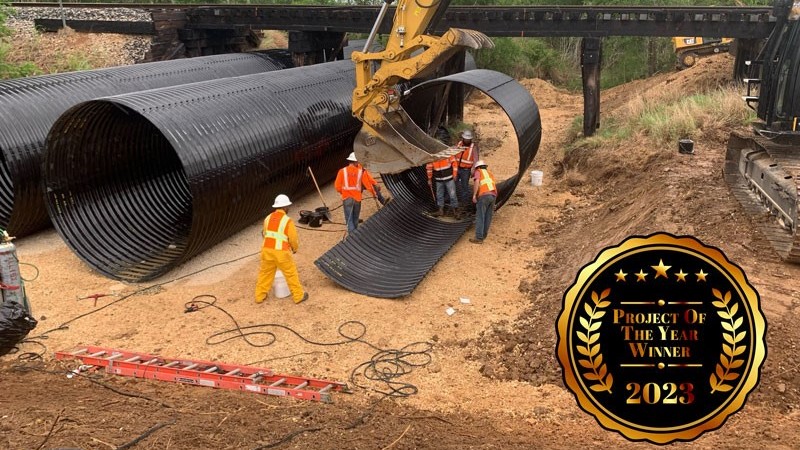
The Union Pacific Bridge receive the National Corrugated Steel Pipe Association (NCSAP) 2023 project of the year award for rehabilitation.
Polymer-Coated Structural Plate Pipe Provides Solution
The railways have a long history with corrugated steel pipe (CSP) and structural plate pipe (SPP). However, their design standards and material specifications are not always consistent with industry offerings and/or manufacturing capabilities, as would have been the case for this project if it weren’t for a timely development in 2020 virtually unknown to engineers and specifiers alike to this day.
The four-span timber trestle was targeted for removal and the objective was to accomplish this feat while keeping the rail seamlessly in service. The railway decided that three, 84-ft long, 120-inch SPP’s would be used in three of the four spans, an outside span being more realistically eliminated altogether with appropriate fill.
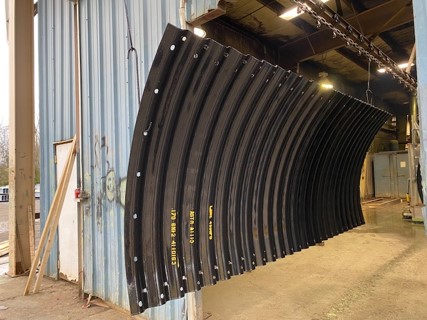
The structural steel pipe was manufactured using polymer coated steel sheets.
The decision for SPP was on target as the specifiers would have been hard-pressed for a different solution. The problem, however, is that the SPP was specified in accordance with Union Pacific standards: (1) 8 gage pipes must be polymer coated, and (2) pipes 96-inch and larger must be polymer coated.
In order to meet their own standards they specified the SPP to be manufactured with polymer pre-coated steel sheet per AASHTO M246 (a CSP specification), commercially unavailable in 8 gage and a material incapable of being converted to structural plate for a host of reasons.
Unbeknownst to the designers, the industry had developed a method to provide a polymer coated steel structural plate product, the fruits of their efforts being published as an ASTM standard in 2020 with the designation ASTM A1113, Standard Specification for Corrugated Steel Structural Plate, Polymer-Coated, for Field-Bolted Pipe, Pipe-Arches, and Arches.
Seamless Installation
With a coating facility located in Carlisle, PA, Lane was intimately involved in the polymer-plate product development and uniquely poised to manufacture and coat the plate used in the bridge replacement project.
The work remaining to be done went seamlessly as hoped: structural plate pipe was field-bolted in place, exposed pipe on each side of the tracks was backfilled, and flowable fill was used beneath the tracks to complete the embedment.
While the old timber trestle remains as a sort of time capsule – a buried bridge if you will – the new structure is in fact a very much visible and beautiful buried bridge.
What are buried steel bridges?
Buried steel bridges provide an economical choices for bridge replacement or bridge rehabilitation.
They essentially are a corrugated steel pipe or structural plate pipe systems that is “buried” with backfill to carry loads through soil-structure interaction. This means the bridge structure itself and the backfill soils surrounding the structure interact with each other to support the loads. In effect, the backfill material is part of the bridge.
Because of this interaction, the bridge structure is typically lighter, and there can be significant savings in structure costs.
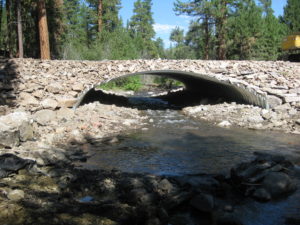
There are also many cases where buried bridges can carry heavier loads than traditional bridges because of the benefits of spreading vehicle loads through the fill. Buried bridges do not require abutments; and unless foundation soil conditions are poor, do not typically
require deep foundations.An additional benefit with buried bridges is that they can be tailored to site conditions and geometric requirements. The design includes inputs for site soils and backfill, meaning that locally available materials can often be used in construction and the structure can be tailored to fit the needs of the site and the owner’s requirements.
 Buried Bridge
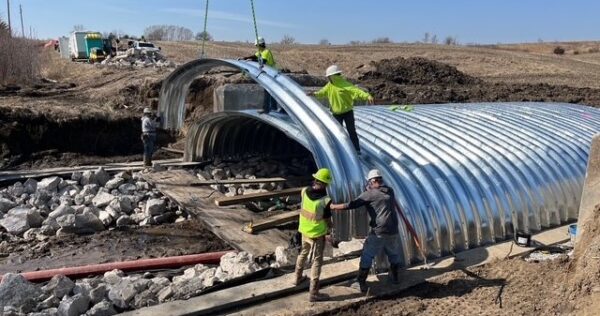
Buried Steel Bridge Preserves Streambed While Supporting Heavy Loads
A new galvanized buried steel bridge in Riverside, Iowa, supplied by SSSBA member Lane Enterprises, replaced a weight-restricted structure and restored direct access for local farmers. Its open-bottom steel design preserves the natural streambed, enhances durability, and provides a cost-effective solution for rural infrastructure.
 Buried Bridge
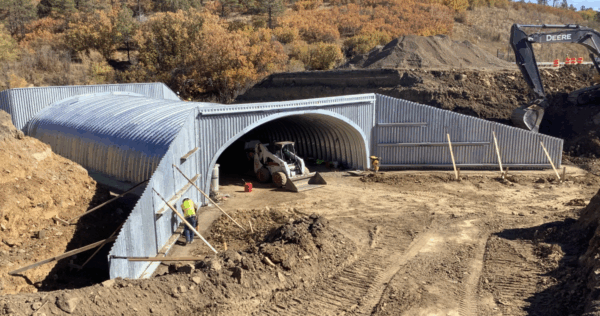
Buried Steel Bridge Protects Wildlife and Motorists in New Mexico DOT Project
The New Mexico DOT buried steel bridge project, featuring SSSBA member Contech’s custom structural plate design, was honored as the NCSPA Project of the Year for its innovative wildlife crossing solution on I-25 at Raton Pass.
 Case Study
Steel in Action: On-Demand Steel Bridge Video Series
Watch this four-part, on-demand video series featuring expert-led case studies on cost-effective, resilient short span bridge projects—now available with downloadable presentation materials.
 News
News
NCSPA Announces 2025 Project of the Year Winners
The National Corrugated Steel Pipe Association announced the 2025 project of the year winners, including members of the Short Span Steel Bridge Alliance.
 Buried Bridge
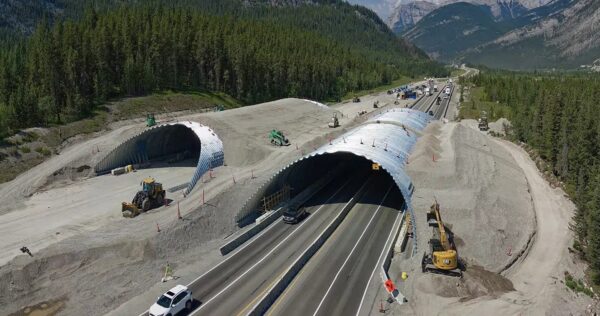
Corrugated Steel Animal Overpass Reduces Wildlife-Vehicle Collisions
The corrugated steel Stoney Nakoda Exshaw Wildlife Arch in Western Canada showcases the balance of engineering and environmental stewardship, setting a new standard for wildlife-friendly infrastructure.
 Buried Bridge
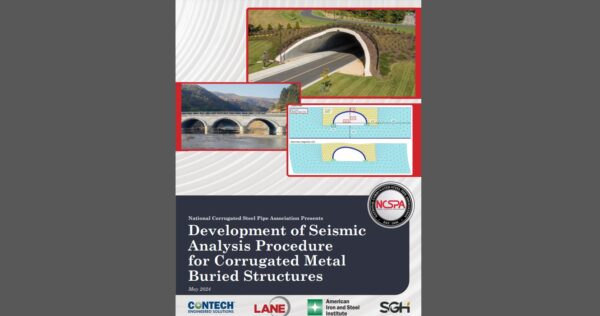
NCSPA Releases Report to Simplify the Seismic Design for Buried Structures
The National Corrugated Steel Pipe Association (NCSPA) released a groundbreaking report that simplifies the seismic design for buried structures including culverts, tunnels and buried steel bridges.