 Short Span Steel Bridges
Whitman County Saves 32 Percent with Steel Superstructure
In this video from the Steel Bridge Essentials webinar series, Mark Storey, P.E., Public Works Director / County Engineer, Whitman County (WA), provides information on the Seltice-Warner prefabricated steel rolled-beam bridge project.
Project Overview
The Seltice-Warner Bridge in Whitman County, Washington was a replacement project for a 1952 all-wood structure (30 feet long by 20 feet wide). The original wood structure was rebuilt in 1986 on short-wood piles with wood backwalls. The bridge experienced deterioration and was susceptible to scouring, so it was scheduled for replacement in 2020.

The original wood structure was susceptible to scouring, so it was scheduled for replacement in 2020.
Plans for the replacement bridge included a longer span to improve the hydraulic opening under the bridge. This opening made it easier to build the new foundations behind the existing wood pile foundations.
The channel, Willow Creek, has an average width of 20 feet. The road approach on both sides of the channel is normal to the channel alignment. Therefore, neither the existing bridge nor the replacement required any skew.
Building the Bridge with Local Crews
Whitman County has a dedicated bridge crew of four professionals and the equipment to replace short span bridges. The county has been using its own bridge crews for several decades.
Steel Competes and Wins
In the past, the county traditionally constructed concrete superstructure bridges. However, for the Seltice-Warner Bridge, Whitman County competitively bid both steel and concrete for the superstructure.
The successful bidder with the lowest cost was a modular rolled beam steel structure supplied by Big R Bridge, now known as Contech Engineered Solutions.
Foundation and Abutment
Most bridges in the county are supported on steel “H” piles driven into the underlying basalt bedrock. The depth of the basalt ranges from five feet to more than 30 feet. The county has found it is more cost-effective and easier to simply drive steel piles into bedrock and build tie-back anchors as mitigation if the final bearing depth does not satisfy scour requirements.
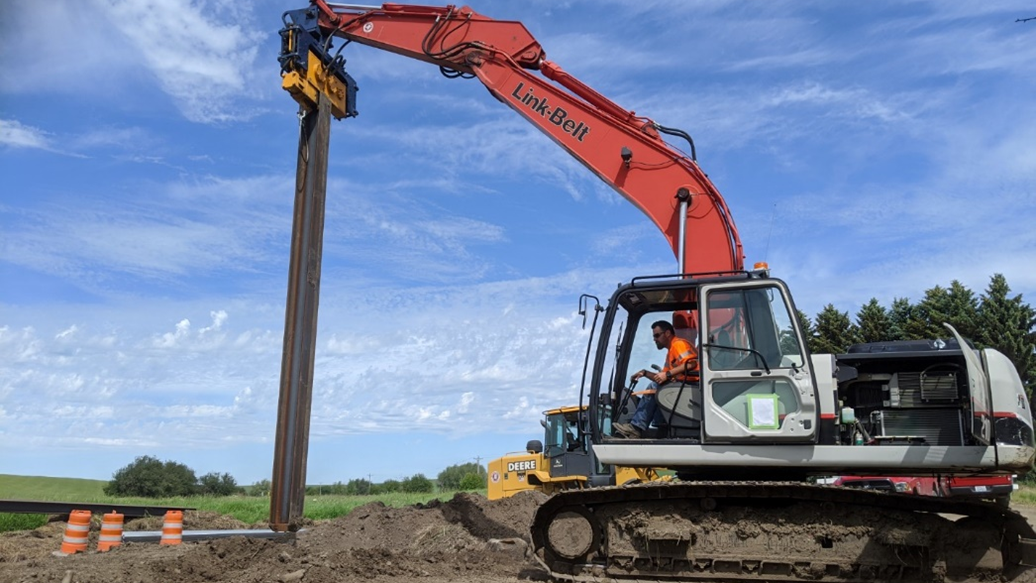
A county owned pile driver was used for the project (44 ton/pile) – H12x53 Pile Cap.
For the abutment pile cap, rather than forming and casting concrete and then waiting for it to cure, the county installs a top plate or pile cap using the same size “H” pile that was used for the piles themselves and welds it to the piles.
By making the bridge longer than the one it is replacing, the piles can be driven behind the existing piles and away from the channel. This process also simplifies the required permitting from the Washington Fish and Wildlife Department.
After the piles and pile caps are completed, the old foundations can then be isolated and removed with less disturbance to the channel. This was the process used for the Seltice-Warner Bridge.
Prefabricated Modular Steel Beam Bridge
The final dimensions for the superstructure of the Seltice-Warner Bridge were 35 feet long and 28 feet wide. The bottom of the new bridge was raised above the creek at a higher elevation than the original wood bridge, so the road was raised approximately 18 inches to accommodate the new superstructure.
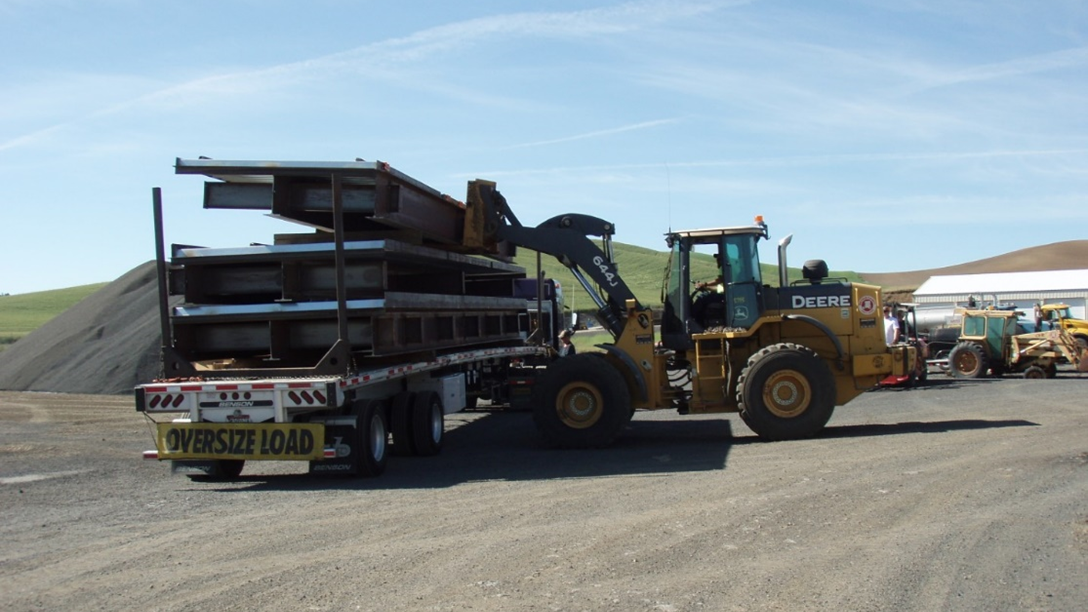
Three modules were shipped to the site on one truck. Each module had two weathering steel rolled beam girders fully assembled.
The modular rolled beam steel bridge consisted of three modules that were shipped to the site on one truck. Each module had two weathering steel rolled beam girders fully assembled.

The corrugated steel deck was attached to the modules before shipping for easy placement of the gravel riding surface.
The corrugated steel deck, side dams, simple cross-frame diaphragms and guard rail stubs were attached to the modules before shipping for easy placement of the gravel riding surface. The county-owned front-end loader and excavators picked up the modules and placed them on the abutments with the bearing assemblies. The modules were connected using simple connection details for easy erection.
The guard rail stubs, guard rails, backwall and gravel roadway surface were then installed.
Steel Reduces Construction Costs

Mark Storey, P.E., is the Public Works Director / County Engineer, for Whitman County, Washington.
In addition to direct costs, there are indirect costs associated with various superstructures. With a concrete superstructure option, Whitman County would have had to hire a crane service to lift the concrete girders into place, which in the local region costs between $4,000 and $8,000.
By choosing the steel beam girder option, the county significantly reduced the overall project costs and decreased the time for construction by using its own excavators and large front-end loaders already on site. This is a significant benefit provided by modular steel bridges, as they are relatively lightweight, easy to handle and match-fit well due to the quality of shop fabrication.
An additional benefit of using steel is that the bridge can be opened to traffic sooner since there is no additional time required for concrete curing.
Steel Superstructure Saves Almost 32 Percent Over Concrete Alternative
The Seltice-Warner Bridge project was completed during the summer in accordance with the Washington Fish and Wildlife permit. It was started on June 15, 2020 and was completed and opened to traffic on July 15, 2020.
The work included installation of a temporary detour bridge (a single-lane steel bridge that was purchased about seven years prior). The stream site isolation and erosion control measures, pile installation, pile cap installation, welding of seismic anchor pins, placement and completion of the superstructure, and associated road building activities was completed in roughly four weeks.

The cost for the concrete alternative was $82,000, and the cost for the modular steel beam superstructure was $56,000 – a 31.7 percent cost savings.
Whitman County sought competitive quotes for the manufacture and delivery of both steel and concrete superstructures. The cost for the concrete alternative was $82,000, and the cost for the modular steel beam superstructure was $56,000 – a 31.7 percent cost savings.
With the costs of labor, equipment, the pile foundation and permitting, the total cost of the Seltice-Warner Bridge was $159,000, or $162.25 / ft2.
- Timing: Excavation, Stream Restoration & Bridge Installation ~ 4 Weeks
- Costs:
- Steel Superstructure: $ 59,000 (Concrete Superstructure Alternative $82,000)
- Labor & Equipment: $ 70,000
- Pile Foundations: $ 20,000
- Permitting: $10,000
- Total: $159,000 ($162.25 / ft2)
Key Takeaways From This Project
- The cost of a steel bridge superstructure is competitive with other bridge material types.
- Steel provides additional benefits. Steel bridges are lighter in weight, resulting in economies in required construction equipment and substructure costs.
- Steel modular bridges allow for ease of erection and construction, as well as faster construction times, due to the quality of shop fabrication.
Steel is the most recycled material in the world. The U.S. annually recycles enough steel scrap to build more than 650 Golden Gate Bridges.[i] Plus, steel from a disassembled bridge can be used again for another project.
- Steel’s high strength-to-weight ratio, coupled with a low carbon footprint, results in an overall reduction of the embodied carbon of a typical structure compared to other materials.
- Modular bridges can be moved and repurposed to another bridge site, as demonstrated by the detour bridge for the Seltice-Warner Bridge.
[i] U.S. Geological Survey. https://pubs.usgs.gov/periodicals/mcs2021/mcs2021-iron-steel-scrap.pdf; and https://www.goldengate.org/bridge/history-research/statistics-data/design-construction-stats/
 Case Study
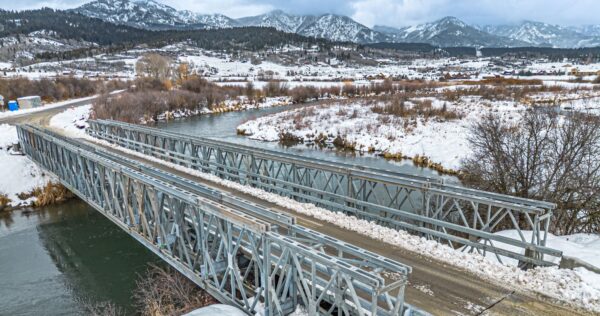
Modular Steel Bridge Keeps Rural Wyoming Connected
Acrow’s modular steel detour bridge in Alpine, Wyoming, ensures safe traffic flow while the Salt River bridge undergoes repairs.
 Case Study
Bridges of Franklin County: Why Missouri is Turning to Steel
Franklin County, Missouri, saved $283,000 by selecting steel over concrete for four short-span bridge projects, demonstrating that simplified designs combined with a competitive bidding process can deliver exceptional value, durability and long-term performance.
 Buried Bridge
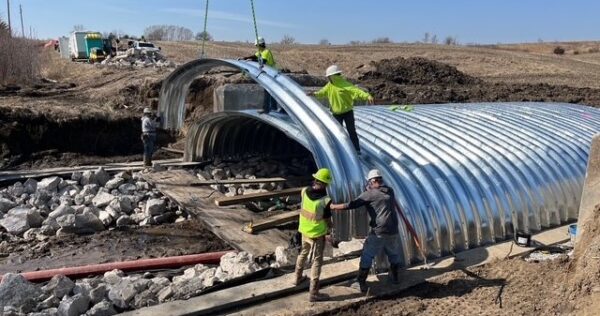
Buried Steel Bridge Preserves Streambed While Supporting Heavy Loads
A new galvanized buried steel bridge in Riverside, Iowa, supplied by SSSBA member Lane Enterprises, replaced a weight-restricted structure and restored direct access for local farmers. Its open-bottom steel design preserves the natural streambed, enhances durability, and provides a cost-effective solution for rural infrastructure.