 Short Span Steel Bridges
Factors to Consider When Galvanizing or Metalizing a Steel Bridge

Ronnie Medlock, P.E. Vice President -Technical Services
The following article was provided by Ronnie Medlock, P.E. Vice President -Technical Services, High Steel Structures, LLC.
The Kosciuszko Bridge replacement offers an excellent study in the choice between galvanizing and metalizing. These two structural steel coatings options are similar in that both involve the direct application of molten metal to the steel.
When choosing between the two, how the coatings are applied is a key consideration.
Hot-Dip Galvanizing
Galvanizing is accomplished by cleaning components in an acid bath and then immersing the components in a kettle of molten zinc. There, the zinc reacts with constituents in the steel to build a series of metallurgically bonded zinc-iron layers on the steel surface. This process is highly effective at ensuring that every exposed steel surface is cleaned and coated, with zinc readily flowing into nooks and crannies, regardless of their complexity.
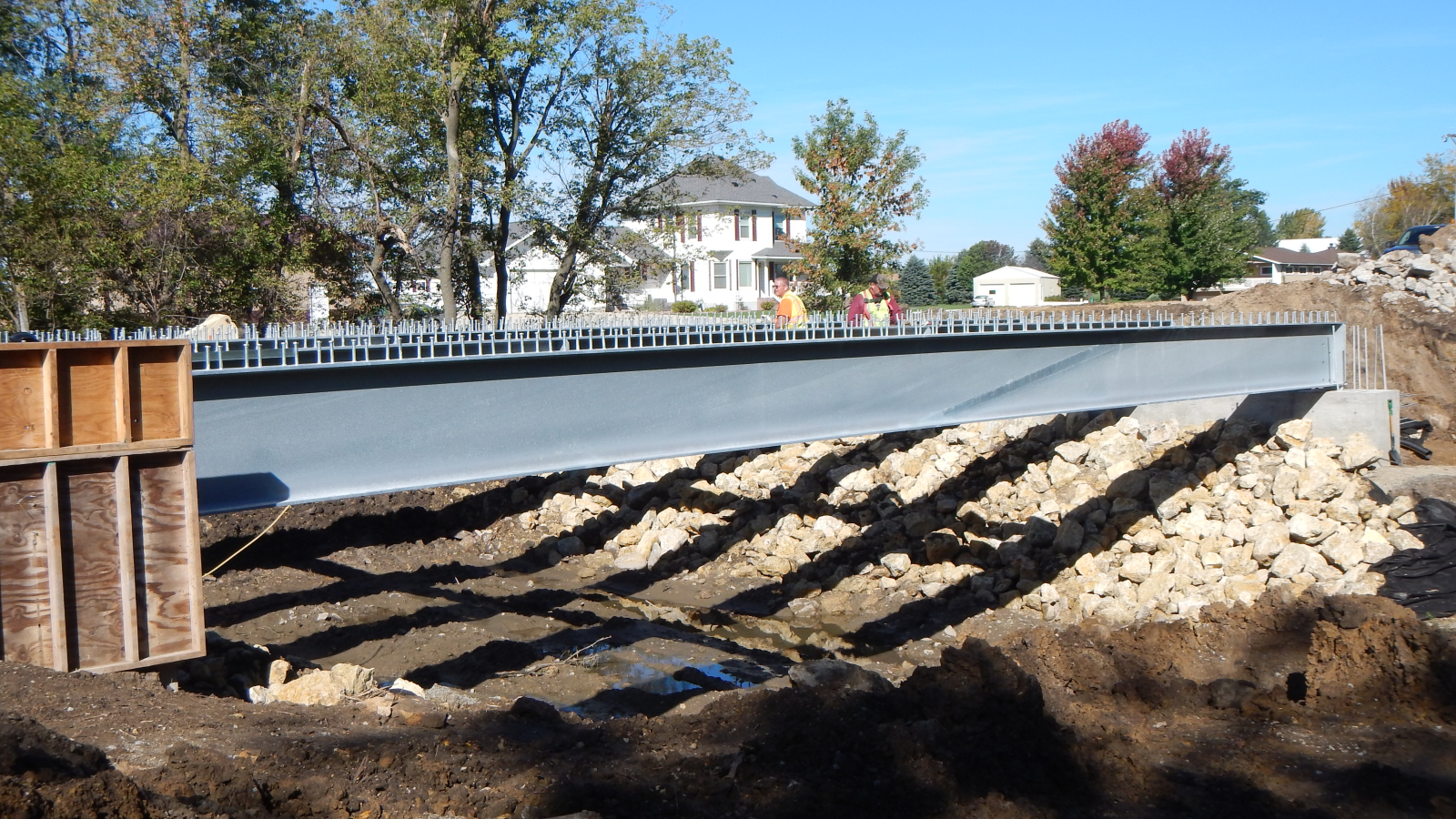
Progressively dipped bridge 63 ft bridge girder used on Jesup South Bridge in Buchanan County, Iowa (2013).
However, one thing is essential for a successful galvanizing project: the component must be able to fit into the galvanizer’s kettle. Kettle
sizes vary, but larger ones are about 55 feet long by 10 feet deep. This means that pieces up to 50 feet long can be single dipped or
larger pieces up to 85 feet can be accommodated with progressive dipping.
Metalizing
The fact that large bridge girders do not fit into galvanizing kettles has helped drive the popularity of metalizing. With metalizing, preparation is by blast cleaning and application is typically by arc spray. Therefore, there is no practical maximum I-girder size limit
for metalizing. However, while metalizing is effectively applied on large, flat surfaces like those of I-girders, it is not effectively applied
on nooks and crannies or inaccessible areas. Therefore, applications like tub girder interiors are not strong candidates for metalizing.
The New Kosciuszko bridges’ metalized coating was chosen to reduce maintenance costs over a 100-year service life. High Steel Structures was awarded the contracts to supply the steel superstructure for each phase’s main cable stay spans, ultimately fabricating, metalizing, and delivering a total of 6,240 tons of steel for the two independent contracts.
Galvanize or Metalize?
Hence, when choosing between metalizing and galvanizing for bridges, two rules of thumb apply:
- Galvanize components that have dimensions which fit within a galvanizing kettle, especially if they have complex, difficult to
reach surfaces. - Metalize components that are too large to fit into a galvanizing kettle, if all surfaces are readily accessible for blast cleaning and metalizing arc spray application.
Based on these rules of thumb, for I-girder bridges, if the girders are too large for galvanizing, consider metalizing them but galvanize
the cross-frames. Given their many narrow surfaces and nooks and crannies, cross-frames do not lend themselves well to metalizing but
are well-suited to galvanizing.
The example of the Kosciuszko Bridge is similar to the I-girder bridge considerations. The anchor assemblies are relatively short in length
and not too tall or wide, thus they readily fit into a kettle. Also, they are complex, with many difficult to access surfaces. In particular, cable anchor stay tubes are very difficult to metalize but very easy to galvanize, making the bridge’s anchor assemblies great candidates for galvanizing.
Conversely, cable stay bridge edge girders and floor beams are generally too large to fit into galvanizing kettles and but have accessible, wide open surfaces. Thus, on the Kosciuszko Bridge, these elements were metalized.
Fabrication Factors for Galvanizing and Metalizing
Other fabrication factors for designers to be aware of regarding galvanizing and metalizing include the following:
Project Schedule Impact
Coating application adds time to fabrication, and metalizing does so disproportionately. Hand blasting is needed to produce the sharp anchor pattern required by metalizing, and this takes time. In fact, very large girders can take up to an entire shift just to clean. This does not preclude metalizing; however, if a project is time critical, consult with High Steel or other applicators to ensure the chosen coating will facilitate the project schedule.
Specify Correct Surface Condition
Remember to use a class C surface condition for slip resistant design when galvanizing. If a class B or D is used for connections on galvanized members, special processing will be needed to keep the galvanizing off the faying surface. Not only does this processing require extra effort, but also if the member is galvanized, it is better to have galvanizing on the bolted surface, helping to protect the steel.
Cost Considerations
For I-girder bridges, galvanizing the bridge or metalizing the girders and galvanizing the cross-frames adds about 20% to 30% to the cost of the delivered fabricated steel compared to using uncoated weathering steel. Also by comparison three-coat paint adds about 10% to 20%. If both paint and metalizing/galvanizing are used, these premiums can be more or less combined. For complex bridges, these premiums are less.
For example, for a cable stay bridge, the premium for galvanizing the anchor assemblies and metalizing the edge girders and floor beams adds about 10% to 15% to the cost of the fabricated steel. Note that these are general numbers intended to provide a rough idea of initial premium in this article; actual costs can vary considerably depending on the nature of the bridge. Reemphasizing, these are not premiums on the cost of the bridge but rather on the cost of the fabricated and delivered steel.
Conclusion
The choice of protection system for bridges is important. If using galvanizing or metalizing, choose galvanizing provided components
will fit in a kettle, and consider metalizing for the larger components provided they are not too complex or have areas such as the inside
of tubes that are inaccessible to metalizing.
Finally, if you would like to discuss the best practices in greater detail, remember that you can consult with High Steel or a local steel bridge fabricator for project specific recommendations and the latest details about coating best practices.
 News
News
AISI Corrosion Advisory Group to Meet October 27 in Ohio
The AISI Corrosion Advisory Group (CAG) will meet October 27 at the Sherwin-Williams Research & Development Center in Ohio. Discussions will focus on corrosion research, coatings, steel durability and related industry needs.
 Events
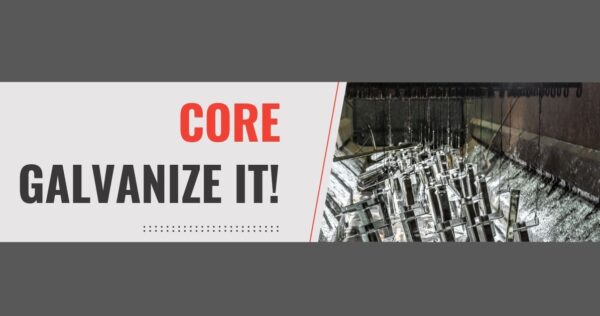
Free Webinar: Galvanize It! Core Webinar (Aug. 26)
SSSBA member American Galvanizers Association’s Core Galvanize It! webinar provides an introduction to hot-dip galvanizing, covering the galvanizing process, zinc coatings, and key benefits such as corrosion resistance, durability, longevity, sustainability and life-cycle cost. The seminar is AIA and RCEP accredited for 1.0 LU/PDH.
 Durability & Coatings
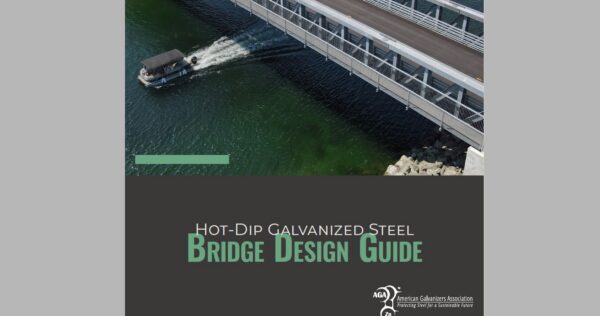
AGA Releases Guide for Hot-Dip Galvanized Steel Bridge Design
SSSBA member the American Galvanizers Association has released a new resource on hot-dip galvanized steel bridges, highlighting durable, low-maintenance solutions that support long service life.