 Short Span Steel Bridges
ARTBA Report Finds 36 Percent of U.S. Bridges Require Major Repair or Replacement
Photo Credit: U.S. Bridge
The American Road & Transportation Builders Association’s (ARTBA) analysis of the recently released 2024 U.S. Department of Transportation (DOT) National Bridge Inventory (NBI) database reveals that 221,800 bridges (36%) require repairs, with 76,175 are in need of full replacement.
Placed end-to-end, these structures span over 6,100 miles, or the equivalent of every mile of urban and rural Interstate in California, Florida, and Illinois.
$400 Billion Required to Repair All Bridges
According to ARTBA, states have received $15.9 billion in the first three years of the Infrastructure Investment and Jobs Act (IIJA) $27.5 billion formula bridge program and, to date, have committed 46 percent ($7.3 billion) of these resources to over 4,170 bridge projects.
The remaining 54 percent ($8.5 billion) of already released bridge funds AND the $10.6 billion that will be provided in the next two years will support needed bridge improvements well into the future.
Another new IIJA initiative, known as the Bridge Investment Program (BIP), administered on a discretionary basis by the U.S. DOT, provides an additional $12.5 billion for projects that will be awarded through 2026.
The BIP has awarded $7.8 billion for 87 planning, small, and large bridge project grants in over 40 states.
ARTBA estimates it would cost at least $400 billion to make all needed repairs, not taking into account future climate stressors.
Bridges in Poor Condition Down 0.5%
Bridges in poor condition represent 6.8% of the 2024 U.S. bridge inventory, ticking down from 7.3% in 2020.
“Over the last five years we have seen significant progress in states like Oklahoma, Pennsylvania, Mississippi, Louisiana, and West Virginia – reducing the number of bridges in poor condition,” said ARTBA chief economist Alison Premo Black, who conducted the analysis, in a release. “While improvements can take time, every bridge repair increases the safety and efficiency of our network for the traveling public.”
Bridge Owners Look to Steel for Answers
To address the high number of structurally deficient structures, bridge owners and designers are looking to steel to fix our nation’s infrastructures. Why steel?
- Due to the light weight of steel, cost savings can be significant by using smaller abutments, local crews, and lighter equipment.
- Learn how Whitman County, Washington saved 32 percent by using steel for a bridge replacement project.
- Steel can compete and save costs when compared with nearly identical concrete structures.
- Learn how Audrain County, Missouri saved 19 percent by using steel in a side-by-side comparison of a steel versus concrete bridge.
- Steel bridges also have long lives, decreasing the need for replacement.
- Learn about the innovative press-brake tub girder system – it has a life expediency of over 100 years, with the first 60 of those years being maintenance-free.
- Steel bridges can be designed with prefabricated elements which provide a simpler installation and time savings.
- Learn how a prefabricated steel truss bridge was quickly erected to reconnect a community decimated after the Woolsey fire that swept through the Santa Monica Mountains.
- Habitat protection and environmental enhancements are major benefits of using buried steel bridges.
- Learn how a buried steel bridge provided a natural pathway for fish to spawn in Idaho.
- Steel is the world’s most recycled material and is infinitely recyclable, so it can be repurposed from one bridge project to another.
- Learn how Muskingum County, Ohio saved $51,000 in superstructure costs by repurposing steel beam for the replacement of the Green Valley Road Bridge.
Want to Learn How You Can Save With Steel?
The SSSBA is offering complimentary customized educational guest speakers/webinars and workshops (on-site or virtual) specifically for county engineers, state DOTs, and design firms. The webinars/workshops are taught by industry experts with decades of experience in the cost-effective design and construction of short span bridges.
For more information or to customize a workshop for your organization, please contact:
- Dan Snyder (Director of the SSSBA) at dsnyder@steel.org or 301-367-6179.
- Michael Barker (University of Wyoming & SSSBA Director of Education) at barker@uwyo.edu
 News
News
Missouri Steel Bridge Bundle Project Wins Prize Bridge Award
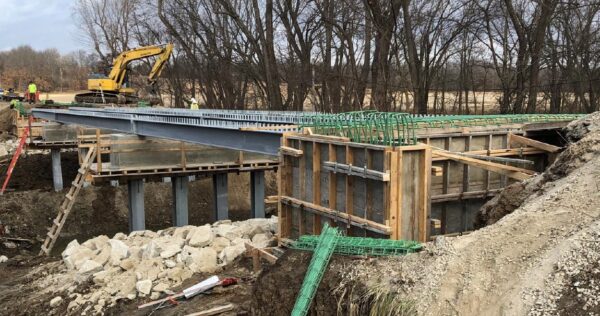
The National Steel Bridge Alliance (NSBA) named Missouri’s FARM Bridges Design/Build Bundle the 2026 Prize Bridge Award winner in the Short Span category. Fabricated by SSSBA member DeLong’s, the project delivered 31 rural bridges across 15 counties using galvanized steel and SDCL design for a 100-year service life.
 Design
NSBA Releases Updated Bolted Splice Spreadsheet 4.01
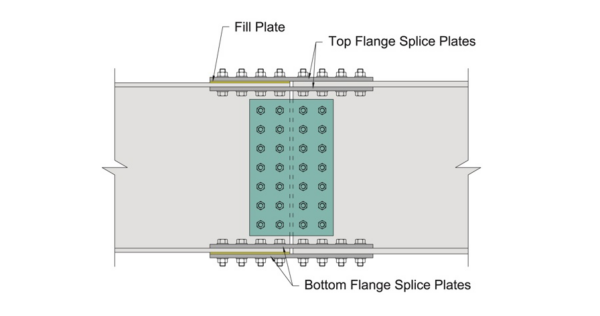
NSBA’s Bolted Splice Spreadsheet 4.01 streamlines connection design with expanded options and updated AASHTO LRFD provisions for faster, more economical solutions.
 News
News
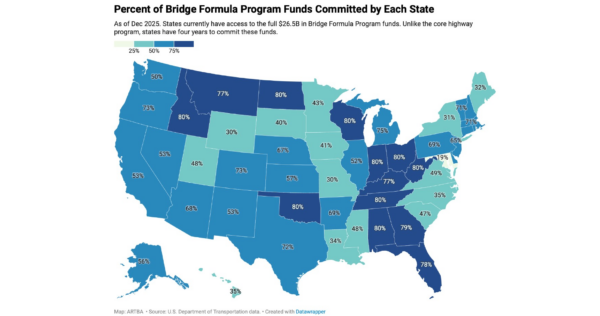
ARTBA Reports $15 Billion Committed Through Bridge Formula Program as Needs Remain
According to an ARTBA analysis, states have committed $15 billion through the bridge formula program, yet one in three bridges still needs work.