 Short Span Steel Bridges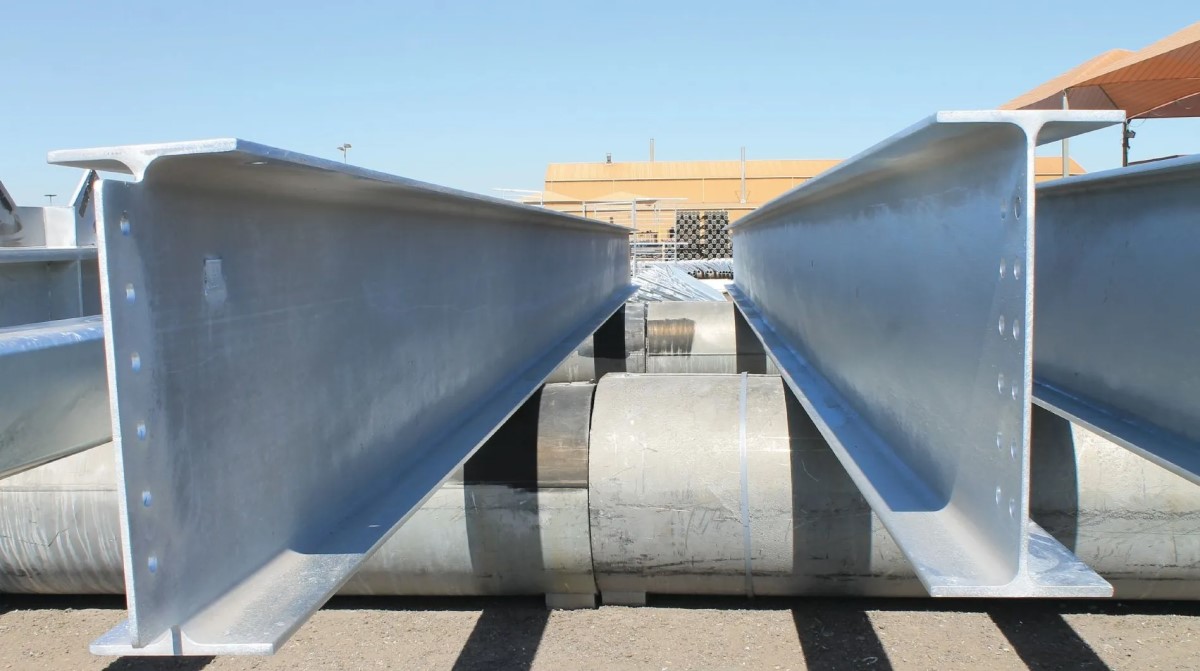
“Crafting a Coat” – Modern Steel Construction
Excerpt and image provided by Modern Steel Construction – “Crafting a Coat” – By John Krzywicki (American Galvanizers Association)
Ancient Societies were the first to discover that coating metals with zinc protects them from corrosion. Only in recent decades, though, could engineers predict just how long that protection would last, thanks to the introduction of a new assessment method. That method, the Zinc Coating Life Predictor (ZCLP), was recently refined and made available on the American Galvanizers Association’s website (zclp.galvanizeit.org).
Originally designed as a sophisticated computational model by Gregory Zhang nearly 30 years ago, the ZCLP allows engineers, architects, and other specifiers to estimate the anticipated service life of zinc coatings based on various atmospheric exposure conditions. Factors such as humidity, temperature, sulfur dioxide concentration, and chloride deposition rate play a crucial role in determining the longevity of a zinc-coated structure. By integrating these variables, the ZCLP provides a reliable estimate of when the first coating maintenance might be due.
The ZCLP is web-based and accessible from any device with an active internet connection. It requires no downloads or installations, and thanks to its new responsive design, it works on all devices. The tool requires the user to input six yearly average atmospheric parameters: annual precipitation, sulfur dioxide deposition rate, relative humidity, airborne salinity, air temperature, and sheltering condition (open air, rain-sheltered or indoor). Thus, using the tool begins with data collection.
The ZCLP computes a corrosion rate in the chosen environment and allows the user to calculate a recommended zinc coating thickness based on the desired time to first maintenance. It can also esti mate the time to first maintenance based on a given zinc coating thickness.
Concrete embedment, immersion, offshore, aquatic facility, chemical exposure, galvanic corrosion, treated wood, and soil embedment applications are not represented by the ZCLP.
Additionally, yearly average wind direction can significantly affect corrosion rates for structures within one mile of coastlines. Evaluation of coastal applications can be limited to structures at least one mile inland or sheltered from coastal winds. The practicality of the ZCLP becomes evident when applied to real-world scenarios. Consider an engineer tasked with designing a bridge in a coastal region. The salt-laden air, high humidity, and variable temperatures create a challenging environment for steel structures. By employing the ZCLP, the engineer can make informed decisions regarding the performance of the zinc coating, anticipate maintenance schedules, and ensure structures remain resilient through their intended service life.
Additional Resources
What are Press Brake Tub Girders?
Press-brake-formed tub girder (PBTG) is a new technology for short span bridge applications. It consists of modular galvanized shallow trapezoidal boxes fabricated from cold-bent structural steel plate (watch fabrication video). A concrete deck is recommended to be precast on the girder and the modular unit can be shipped by truck to the bridge site.

The system utilizes standard plate widths (based on availability) and is optimized to achieve maximum structural capacity, with most of the steel in the bottom flange and increased torsional stiffness. It is a closed system, since the girder is closed at the bottom. It is versatile for multiple-deck options.
The system utilizes Accelerated Bridge Construction practices, since it:
- Can be installed in one or two days
- Is modular, allowing the use of a precast deck
- Is cost-effective―as much as 1/3 less than a standard concrete girder structure
- Is simple to fabricate, requiring very little welding.

The Short Span Steel Bridge Alliance has developed standardized plans using standard plate sizes (60”, 72” 84”, 96”, 108”, 120”). The designs were developed to achieve maximum structural capacity and are available to use in the free-to-use, web-based design tool eSPAN140.
The press-brake-formed tub girder system is open source.
 Case Study
Steel in Action: On-Demand Steel Bridge Video Series
Watch this four-part, on-demand video series featuring expert-led case studies on cost-effective, resilient short span bridge projects—now available with downloadable presentation materials.
 Press Brake & Folded Plate
New Specs, New Opportunities for Press-Brake Tub Girders
Valmont Structures developed a summary outlining how the new AASHTO 10th Edition Bridge Design Specifications impact the use of press-brake tub girders (U-BEAMS) in bridge construction.
 Press Brake & Folded Plate
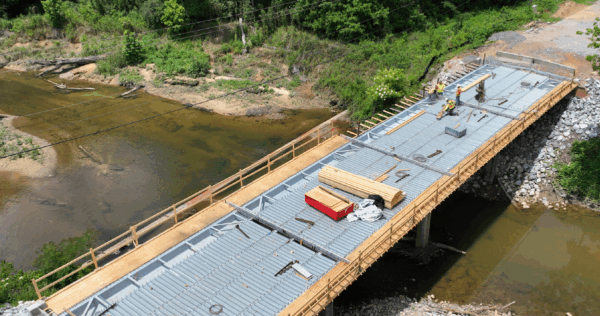
Press-Brake Tub Girder Delivers Modern Upgrade for Historic Alabama County Bridge
After over 80 years of wear from daily traffic, the Parkwood Road Bridge was upgraded with Valmont’s U-BEAM™ system to enhance safety and streamline construction.
 Press Brake & Folded Plate
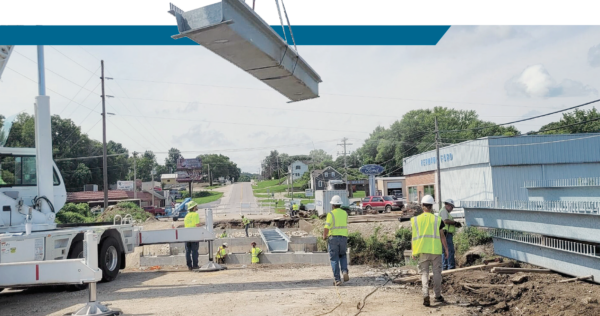
Missouri DOT Fast-Tracks Bridge Replacement with Steel Solution
The Missouri Department of Transportation (MoDOT) replaced an aging bridge to enhance safety and accessibility, using a press-brake tub girder bridge from SSSBA member Valmont Structures.
 Press Brake & Folded Plate
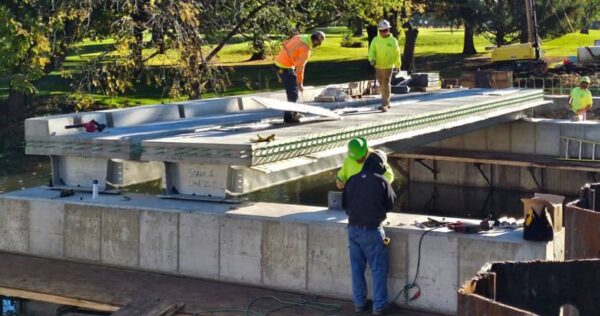
Whiteside County (IL) Selects Steel Bridge Solution for Short Lead Time
Russ Renner, Whiteside County Engineer, decided on a steel solution for an upcoming 105′ long bridge replacement project.
 Case Study
“Press Forward” – Modern Steel Construction
The durability and rapid installation of press-brake-formed tub girders made them the optimal choice for replacing a concrete short-span bridge in Illinois