 Short Span Steel Bridges

AASHTO/NSBA Steel Bridge Collaboration Releases Galvanizing Guide Specification
The following information was provided by the National Steel Bridge Alliance.
Developed by the AASHTO–NSBA Steel Bridge Collaboration, S8.3 Hot-Dip Galvanizing Specification presents information and practices for owners, designers, and fabricators for specifying hot-dip galvanizing of steel bridges and other highway structures, which provides a durable protection from corrosion.
The specification includes best practices for design and fabrication, as well as information on:
- Material properties of hot-dip galvanizing
- Types of materials suitable for hot-dip galvanizing
- Welding considerations and procedures
- Venting and draining
- Distortion control
The specification also presents information related to other zinc coating processes, including mechanical galvanizing, electroplating, and metalizing.
Does steel provide an economical solution for bridge construction?
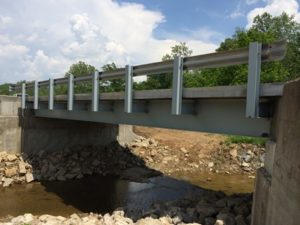
- Due to the light weight of steel, cost savings can be significant
- Studies show that weathering, A1010 (A709-50CR), and galvanized steel reduces both initial and life cycle costs.
- Steel can compete and even save costs when compared with nearly identical concrete structures. re.
- Steel bridges also have long lives, decreasing the need for replacement.
- Steel’s high strength permits longer spans, minimizing disruption to underlying habitats.
- Steel is highly resistant to extreme natural disasters such as earthquakes.
- Steel is the world’s most recycled material and is infinitely recyclable.
- Short span steel bridges can be designed with prefabricated elements which provide a simpler installation and cost savings.
 Durability & Coatings
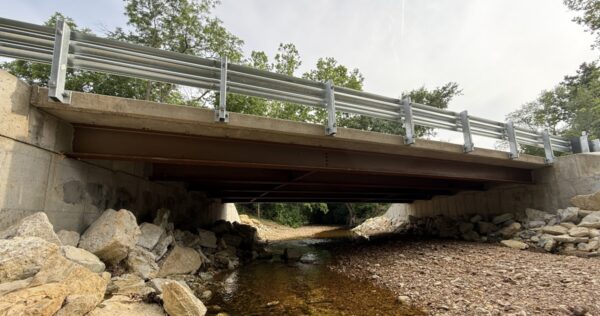
Steel Bridge Durability: Weathering Steel and Corrosion Protection Resources
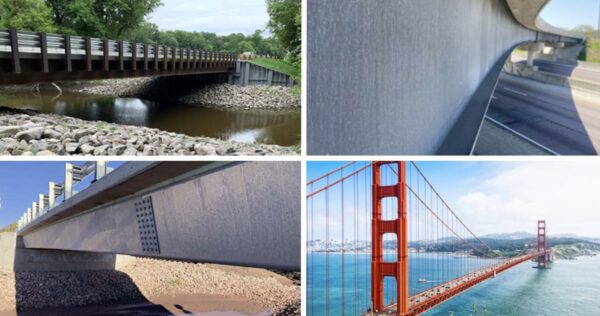
The SSSBA, with assistance from the National Steel Bridge Alliance (NSBA), has compiled technical resources on weathering steel performance and corrosion protection systems for steel bridges. These resources provide research findings, design guidance, and best practices to help bridge owners and engineers make informed decisions that support long-term bridge durability.
 News
AISI Corrosion Advisory Group to Meet October 27 in Ohio
The AISI Corrosion Advisory Group (CAG) will meet October 27 at the Sherwin-Williams Research & Development Center in Ohio. Discussions will focus on corrosion research, coatings, steel durability and related industry needs.
 Events
Free Webinar: Galvanize It! Core Webinar (Aug. 26)
SSSBA member American Galvanizers Association’s Core Galvanize It! webinar provides an introduction to hot-dip galvanizing, covering the galvanizing process, zinc coatings, and key benefits such as corrosion resistance, durability, longevity, sustainability and life-cycle cost. The seminar is AIA and RCEP accredited for 1.0 LU/PDH.