 Short Span Steel Bridges
Testing of 3-D Metal Bridges: What Did We Learn?
The world’s first 3-D printed metal bridge was constructed in Amsterdam in July 2021. The pedestrian bridge spans over a canal in Amsterdam’s City Center. The whole bridge was fabricated by placing layer after layer of austenitic stainless steel welding wire (308LSi specifically). Since the bridge is the first of its kind, the fabricators strategically placed gauges that will monitor the structure’s performance throughout its lifetime. The data taken from the gauges will provide useful information that will advance the technology for future projects.
Obtaining Engineering Data from the Bridge
To collect the data, Leroy Gardner, a professor at Imperial College London, worked with The Alan Turing Institute and the Dutch company MX3D, whose wire-arc additive manufacturing (WAAM) process built the Amsterdam pedestrian bridge. Gardner and his team tested the welding wire material and the performance of the printed components. In addition, they performed full load testing on the entire structure.
The team used noncontact technology with a special camera that took images of the material undergoing tests. The details they discovered aided in the development of engineering information that will be used for additional structural components fabricated with WAAM. The team also studied the material’s behavior under tensile tests.
Gardner said, “We wondered why we got this lower stiffness in the 90- and 0-degree directions, yet higher in the 45-degree directions. We spoke to our friends in material science, and they weren’t surprised. It relates to the temperature and thermal gradients created during the process.”
The structure’s component level presented challenges due to its bumpy, irregular surfaces and its negative effects on common measurement devices. To obtain proper measurements, the team relied on laser technology and silicon molding. “This was really useful,” Gardner said, “because we could now measure how much geometric variability you get, where the weak points were, and other statistics about the geometric properties of these components.”
Results
Given all the testing that took place, researchers discovered that the components performed similarly to conventionally produced peer material. Gardner and his team compared the results of their testing to ANSI/AISC 370-21, Specification for Structural Stainless-Steel Buildings (https://www.aisc.org/publications/steel-standards/stainless-steel-standards/aisc-370/) and found that the material’s behavior was “predictable and generally in line with the standard.” This was a critical step needed to ensure the material’s acceptance in the marketplace.
Lastly, the team tested the entire bridge, applying horizontal loading with jacks, pushing the handrails in and out, and applying vertical loading with large water tanks and concrete blocks. The bridge performed well and, most critically, behaved similarly to the finite element simulations the team built based on findings from tests at the material and component levels.
For more information on this project, please visit this link.
Additive Manufacturing and the Steel Industry
Additive manufacturing is knocking at the door of many industries throughout the world. The steel industry is no different. Where can additive manufacturing be used effectively as it relates to steel infrastructure? Industry experts like Professor Ryan Sherman, Ph.D., P.E. at the Georgia Institute of Technology are actively researching answers to this question. “Additive manufacturing (sometimes called 3D printing) could be a game-changer,” said American Institute of Steel Construction (AISC) Director of Research Devin Huber, PE, PhD. “Dr. (Ryan) Sherman is exploring whether combining commercial robotic welding hardware with readily available wire feedstock could achieve a high-throughput and favorable economics compared to other metallic additive manufacturing techniques, which would make that a practical solution for the structural steel industry.”
Dr. Sherman is actively researching material factors (including non-destructive and destructive evaluation), mechanical and small-scale component testing of various connection types, and computational analyses and large-scale testing to demonstrate structural steel applications. He was recently recognized with the 2023 Robert J. Dexter Memorial Award Lecture by the Steel Bridge Task Force of the American Iron and Steel Institute (AISI), the National Steel Bridge Alliance (NSBA) and the American Association of State and Highway Transportation Officials (AASHTO) Steel and Metals Technical Committee. His lecture topic was “Evaluation of Steel Additive Manufacturing Experimental Results.”
To learn more about Dr. Sherman and his research, please visit this link.
-

Free Webinar – Galvanize It! Duplex Systems: Coating Galvanized Steel (March 26)
The American Galvanizers Association invites you to attend a free, one-hour webinar on hot-dip galvanized steel and the synergistic benefits of combining galvanizing with paint or powder coatings.
-
SSSBA to Present at 2026 Purdue Road School in West Lafayette, IN (March 17)
Join the SSSBA at the 2026 Purdue Road School on March 17 (11:00–11:50 AM) to explore free tools for designing short span steel bridges. Hear a contractor’s perspective on simplifying construction, improving efficiency, and reducing costs.
-

Free Steel Bridge Plate Girder Design Course: 6-Part Live Webinar Series (Starts Feb. 24)
Take your bridge design skills to the next level in this free six-part webinar series led by Dr. Michael Barker, University of Wyoming. Learn step-by-step how to design a composite plate girder bridge and earn a certificate of completion in this course from the SSSBA.
-
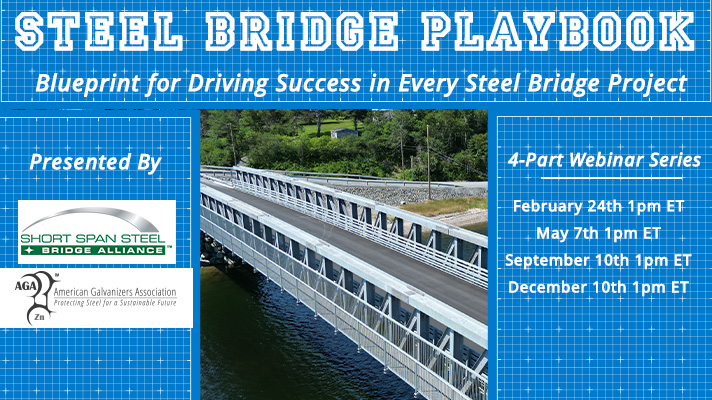
Free 4-Part Quarterly Webinar Series: Steel Bridge Playbook (Next Webinar May 7)
This free, four-part quarterly webinar series delivers expert insights on steel bridge design, preservation, and innovation. Explore essential design resources, corrosion protection through galvanizing, accelerated construction methods, and real-world case studies to gain practical guidance for every steel bridge project. Sponsored by SSSBA and AGA.
-
 News
News
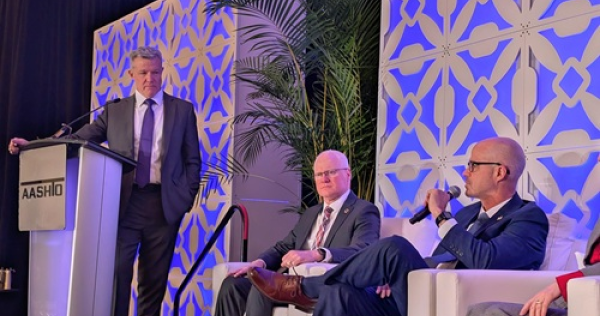
State DOT CEOs Discuss Key Reauthorization Funding Issues, Investment in Local Programs
AASHTO recently held its 2026 Washington Briefing in D.C., featuring a panel of state DOT leaders discussing critical surface transportation funding and reauthorization issues.
 News
News
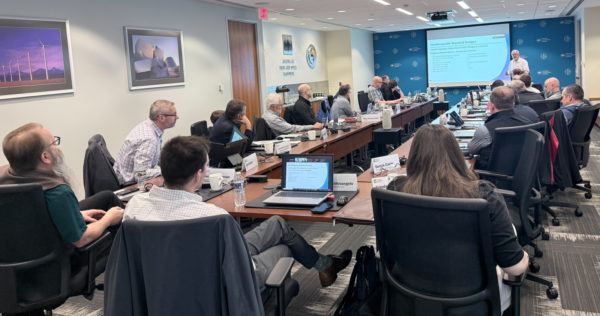
SSSBA Gathers Industry Leaders to Advance Steel Bridge Solutions in Washington, DC
The SSSBA March Semi-Annual meeting in Washington, DC unites industry experts to exchange ideas and advance steel solutions for short span bridges.
 News
News
Dr. Robert Connor Featured on Road Less Traveled Podcast
In a recent episode of the Road Less Traveled podcast, Dr. Robert Connor of Purdue reflects on his path to becoming a national leader in steel bridge fatigue and fracture, and shares his vision for advancing bridge engineering and inspection across the United States.